Monday, 7 December 2009
Birthday
Birthday again - and this year's a big one for me and Tom. As ever at this time of year, I'm up to the oxters in work, but I expect Tom to touch down on the NigeCorp helipad this evening, bearing a case of the Lafitte '49 (a legendary year). Then it's all back to Edmundo Ros's - he's 99 today. Happy birthday, Edmundo!


Sunday, 6 December 2009
Nevil Shute
I'm glad to hear that the novels of Nevil Shute have suddenly come back into fashion and are being reprinted by Vintage - see this excellent piece. My gladness is largely on behalf of my late father, who adored these books, even investing in a book club uniform edition, red-and-gilt, bound (as Private Eye would put it) 'in hand-tooled Gnomitex'. He would read them repeatedly, and some of them would, oddly, reduce him to tears (he wasn't a lachrymose man, unlike the one his younger son seems to be turning into). A pity he isn't alive to see his man restored to favour (and to replace his uniform edition with something a little easier on the eye). Mind you, he'd be 100 years old...
The Cost of Living
I've been half-reading a small book on Edward Thomas, which I picked up in a second-hand bookshop that was so perfect of its kind I couldn't bear to leave without buying something. On closer inspection, I discovered that this nicely produced little book was a 'Faber Student Guide', published in the mid-80s and clearly designed to fit poor Thomas's works to a Procrustean bed of Marxian analysis. This approach does yield the odd insight in passing, and the book's concentration on Thomas's prose as well as his poetry is refreshing. There's also enough extensive quotation from both to remind the reader of the real thing. But, putting all that aside, it was a biographical detail that caught my eye. Thomas's father was a clerk - 'staff clerk for light railways' at the Board of Trade - and on his Civil Service salary alone, he was able to support a wife and large family (six sons), plus domestic help, in a large detached house near the common in Clapham. So, at that time, a clerk in the Civil Service could afford what today only millionaires or the recipients of City bonuses can run to. What level of inflation does that suggest? It's barely computable. Similarly, in The Death of the Heart, set in the 1930s, we are informed that the total income of the Quayles amounts to £3,000, which is ample for a large house on Regent's Park with live-in domestics, all the comforts of upper-middle-class life, and long holidays abroad (when travel was relatively dearer). To achieve that standard of living today would surely require an income nearer £3 million than £3,000. My question is - What happened? Why would it now cost a fortune to live in the kind of style our middle-class ancestors took for granted? No Marxists need respond.
Saturday, 5 December 2009
Richard Todd
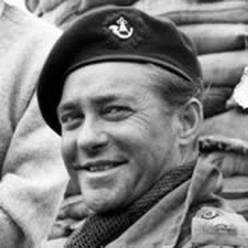 It was sad to hear yesterday that the actor, war hero and all-round good egg Richard Todd had died, albeit at a ripe old age. To say that Todd had a good war would be an understatement - read this and be humbled... This was a man - and, to judge by that piece, he was rather a good writer too.
Christina Rossetti
 The annual winter workstorm has kept me from blogging much lately, but I note that today is the birthdate of Christina Rossetti (born 1830). The poor woman led one of those sad Victorian lives that were the lot of so many of her sex, self-thwarted by religious scruples whose force we can scarcely comprehend today. She left behind much half-good poetry, little of which entirely works (she certainly wasn't our homegrown Emily Dickinson) - but In the Bleak Midwinter will surely survive. In its beautiful setting by Holst, it's one of the most moving of Christmas carols - and read as a poem it has something of the force and simplicity of George Herbert. Played by a Salvation Army band, it is certainly more than I can easily bear - but more and more things reduce me to tears these days. I think it's part of growing older. Lacrimae rerum...
Wednesday, 2 December 2009
Winter Night, Summer Meadow
Lying awake in the small hours this morning (having been abruptly woken by a violent calf cramp, the afterpain of which is still with me), I realised again how poorly we semi-insomniacs are served by the radio since the demise of the much missed Birdsong radio. The World Service, at an appropriately low volume, is fine, though it's all too likely to grab the attention and haul you back from incipient slumber - or, worse, wake you from a doze with a blast of vibrant ethnic music. Radio 4 has an appalling habit of switching from the World Service to loud, jaunty and utterly infuriating song-and-dance programmes that appear to be aimed at deaf imbeciles, but are, I believe, intended for teachers to record and inflict on classrooms of helpless children - one can but pity them. Similarly, Radio 7, once the studio laughter shows have died down, is likely to jolt you with a blast of jollity aimed at the little ones, god bless 'em. Radio 3 would be fine, but you just can't rely on music to stay at the same volume for long, so there's no sleeping through it. What to do then? I know what I'd have, to see me through the long winter nights in a calm, going on blissful state - an endless loop, a la Birdsong, of the sound of a summer meadow. The buzzing of bees from flower to flower, the intermittent chirring of grasshoppers, birds singing merrily in the middle distance, every now and then the faint susurration of a passing butterfly... I'm nodding off already. Here's a project for some right-minded philanthropist - maybe that Anglophile Getty, whatever his name is - Radio Summer Meadow. What could be more perfectly relaxing in the long small hours of a winter night?
Tuesday, 1 December 2009
That's What I Call a Walk...
The other day I came across a mention of a chap called Foster Powell, who, back in 1773, was now about halfway through an epic walk, from London to York and back (396 miles) in less than six days, that won him a hefty bet and made him a celebrity. I've long been vaguely fascinated by these feats of 'pedestrianism', but hadn't realised quite how extreme they were - or, still more surprisingly, that they are still being surpassed in the 21st century. Foster Powell's great walk was soon bettered, and, in the 19th century, the six-day walk became a fiercely competitive, big money, big crowd (a staggering 70,000 for one event!) indoor sport, largely because of the prodigious feats (500 miles in 6 days? No problem) of an American pedestrian called Edward Payson Weston. By the time the 500-mile mark was reached, the six-day walk was open to all comers - runners or walkers. The distances covered in six days became ever more mind-boggling, Weston reaching 550 miles and the Englishman Charles Rowell managing 530. Then in 1882 another Englishman, George Hazel, hit the altogether unbelievable 600-mile mark - but even that record didn't stand long, with yet another Englishman, competing in America, clocking up 623 miles in 1888 - by which time interest in the six-day event was waning. So that was that? No, far from it - there was a revival of interest in this form of 'ultrarunning' in the 1980s, and new six-day records were set in 1984 - 635 miles - and, finally and surely unbeatably, 644 miles, run indoors by a Greek runner, Yiannis Kouros (nicknamed 'Pheidippides' successor') as recently as 2005. Why do we never hear of these astonishing feats - equivalent to running four consecutive marathons a day for six consecutive days? Oh of course - there's no money in it, and it's too boring to attract spectators or TV cameras. This makes these lonely endeavours at the extremes of human endurance all the more noble - or mad, or both... There's a potted history of the six-day race here. Read and boggle.
Subscribe to:
Posts (Atom)
