Friday, 19 February 2010
More Sad News
Less than a fortnight after the death of Ian Carmichael comes news of the passing of another fine actor and thoroughly decent man of the same generation, Lionel Jeffries. His most lasting legacy will probably be the classic 1970 film of The Railway Children, which he directed and scripted, but he put in some wonderful performances too, both comic and dramatic. As Prison Officer 'Sour' Crout, he was an essential element in that great comedy caper Two Way Stretch; he did a similarly brilliant job as Inspector 'Nosey' Parker in The Wrong Arm of the Law; he was suitably appalling as the Marquis of Queensberry in The Trials of Oscar Wilde; and, much later in his career, he gave a memorable performance opposite Peggy Ashcroft in Dennis Potter's bleak Cream In My Coffee. He had a 'good war', too, serving in Burma. Another good man gone.


Thursday, 18 February 2010
The New Seriousness or the New Ignorance?
This rather overlong piece on what might be called 'the new seriousness' is vaguely heartening, though we shouldn't take the BBC's expansion of factual programming as in itself a good thing: some pretty dire stuff appears under this rubric in the terrestrial schedules (Andrew Marr's The Making Of Modern Britain anyone?). But BBC4 is certainly a Good Thing, in much the same way as Radio 4 - see the last section of Burrell's piece for the story of the soaraway success of Radio 4's excellent History of the World in 100 Objects. That truly is heartening. But where does this current wave of 'thirst for knowledge' come from? I suspect one factor in it is simply this - that schools, by and large, no longer teach stuff. The new seriousness might be a by-product of the new ignorance. Especially in the humanities, school subjects seem to be approached from every possible angle but that of building a solid backbone of fact. In particular, narrative history - perhaps the most popular form of factual TV - is conspicuously absent from the form of history taught in the classroom. Is television now effectively doing the job that always used to be done by schools - teaching people stuff? If so, it makes you wonder what(apart from its custodial and socialising functions) school is for...
Wednesday, 17 February 2010
Sherlock Holmes and the Strangely Silent Eighties
Those of us who find ourselves straying from terrestrial television in a bid to find something worth watching (if it's only Two and a Half Men) will be aware that the commercial breaks on many channels are not only amazingly long but also extremely loud. Now ITV3 has got into trouble for 'excessively strident' ad breaks during an episode of Sherlock Holmes. It's all about 'subjective loudness', and ITV3's defence is interesting: this Sherlock Holmes (the definitive TV version) was made in the Eighties and is therefore full of silent pauses, making the ads seem louder than they are. A bit of a lame argument perhaps, but based on truth. It's a reminder of how different TV drama was just a couple of decades ago, when it was not afraid of silence, or of inactivity, or of words. To watch such Eighties epics as Brideshead Revisited or The Jewel in the Crown now is to be amazed not only at the 'silent pauses' but at the leisurely pace, at the restrained use of music, and at how packed with serious dense dialogue - and static scenes - they are. Television dramas now keep dialogue minimal and functional, while filling the screen with (often pointless) activity, and laying on washes of music at every opportunity - and yet, despite the appearance of activity, they rarely get anywhere much. Compare an episode of a standard US crime drama with its UK equivalent - there is more meat in one crisply-scripted 40-minute episode than in an entire British miniseries. The mainstream TV dramas that reach the small screen these days are busy all right, and loud - but they are busy doing nothing.
Tuesday, 16 February 2010
Consolations of Rain
Another day of Haggard weather - but, determined not to be at my desk all day, I set out, raincoated, gloved and umbrella'd, through the cold rain to Holland Park. All this rainfall is making the trees very beautiful, even in deadening winter light, their soaked trunks almost purple against the bright green of moss, mingling with the duller greens and greys of lichen on the branches (lichens are thriving in London, a reassuring sign of clean air). I don't remember a winter where so many of the tree trunks have been so startlingly green... The great thing - one of the great things - about Holland Park is that there are a few places where you can sit in full shelter from the rain and look out at it. This sensation of being in the open air and yet sheltered - and with a view - has a special cheering magic, and, having eaten my sandwich al (demi)fresco, I went on my way that bit lighter of heart. What's more, I spent a while standing under my umbrella and watching the comings and goings at a well frequented bird feeder. The traffic was incessant - mostly tits and finches, but at one point a pied woodpecker swooped down for a quick taster. I was glad to see several coal tits - my favourite, and so far absent from my garden this winter. Work may be grim, but to have sights like these so close at hand is a magnificent consolation.
Sunday, 14 February 2010
Two Finds
Unlike many charity shops these days, my local Oxfam has a few shelves of older books as well as the usual massed ranks of recent paperbacks. Browsing there yesterday, a book on Trollope caught my eye. I'm not a huge Trollope fan, but I took it down to have a look, opened it - and there on the flyleaf was the unmistakable signature of my old friend, mentor and English teacher who died a few years ago (he was first memorialised here)! As was his habit, he'd also put the place and date of purchase - Manchester, October 1944. It was a heart-jolting moment - I think the first time I've come across a friend's name in such circumstances - but a happy one. Clearly I was meant to buy the book, which I duly did. It was Trollope: A Commentary by Michael Sadleir - which reminded me that my old friend had once given me another by Sadleir, Blessington-D'Orsay: A Masquerade, a very readable account of the strange relationship of the reprobate dandy Count d'Orsay (a friend of Dickens) with the Blessington family. Sadleir was a 'man of letters' - a breed that has long since died out. Best known for his (at the time) scandalous novel Fanny By Gaslight, he was a prolific author and a serious literary scholar, among whose bookish achievements was proving the authenticity of the Northanger Horrids. Anyway, be that as it may, the Trollope book was not the only one that caught my eye ysterday. Sitting on the bottom shelf was one with a title I could not possibly resist: The Making Of A Moron. This, surely, was the book for me. I snapped it up, and on examination it proved to be a treatise on the nature of work in modern (1953) society by one Niall Brennan, a man who had clearly tried his hand at many occupations and seen a thing or two. His jumping-off point is the fact that various recent experiments had found that 'morons' ( a term then still acceptable) had been successfully employed doing manual work in factories. From this he goes on to argue that modern work in virtually all its forms makes morons of us all. The first two chapters are summarised thus:
I. The Use of Morons.
Certified morons can be fitted into a working community without seeming different from their normal companions; this could be good from them, but if it is only because they are merged into something itself moronic, then it is no good for anyone. Uncertified morons are at large and recognisable only when they cause trouble. It would seem then that the environment has moronic elements. If it has, then instead of improving the certified morons, it will only be pulling everyone else down to their level.
II. Muscle and Mind.
The place where one expects to find morons, both made and in the making, is unskilled physical labour. But this is not so. Not only is unskilled physical labour an intellectual stimulant, but the ultimate object of any business as a whole influences the attitude of men to their work.
And so it goes on - but, as I say, this was a man who had seen thing or two, and his account of the workers in a paper mill is quite hair-raising:
'The workers themselves... were a rabble... loud-mouthed, dogmatic and evil-minded men who had apparently committed every sin in the calendar, and were proud to admit it over lunch without the omission of a detail.
I would never have believed it possible that the sexual life of a man could be revealed with such vigour in such dispassionate activities as rabbiting, the races, football or the comic papers... Not one thing was allowed to pass without its sexual significance being demonstrated to the innocent... There was a certain amount of flippant homosexuality. The organs were occasionally produced or displayed. It may comfort the fashionable ladies who insist upon having their parcels wrapped to know that the paper was freely impregnated with urine. Had Freud lived to see it, he would have been a happy man. Not even Havelock Ellis could have demanded fewer inhibitions.'
Crikey. I shall keep this book for the title - and the other for the name on the flyleaf.
I. The Use of Morons.
Certified morons can be fitted into a working community without seeming different from their normal companions; this could be good from them, but if it is only because they are merged into something itself moronic, then it is no good for anyone. Uncertified morons are at large and recognisable only when they cause trouble. It would seem then that the environment has moronic elements. If it has, then instead of improving the certified morons, it will only be pulling everyone else down to their level.
II. Muscle and Mind.
The place where one expects to find morons, both made and in the making, is unskilled physical labour. But this is not so. Not only is unskilled physical labour an intellectual stimulant, but the ultimate object of any business as a whole influences the attitude of men to their work.
And so it goes on - but, as I say, this was a man who had seen thing or two, and his account of the workers in a paper mill is quite hair-raising:
'The workers themselves... were a rabble... loud-mouthed, dogmatic and evil-minded men who had apparently committed every sin in the calendar, and were proud to admit it over lunch without the omission of a detail.
I would never have believed it possible that the sexual life of a man could be revealed with such vigour in such dispassionate activities as rabbiting, the races, football or the comic papers... Not one thing was allowed to pass without its sexual significance being demonstrated to the innocent... There was a certain amount of flippant homosexuality. The organs were occasionally produced or displayed. It may comfort the fashionable ladies who insist upon having their parcels wrapped to know that the paper was freely impregnated with urine. Had Freud lived to see it, he would have been a happy man. Not even Havelock Ellis could have demanded fewer inhibitions.'
Crikey. I shall keep this book for the title - and the other for the name on the flyleaf.
Friday, 12 February 2010
Max Beckmann
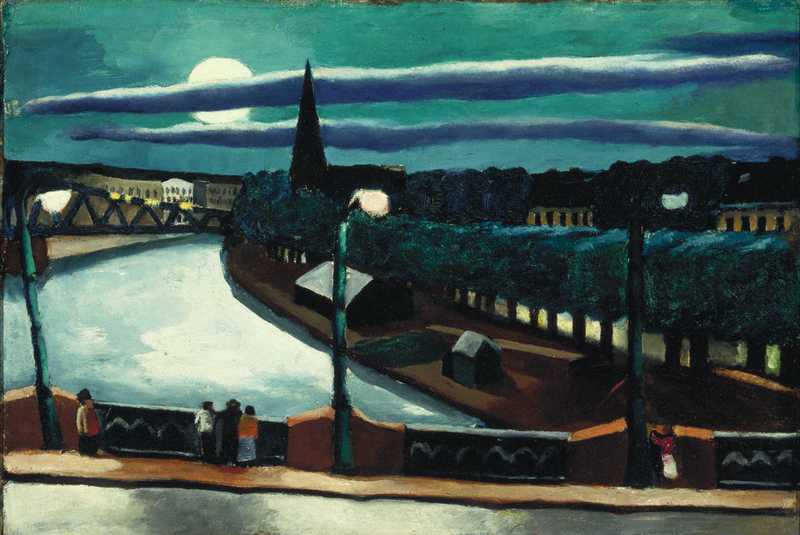 Today is the birthday of that great unclassifiable artist Max Beckmann (born 1884). That's his Moon Landscape (1925) above, representative of one of his many styles - and rather beautiful I think. I knew very little of Beckmann until the eye-opening exhibition at Tate Modern a few years ago, which showed beyond doubt that he was a major painter who had been seriously underrated. But that's the price an artist pays for not fitting conveniently into the pigeonholes of critical theory...
Thursday, 11 February 2010
The Industrious Francis Bacon...
Jonathan Bate, in The Genius of Shakespeare (an excellent book), devotes a chapter to demolishing, coolly but definitively, the various absurd theories about who - other than the man himself - wrote Shakespeare. Of course no rational argument will ever dent the conspiracy theorists' conviction - based on snobbery and ignorance - that someone other than the 'grammar school boy' Shakespeare must have written his plays. Bacon is generally the favourite (even the otherwise sane E. Nesbit was a convinced Baconian) - but what I hadn't realised, until I read Sarah Bakewell's How To Live: A Life of Montaigne in One Question and 20 Attempts at an Answer, was that the arch-Baconian Ignatius Donnelly, having proved to his own satisfaction that his man wrote Shakespeare, then goes on to establish beyond peradventure (hem hem) that Bacon also wrote The Anatomy of Melancholy, all of Marlowe's works - and, er, the Essays of Montaigne. Stands to reason, doesn't it? The word Francis occurs several times in the Essays (referring to Francois I), and the word bacon more than once. And the clincher is that the plays supposedly written by Shakespeare frequently mention mountains, or 'Mountaines'. Why did Bacon write in French, under Montaigne's name? Why, he needed the cover in order to express sceptical, heterodox views. Case closed... Truly there is no bottom to human folly.
Subscribe to:
Posts (Atom)
