 ... in 1796 was Hartley Coleridge, the unfortunate son of Samuel Taylor. He inherited a good deal of his father's character and inclinations, but nothing like the full range of his talents. However, he was a dab hand at the sonnet form and wrote several that deserve to survive. Half a dozen are rounded up on Hartley Coleridge's page of Sonnet Central, a rather wonderful website devoted entirely to the sonnet form. Night seems especially well made, and November is the work of a man who has really looked and listened. I especially like that scentless rose...
Sunday, 19 September 2010
Born on This Day...
... in 1796 was Hartley Coleridge, the unfortunate son of Samuel Taylor. He inherited a good deal of his father's character and inclinations, but nothing like the full range of his talents. However, he was a dab hand at the sonnet form and wrote several that deserve to survive. Half a dozen are rounded up on Hartley Coleridge's page of Sonnet Central, a rather wonderful website devoted entirely to the sonnet form. Night seems especially well made, and November is the work of a man who has really looked and listened. I especially like that scentless rose...


Thursday, 16 September 2010
Meanwhile...
Over at The Dabbler, I'm the 1p Book Review - Time Will Darken It, one from the archives.
Wednesday, 15 September 2010
Tillotson anyone?
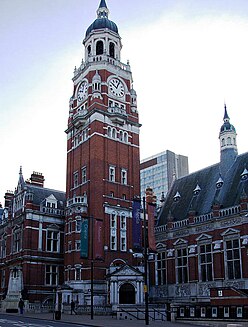 The reference library in Croydon is part of this grand complex, a gloriously extravagant expression of Victorian municipal pride and aspiration. The last time I went in, I was pleased to find it quite wonderfully old-fashioned and unmodernised, complete with chained newspapers, wooden lecterns and dim book-lined galleries - but that was a long while ago, and I'm sure it's a very different story now. However the exterior survives unchanged, with its tall stained-glass windows and, above each, the names of various English worthies, literary and artistic, in threes on little scrolls - very Victorian. Mostly they are the names you'd expect - the likes of Shakespere [sic], Chaucer, Hogarth, Reynolds - but one trio is decidedly odd: Scott, Macaulay (with you so far) - and Tillotson. Who? And why? The only Tillotson of note I can unearth (apart from Johnny 'Poetry in Motion' Tillotson and it's unlikely to be him) is this 17th-century divine. Presumably he enjoyed a Victorian vogue - or perhaps he was a kinsman of the Mayor of Croydon. Who knows?
Alas Poor Jumbo
 It was on this day in 1885 that the famous T.P. Barnum elephant Jumbo was killed, struck by a locomotive while crossing the tracks in a marshalling yard at St Thomas, Ontario. The collision derailed the train, and it took 150 people to haul Jumbo's body up an embankment. The melancholy scene is pictured above. Barnum of course couldn't leave it at that. In what was then the largest taxidermy project ever undertaken, he had Jumbo stuffed so that he could carry on touring with the circus. After four years, Barnum let Jumbo go, donating him to Tufts University, where he became the university's much-loved mascot - until he was destroyed in a fire in 1975. His ashes are now kept in a 14-oz Peter Pan Crunchy Peanut Butter tin in the office of the Tufts athletics director, but his tail, which had been removed earlier, resides in the Tufts archives. That peanut butter tin troubles me - surely Jumbo deserves a more dignified resting place after all he's been through...
Monday, 13 September 2010
A Marvellous Thing
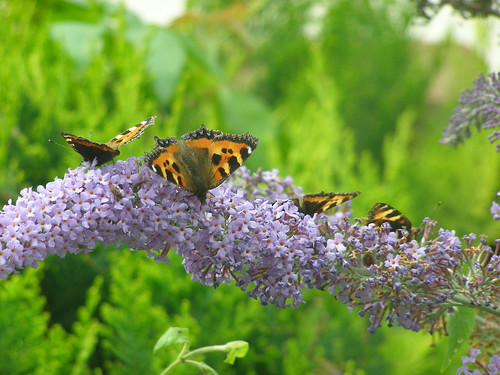 I'm just back from a rather wonderful weekend in Derbyshire, which was mostly about an unusual and unusually joyous family get-together - but, this not being That Kind of Blog, I'm not going to go into all that... Two beautiful, non-family-related images linger in my pleasure centres. One is the spectacular view from the tall gothick window of room 7 of the Temple Hotel in (but safely above) the curious resort of Matlock Bath - surely one of the best hotel room views in England (and the hotel itself is delightful, a nicely frayed-at-the-edges Regency house with none of the character-destroying horrors that afflict most modern hotels). The other lingering image is from Sunday morning, when the warm autumn sun broke through early and the late butterflies were flying and basking. On the remaining flowers of a large buddleia bush I saw a marvellous thing - a dozen and more small tortoiseshells feeding happily (along with a red admiral and a peacock). Not so long ago this would have been a common sight, but lately those of us who live in the southeast have been starved of tortoiseshells as their numbers fell steeply. The cause has still not been established, but the likelihood is that a parasitic infection is to blame, rather then the default culprit 'global warming' (in my experience butterflies seem to rather like warmth). This year there were encouraging signs that the tortoiseshell was rallying in the south. Perhaps a dozen of them on a buddleia bush will once again become a common sight - but it will still be a marvellous heart-lifting thing at summer's end.
Friday, 10 September 2010
Where There's a Will...
 I'm developing one of my irrational loathings again - and, having asked around, I don't think I'm alone in this one. It's that Will Gompertz, the BBC's Arts Editor, i.e. spouter-in-chief of modish banalities about The Yarts (as Sir Les Paterson eloquently calls them). With his bald dome fringed by long hair (not a good look) and combination of very open-necked shirt, formal jacket and tight jeans (an even worse look on a middle-aged man), his appearance is so strikingly unpleasant as to distract the viewer from what he's saying - which might very well be a mercy but is hardly an advantage for a man in his job. He also likes to stride around self-consciously and chop the air with mannered hand gestures - and he's now adopted a conspicuous glottal stop. And who is Will Gompertz (apart from a former director of Tate Media, whatever that is)? He is, Wikipedia informs us, the third cousin of Simon Gompertz, a reporter on BBC2's Working Lunch. That is quite possibly the most obscure fact I have ever learnt about any living person. Hands up those who know who their third cousins are? Hands up those who even know what a third cousin is? Hands up those who would happily get through the rest of their lives without another report on The Yarts by Will 'Third Cousin of Simon' Gompertz...
A World without Men
Gareth Malone - geeky choirmaster and motivator extraordinaire - launched his latest venture on BBC2 last night. This time he's tackling the sad fact that boys fall way behind girls in primary schools these days, especially in reading and writing. He's going to be giving special boy-friendly lessons to a group of lads in an Essex primary school - and no doubt his efforts will improve their plight. But what a sad plight it is - at school these boys clearly feel themselves in a largely alien world, one where they can only fail, because the whole setup plays to the strengths of the girls. Gareth will be giving them something more tailored to their need for outdoor activity, competition and risk-taking - and from the get-go they seem to thrive on it. But what is most striking about their world, in school and, apparently, out - and what is never actually mentioned - is that there are virtually no men anywhere. Occasionally a father is glimpsed in the background, but there's no sign of a male teacher, or a man in any capacity, at the school. It's a female world. Not only do these boys have no male role models - some of them seem to have no men at all in their lives. Also striking is that several of the all-female staff who you would have assumed were classroom assistants or teenagers on work experience are actually fully qualified teachers - and estuary English is spoken throughout the school, from the head(mistress, natch) down. This is all rather dispiriting to those of us who remember when teachers came in two sexes and gave us something to aspire to, some kind of role model - oh and they also taught us stuff, but that's another matter. Meanwhile, perhaps there's some hope for the boys in Gove's latest wheeze...
Subscribe to:
Posts (Atom)
