Sunday, 16 October 2011
Perhaps College Isn't for Everyone
The young till jockey in my local supermarket - nice chap, hard-working, obliging - was chatting to a customer as he scanned her purchases. He was telling her he was getting nowhere looking for another job - applications not even acknowledged etc, a familiar story - and that he was thinking of going to college. As she worked at the local college (or university or whatever it is these days, I lose touch), she suggested helpfully that, next time she came in, she'd give him a prospectus. He thanked her and she went on her way. A moment later, he turned to his colleague at the next till. 'What was all that about?' he inquired. 'What's a prospectus?'


A Surprising Comparison
It was a second visit to Nimes, and the place seemed even more wonderful than last time (the unbroken autumn sun helped). With its extraordinary Roman remains and 18th-century waterworks, fascinating ancienne ville, fine restaurants and beautiful shady terraced gardens rich in bird life, butterflies and red squirrels, surely Nimes is one of France's most delightful small cities. Not, it seems, to all. In one of those fine restaurants, we got talking to a young local couple dining at the next table (their English was good) and the young fellow couldn't speak too highly of London, which he'd visited just once, flying in via Luton airport. London, he declared, was the finest city on earth - he absolutely loved it. But what of Nimes? we protested - Isn't this a wonderful city? Nimes? he replied, as if surprised at the suggestion. Oh no, he declared, Nimes is like Luton.
Monday, 10 October 2011
Phew!
I'm back from Normandy, but only to turn on a sixpence and head off again, this time to Nimes, by rail - we leave early tomorrow. I see that another of my Oxfam book finds lives again on The Dabbler - maybe something else will pop up while I'm off in the sunny (I hope) South...
As ever, the trip to Normandy was a reminder of how large, various and variously wonderful the country is - also, this time, of how much has survived the most appalling bouts of destruction, both self-inflicted (internal wars and the bloody Revolution) and external (two hideously destructive world wars). I had never visited Caen before, and was amazed how much more there was of the old town than I'd imagined. I'd thought there'd be nothing left after all those bombs but the cathedral and a few scattered remnants, but no - the castle and its outer defences are still monumentally present, along with large numbers of fine churches of one kind and another, and great tracts of the ancienne ville. Still more amazing is Falaise, site of the some of the most ferocious fighting and relentless bombardment of the last War: though much of the centre is rebuilt (rather well, if a little blandly), the indestructible castle where William the Bastard was born still looms hugely over the town, where the two grandest churches survive, along with many other old buildings and great stretches of the massive town walls.
Then there was Sees (there should be an acute accent on that first e) - a gem of a town, seemingly quite untouched by the general destruction and largely undiscovered by tourists. The Abbey is utterly beautiful, rather like a small-scale Amiens in its purity of line... We also visited the 'Norman Alps', as they're half-seriously called - the Alpes Mancelles - taking a look around Saint Ceneri-le-Gerei (acute on first e), an achingly picturesque riverside village much frequented in its day by painters and poets, with a wall-painted medieval church (disfigured, when we visited, by a truly terrible display of modern 'art') and the saint's little hermitage chapel, where he slept on a thoroughly unsuitable lump of stone...
But enough - I'm off again. Au revoir, amis!
As ever, the trip to Normandy was a reminder of how large, various and variously wonderful the country is - also, this time, of how much has survived the most appalling bouts of destruction, both self-inflicted (internal wars and the bloody Revolution) and external (two hideously destructive world wars). I had never visited Caen before, and was amazed how much more there was of the old town than I'd imagined. I'd thought there'd be nothing left after all those bombs but the cathedral and a few scattered remnants, but no - the castle and its outer defences are still monumentally present, along with large numbers of fine churches of one kind and another, and great tracts of the ancienne ville. Still more amazing is Falaise, site of the some of the most ferocious fighting and relentless bombardment of the last War: though much of the centre is rebuilt (rather well, if a little blandly), the indestructible castle where William the Bastard was born still looms hugely over the town, where the two grandest churches survive, along with many other old buildings and great stretches of the massive town walls.
Then there was Sees (there should be an acute accent on that first e) - a gem of a town, seemingly quite untouched by the general destruction and largely undiscovered by tourists. The Abbey is utterly beautiful, rather like a small-scale Amiens in its purity of line... We also visited the 'Norman Alps', as they're half-seriously called - the Alpes Mancelles - taking a look around Saint Ceneri-le-Gerei (acute on first e), an achingly picturesque riverside village much frequented in its day by painters and poets, with a wall-painted medieval church (disfigured, when we visited, by a truly terrible display of modern 'art') and the saint's little hermitage chapel, where he slept on a thoroughly unsuitable lump of stone...
But enough - I'm off again. Au revoir, amis!
Wednesday, 5 October 2011
Et maintenant...
- or rather in the unthinkably small hours of tomorrow morning - I am off to Normandy for a few days of walking, conviviality and flaneuring around. A bientot, mes amis!
From the Tabard Inn to the long looked for 'American Novel'
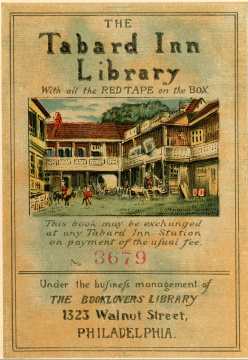 So there I was (again) browsing the bookshelves of the Oxfam shop when my eye was caught by a rather handsome binding and the enigmatic title D'Ri and I, 1812. This was clearly not the date of the book, so I opened it to find out more, and was immediately arrested by the delightful bookplate - the Tabard Inn Library - and the owner's name written on the flyleaf with an address in Bedford Park (the west London garden suburb). Aha, I thought - so the Tabard Inn in Bedford Park (which I visited recently) had a lending library. How very Bedford Park... I was of course quite wrong, for this Tabard Inn Library ('With all the Red Tape on the Box') was 'under the business management of The Booklovers' Library', whose office address was given as 1030 Chestnut St, Philadelphia (in this - and in not having an accession number - my bookplate differs from the one pictured).
 Intrigued, I looked up the Tabard Inn Library online and found this account of the enterprise. What's more, Tabard Inn revolving bookcases are, it seems, very collectible antiques. And no connection whatsoever with Bedford Park. Besides, the Tabard on the bookplate is clearly the Southwark inn from which Chaucer's pilgrims set off...
As for the book, it's subtitled 'A Tale of Daring Deeds in the Second War with the British, being the Memoirs of Colonel Ramon Bell, U.S.A', by Irving Bacheller, published by Lothrop of Boston in 1901, with sepia illustrations all too characteristic of the period and genre by F.C. Yohn. I must confess I had not heard of Irving Bacheller, but - as his Wikipedia entry makes clear - he was a considerable figure in newspaper publishing and journalism (particularly instrumental in the success of Stephen Crane), as well as a very popular novelist. D'Ri and I is 'a tale of adventurous and rugged pioneers', a stirring heady mix of riproaring action, straightforward jollity and easygoing romance. Bacheller even finds space for this saucy roundelay - a kissing game - which he prints complete with melody:
'Oh, happy is th' miller who lives by himself!
As th' wheel goes round, he gathers in 'is wealth,
One hand on the hopper and the other on the bag;
As the wheel goes round, he cries out "Grab!"
Oh, ain't you a little ashamed o' this,
Oh, ain't you a little ashamed o' this,
Oh, ain't you a little ashamed o' this -
To stay all night for one sweet kiss?
Oh,' etc.
D'Ri, by the way, is the nickname of Darius, a rugged pioneer if ever there was one. He is companion, friend and mentor to the young Ramon, and speaks in a picturesque accent, which (in the manner of the time) is laboriously transliterated, to tiresome effect. D'Ri and I is the follow-up to Bacheller's biggest success, Eben Holden. This one is advertised in the endpapers of D'Ri and I: 'The most American of recent novels, it has indeed been hailed as the long looked for "American Novel".' Eat your heart out, Jonathan Frantzen, Don DeLillo - Bacheller got there first.
Laughing on the Train
Yesterday I was in my spiritual second home, the Derbyshire dales, where my cousin and I spent the afternoon enjoying the most spectacularly picturesque of them all - Dovedale (where we were greeted on arrival by a fine Red Admiral, posing to advantage on a sycamore leaf -but enough of Admirals)... On the train on the way back, I noticed a chap sitting diagonally opposite me on the other side of the gangway reading a book. Every few paragraphs, it seemed, he would be overcome by helpless laughter, rocking with delighted mirth. He wasn't guffawing or braying embarrassingly, just hugely enjoying himself. That must be one funny book, I thought, idly glancing across from time to time. What could it be, this riproaring ribtickler? A Wodehouse perhaps, even a Tom Sharpe?... And then I caught sight of the title: it was Anne Tyler's The Amateur Marriage. Now, this is a very fine novel - I wrote about it here - but a riproaring ribtickler it is not, by any stretch. I fear the chap on the train probably belongs to that class of eccentrics I used to come across in my reference library days, who would take down, say, the Port of London Tide Tables from the shelf and read them closely with every sign of enjoyment, laughing merrily at who knows what 'jokes' visible only to them.
Sunday, 2 October 2011
Admirals Again
Is it an Indian summer? Strictly not - indeed it's too early to qualify even as St Luke's Little Summer - but whatever it is, the heat continues, the skies are still blue and perfectly cloudless and the sun shines down on us here in the South of England. After the dismal summer it is more than welcome, and especially so to those of us who love our butterflies and thought we had probably seen our last of the year (bar the odd flushed hibernator) back in the grey cold of mid-September. Speckled Woods - which seem to thrive whatever the English summer throws at them - are still flying, and yesterday I saw (as well as Small and Large Whites) a bright Brimstone and a couple of passing Peacocks. But once again the stars of this Indian (or not) summer are the Red Admirals - and not tired, tattered, end-of-season specimens, but fine, fresh ones, full of energy. Yesterday on Ashtead Common, one was careering around an oak tree as if he were a Purple Emperor defending his tree. Then later, at the very point of my leaving the common to head home, right beside the gate, a fine Red Admiral suddenly flew up from the path and landed on my calf, perching on my trousering (beige cotton, since you ask) and unfurling his proboscis to taste a speck of something that seemed to be to his fancy. This beautiful close-up lasted for some minutes, until the Admiral tired of it, flew off in a small quick circuit, then landed back on the path at my feet, where I watched him for several minutes more. It was almost a replay of my Purple Emperor encounter, on the same common back in June, and it would have seemed fitting if this was my last butterfly of the season. But it wasn't - as I got off the train, there, charging around at speed, in and out of the station shop, was another beautiful indomitable bright Red Admiral.
Subscribe to:
Posts (Atom)
