Monday, 19 March 2012

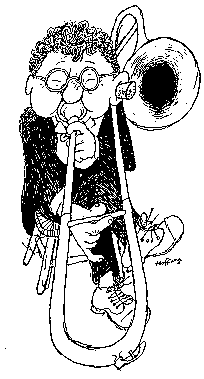
Hoffnung

Over on the Dabbler, under Mahlerman's Sunday post on Unserious Music, Worm mentions the once very famous and popular Gerard Hoffnung. That name took me right back to my boyhood. One of my uncles had a recording of Hoffnung's legendary stand-up (and sway about) performance in front of a notably well lubricated Oxford Union audience. This was the huge comedy hit of its day, and my uncle and father would laugh almost as uproariously as the Oxford audience as they listened to Hoffnung in full flow - sounding, as ever, like the most bufferish of old buffers, though he was a young man. It's a tour de force, and, though something of a period piece, still worth a listen - his comic timing is quite extraordinary.
Hoffnung's charming little books of music-themed cartoons sold very well - it's impossible not to like them - and still turn up quite often in charity shops. The musical performances he staged were perhaps rather laboured affairs, as such minglings of comedy and 'serious music' tend to be. But his most interesting legacy, I think, are his recorded interviews with an urbane Canadian called Charles Richardson. Hoffnung, his bufferish persona honed to perfection, proves the most impossible of interviewees (think Peter Cook's Arthur Streeb-Greebling and then some), offering rambling irrelevant 'answers', interrupting his hapless interviewer, taking offence at innocuous pleasantries and indignantly telling Richardson to mind his own business when pressed for anything resembling an answer. The result is something at once very funny and way ahead of its time. Have a listen here...

Thursday, 15 March 2012

True Grit

Taking a break from Ivy and Rose and all those lady novelists I seem irresistibly drawn to, I've been reading Charles Portis's True Grit, a novel by a man - and what's more, one that might be classified as a 'western'. It's a tricky book to write about, as I suspect it's one those modern classics that's widely read in America but little read over here (like William Maxwell's So Long, See You Tomorrow). Most people on this side of the Atlantic think of True Grit as a John Wayne movie, and latterly a Coen Brothers' movie, and few have so much as heard of Charles Portis, even though he wrote one of the funniest books of the 20th century, Masters Of Atlantis. Anyway, True Grit - the story of a 14-year-old girl, Mattie Ross, avenging her father's murder, with the help of one-eyed marshal 'Rooster' Cogburn - I found an absolute joy to read. Here's how it starts:
'People do not give it credence that a 14-year-old girl could leave home and go off in the wintertime to avenge her father's blood but it did not seem so strange then, although I will say it did not happen every day. I was just 14 years of age when a coward going by the name of Tom Chaney shot my father down in Fort Smith, Arkansas, and robbed him of his life and his horse and $150 in cash money plus two California gold pieces that he carried in his trouser band.
Here is what happened...'
What can you do but read on? As always with Portis, it's all in the voice - and Mattie's voice is utterly distinctive and unforgettable. She is telling the story perhaps some 40 years after it happened, but she is still the same person - a forthright Presbyterian with very clear views of right and wrong, a dauntless spirit and sharp wits, and little sense of humour. And yet her story is engaging and funny, despite taking in an awful lot of violent death and injury - all of which is dealt with in a brisk, spunky, matter-of-fact manner. Mattie's voice, and that of the dialogue passages, is vivid, precise, formal and beautifully phrased - perfectly of its time and place (Arkansas in the 1870s or thereabout). And because the language is so exactly right, True Grit can ditch the baggage that weighs down many a less completely imagined period novel - making for a short (200-odd pages) and hugely readable book.
The language is of course the language of Bible readers - and Mattie is not above giving chapter and verse. She also has an endearing habit of putting any vaguely slangy word or expression in inverted commas: 'thugs', 'booty', 'stunts', 'the land of Nod'. She uses the characteristic locution, 'My thought was' - as in 'My thought was: What on earth!' The exclamations too are characteristic: 'It was not to be!', 'Thank goodness for that!', 'You bet he was a game pony!'
Rooster Cogburn has his distinct voice too, but he is mostly a man of few words. When he does let himself go, with a drink-fuelled account of his early career, he sounds at times almost like the immortal Dr Reo Symes in The Dog of the South, but it doesn't last long, and Mattie remains firmly in charge of the story.
I guess Mattie Ross is a heroine in the mould of Tom Sawyer and Huckleberry Finn. True Grit is every bit as enjoyable as their stories - and, I think, every bit as classic. If you haven't read it, you're missing a treat.
Dabbling again

Over on The Dabbler, I ponder the afterlife of a poet of the 1890s...

Wednesday, 14 March 2012

Honeysuckle

In The Wood (a section of The Worm Forgives the Plough, republished in Penguin's very attractive series of little books, English Journeys, and available at 1p on Amazon), John Stewart Collis describes thinning a wood and restoring it to health...
'During my work of clearing there was one thing which gave me particular satisfaction. This was the cutting away of the honeysuckle. Belonging to the parasitic company of plants that engage trees for climbing up instead of rising of their own accord, they often provide grim spectacles in the woods of merciless throttling and strangulation. Ascending from the bottom of the trunk they spiral their way upwards, clinging tightly to the bark. This hinders the sap, the tree's circulation, and after a year or two the young trunk itself becomes a spiral-shaped pole, bulging out in a remarkable manner, as if an erect rubber tube full of air had been tightly wound with cord in spiral formation so that it bulged out between the cord (though in the case of the victimised tree or branch the bulge appears at the cord of honeysuckle). The tree struggles to live in spite of the stranglehold, but generally in vain. It is apt to die and rot and bend over, a parched ruin upon which the honeysuckle thrives, spurning the base degrees by which it did ascend...'

This is harsh indeed - it's as if he's writing about Lianas, or the terrible Kudzu that has engulfed great swathes of the American South. Honeysuckle is a most lovable woodland plant - not only for the beauty of its flowers and their fragrance, but (from my perspective) for being the food plant of that beautiful butterfly, the White Admiral. Also for its alternative name, Woodbine - which, bizarrely, was adopted by W.D. & H.O. Wills for a cheap brand of cigarettes that played its part in winning the Great War, and was still available in pocketmoney-friendly packs of five, in my earliest smoking days...
Richard Mabey, in his mighty Flora Britannica, takes a much more charitable view of the Honeysuckle (which is not, of course, 'parasitic', as it takes nothing from its host tree but physical support). And those strangely twisted barley sugar sticks that the clinging Honeysuckle can produce were, as Mabey points out, a popular prop among Scottish music hall acts. Och aye - another of the Honeysuckle's gifts to mankind.

Tuesday, 13 March 2012

'That Prodigy in Nature'

Born on this day was the famously fat Daniel Lambert, a man 'of surprising corpulency' (and then some). I remember as a boy seeing the suit of his clothes on display in Stamford - it made quite an impression. In these times Lambert would be lucky (if that's the word) to make the reserve list for a Channel 5 documentary, such are the heights of obesity mankind has scaled since his innocent time. Lambert seems to have been a man of attractive character, good manners and wide interests (especially in the sporting world) and his condition was clearly not the product of any notable excesses on his part. He seems also to have enjoyed strikingly good health and agility, despite his extraordinary bulk. He certainly didn't court fame, but found himself with little choice, and exhibited himself for as long as he could endure, to make the money he needed. His life was active to the end, and his sudden death seems not to have been related to his weight. Reading his epitaph -

In Remembrance of that Prodigy in Nature.
DANIEL LAMBERT.
a Native of Leicester:
who was possessed of an exalted and convivial Mind
and in personal Greatness had no Competitor.
He measured three Feet one Inch round the Leg
nine Feet four Inches round the Body
and weighed
Fifty two Stone eleven Pounds!
He departed this Life on the 21st of June 1809
Aged 39 years -

put me in mind of that to another fat man with an exalted and convivial mind - well, convivial anyway - Tom Humphrys.

Monday, 12 March 2012

'Long, long birch bark...'

It seems that there's going to be some serious opposition to Our Engelbert when Eurovision battle is joined in Beautiful Baku. The Russians have unleashed the
Buravonskiye Babushki, from the glorious Udmurt Republic - and they're rehearsing hard... Whatever the outcome of the Baku silliness, I think Engelbert should join them for a rousing rendition of their imperishable classic, 'Long, long birch bark and how to make a hat of it'. What the world needs now is birch bark hats.

Friday, 9 March 2012

'An Hieroglyphical and shadowed lesson...'

My recent belated discovery of the wonders of Purcell also opened my ears to the beauty of viol music, with its sweet softness of tone. By chance I recently came across a piece by one John Jenkins, who was, I learnt, the supreme composer of his time for viol consorts (and a fine player himself). His time was very long - in effect from Byrd to Purcell, unfortunately including the Civil War and Commonwealth - and, to judge from his Wikipedia entry, he seems to have been as amiable and well-liked as he was talented. Intriguingly, he was in his later years a friend of Sir Thomas Browne's (though sadly he does not figure in my edition of Browne's letters). The author of Jenkins' Wikipedia entry clams that his music is the closest thing to 'an aural representation of the sensibility of this physician-philosopher'. I'm not sure how true that is, but I have certainly enjoyed listening to a CD of Jenkins's works for viol consorts. Here is the remarkable - and untypically programmatic - Newark Seidge, which, with only viols and a chamber organ, portrays the alarums and excursions of battle, the celebration of victory and the mourning for the dead as Prince Rupert relieved Newark in 1644.
It is pleasing to think of Jenkins playing for his friend Browne, who clearly loved music. In Religio Medici Sir Thomas writes:
'Whosoever is harmonically composed delights in harmony; which makes me much distrust the symmetry of those heads which declaim against all Church-Musick. For my self, not only from my obedience, but my particular Genius, I do embrace it: for even that vulgar and Tavern-Musick, which makes one man merry, another mad, strikes in me a deep fit of devotion, and a profound contemplation of the First Composer. There is something in it of divinity more than the ear discovers: it is an Hieroglyphical and shadowed lesson of the whole world, and creatures of GOD; such a melody to the ear, as the whole World, well understood, would afford the understanding. In brief, it is a sensible fit of that harmony which intellectually sounds in the ears of GOD.'