Talking of formal brilliance, here's a beautifully constructed sonnet by Auden. Breaking neatly (into tears) at the approved point (between lines 8 and 9), it presents the facts of the great man's life in the first eight lines, the truth in the following six. The octave stands above the sestet like a monument atop its reflection in a lake.
WHO'S WHO
A shilling life will give you all the facts:
How Father beat him, how he ran away,
What were the struggles of his youth, what acts
Made him the greatest figure of his day;
Of how he fought, fished, hunted, worked all night,
Though giddy, climbed new mountains; named a sea;
Some of the last researchers even write
Love made him weep his pints like you and me.
With all his honours on, he sighed for one
Who, say astonished critics, lived at home;
Did little jobs about the house with skill
And nothing else; could whistle; would sit still
Or potter round the garden; answered some
Of his long marvellous letters but kept none.
Friday, 20 September 2013


Wednesday, 18 September 2013
Anthology 8
Here's one by Richard Wilbur, surely America's greatest living poet.
'Transit' begins with what seems a straightforward epiphany - a moment capturing a vision of beauty - but Wilbur is soon looking aslant at that simplicity ('What use to claim...'), striking a mock-chivalric note. Then it's back to the moment - and the poet hits us with the startling images of the last couplet. As so often with Wilbur, the poem's formal smoothness offsets the strange, marvellous and unexpected things that are going on...
TRANSIT
A woman I have never seen before
Steps from the darkness of her town-house door
At just that crux of time when she is made
So beautiful that she or time must fade.
What use to claim that as she tugs her gloves
A phantom heraldry of all the loves
Blares from the lintel? That the staggered sun
Forgets, in his confusion, how to run?
Still, nothing changes as her perfect feet
Click down the walk that issues in the street,
Leaving the stations of her body there
As a whip maps the countries of the air.
'Transit' begins with what seems a straightforward epiphany - a moment capturing a vision of beauty - but Wilbur is soon looking aslant at that simplicity ('What use to claim...'), striking a mock-chivalric note. Then it's back to the moment - and the poet hits us with the startling images of the last couplet. As so often with Wilbur, the poem's formal smoothness offsets the strange, marvellous and unexpected things that are going on...
TRANSIT
A woman I have never seen before
Steps from the darkness of her town-house door
At just that crux of time when she is made
So beautiful that she or time must fade.
What use to claim that as she tugs her gloves
A phantom heraldry of all the loves
Blares from the lintel? That the staggered sun
Forgets, in his confusion, how to run?
Still, nothing changes as her perfect feet
Click down the walk that issues in the street,
Leaving the stations of her body there
As a whip maps the countries of the air.
Tuesday, 17 September 2013
Anthology 7
Here's something seasonal from Philip Larkin (in The Whistun Weddings). It's sad, naturally - as poems about this particular turn of the seasons tend to be - but there is none of the sour misanthropy that is so often imputed to Larkin (and that he often played up to in his later career). The tone is tender, wistful, elegiac - and incidentally (accidentally) the poem has its interest as social history, a snapshot of a time when 'estatefuls' of skilled working men had secure jobs, and their non-working wives had afternoons free to spend with their children. How long ago it seems...
AFTERNOONS
Summer is fading:
The leaves fall in ones and twos
From trees bordering
The new recreation ground.
In the hollows of afternoons
Young mothers assemble
At swing and sandpit
Setting free their children.
Behind them, at intervals,
Stand husbands in skilled trades,
An estateful of washing,
And the albums, lettered
Our Wedding, lying
Near the television:
Before them, the wind
Is ruining their courting-places
That are still courting-places
(But the lovers are all in school),
And their children, so intent on
Finding more unripe acorns,
Expect to be taken home.
Their beauty has thickened.
Something is pushing them
To the side of their own lives.
AFTERNOONS
Summer is fading:
The leaves fall in ones and twos
From trees bordering
The new recreation ground.
In the hollows of afternoons
Young mothers assemble
At swing and sandpit
Setting free their children.
Behind them, at intervals,
Stand husbands in skilled trades,
An estateful of washing,
And the albums, lettered
Our Wedding, lying
Near the television:
Before them, the wind
Is ruining their courting-places
That are still courting-places
(But the lovers are all in school),
And their children, so intent on
Finding more unripe acorns,
Expect to be taken home.
Their beauty has thickened.
Something is pushing them
To the side of their own lives.
Monday, 16 September 2013
Anthology 6

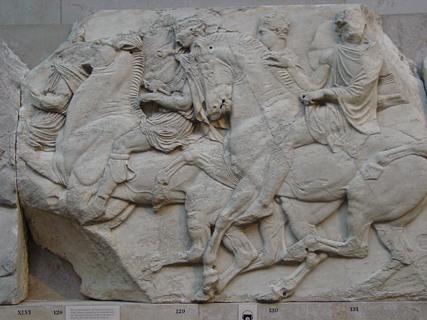
Oblique, playful and endlessy allusive, with a truly unique voice, Moore never takes an obvious course, but somehow always arrives exactly where her poem needs to be. ('Chiton-folds' here is especially clever, by the way, referring at once to chiton the Greek garment and chiton the marine mollusc, while paving the way to that Parthenone mane and to that beautiful ending.)
THE PAPER NAUTILUS
For authorities whose hopes
are shaped by mercenaries?
   Writers entrapped by
   teatime fame and by
commuters' comforts?  Not for these
   the paper nautilus
   constructs her thin glass shell.

   Giving her perishable
souvenir of hope, a dull
   white outside and smooth-
   edged inner surface
glossy as the sea, the watchful
   maker of it guards it
   day and night; she scarcely

   eats until the eggs are hatched.
Buried eight-fold in her eight
   arms, for she is in
   a sense a devil-
fish, her glass ram'shorn-cradled freight
   is hid but is not crushed;
   as Hercules, bitten

   by a crab loyal to the hydra,
was hindered to succeed,
   the intensively
   watched eggs coming from
the shell free it when they are freed,--
   leaving its wasp-nest flaws
   of white on white, and close-

   laid Ionic chiton-folds
like the lines in the mane of
   a Parthenon horse,
   round which the arms had
wound themselves as if they knew love
   is the only fortress
   strong enough to trust to.
Sunday, 15 September 2013
Anthology 5
Saturday, 14 September 2013
Anthology 4
Unlike R.S. Thomas's deus absconditus, George Herbert's God was a very present God. The poet's relationship with him was close, intense, passionate, conflicted - bitter-sweet...
BITTER-SWEET
Ah, my dear angry Lord,
Since thou dost love, yet strike;
Cast down, yet help afford;
Sure I will do the like.
I will complain, yet praise;
I will bewail, approve;
And all my sour-sweet days
I will lament and love.
BITTER-SWEET
Ah, my dear angry Lord,
Since thou dost love, yet strike;
Cast down, yet help afford;
Sure I will do the like.
I will complain, yet praise;
I will bewail, approve;
And all my sour-sweet days
I will lament and love.
This kind of close-quarters engagement with an intensely present personal God has a Jewish flavour to it. Herbert of course was not Jewish - in his day there were officially no Jews in England - but he took a strong interest and probably knew something of the Jewish community in the Netherlands. This extraordinary poem is strongly sympathetic, even if it is essentially a plea for conversion:
THE JEWS
Poor nation, whose sweet sap and juice
Our scions have purloin’d, and left you drie:
Whose streams we got by the Apostles sluice,
And use in baptisme, while ye pine and die:
Who by not keeping once, became a debter;
          And now by keeping lose the letter:
          Oh that my prayers! mine, alas!
Oh that some Angel might a trumpet sound;
At which the Church falling upon her face.
Should crie so loud, untill the trump were drown’d,
And by that crie of her deare Lord obtain,
          That your sweet sap might come again!
Subscribe to:
Posts (Atom)
