Going through some papers just now, I came across a photocopy of something my paternal grandfather (whom I never knew; he died in 1936) wrote – an account of a journey from Liverpool to Montreal in 1892 on the steamship Sardinian. Handwritten and illustrated with little pen-and-ink sketches, it's very nicely produced, in the style of its time. The attitudes too are very much of their time, and the early pages, in particular, make for amusing reading.
When the ship drops anchor off Moville in County Donegal, my grandfather and a few others take a rowing boat to the shore, where they are 'besieged by a crowd of jaunting-car drivers, whose remarks were very witty, chiefly consisting of absurd brag about one's own particular car, and biting sarcasm as to their rivals' vehicles'. As they walk around the town, the party find 'the whole crew of Jehus following us about with great persistency and never-ending jabber'. Eventually they strike a deal with one driver to take them to 'Greencastle, an old ruin of very dubious character' (which is all my grandfather has to say about Greencastle). Later, at the post office, 'a most amusing incident occurred'. This was a lengthy dialogue in which a woman complained, in 'an extremely rapid flow of genuine Irish', that a Post Office vehicle had run over one of her ducks and the Post Office should pay her compensation. I guess you had to be there...
A great deal of singing and music-making goes on – weather and mal de mer permitting – as the journey proceeds, and of course there are church services. At one point my grandfather reports that 'steerage passengers have been encroaching on our part of deck today, and have been repulsed, looking very savage'. He sympathises though: 'Poor beggars. I feel very sorry for them. How on earth they exist in that hole of a steerage, I can't imagine. The smell is unbearable down there, and none of them appear to have had a wash since last Christmas.' At least they get their own church service, in the fo'c'sle, and later they have a dance 'to a bad fiddle accompaniment'.
My grandfather notes various of his fellow passengers, including Colonel Haggard, a brother of Rider Haggard, and his wife, who sounds like a formidable lady: 'She came on board with a large deerhound and a small pug. She is a fine tall lady. This lady, I understand, spends a good deal of time in the Rockies, wearing for the purpose a Norfolk jacket and breeches, being, of course, quite isolated from civilisation.' Well, quite. After several days of heavy weather, the boat comes in sight of land, passing Belle Isle and coming close to a flotilla of icebergs. My grandfather does not get to visit Quebec, as the ship docks at Lévis, on the opposite shore. At journey's end, he finds Montreal 'a very fine city' with 'very clean white buildings and streets'. Churches, priests and nuns abound. 'Many of the sidewalks are paved with wood, and the greater number of the streets are planted with tall trees, which look very fresh & green. Some of the houses are covered with creepers and flowers in the main streets of the city.' All of which sounds very different from the Montreal that I visited a few years ago.
My grandfather's account comes to an abrupt and anticlimactic end, describing a 'Japanese gentleman' on board, a Mr Arthur Hart. 'The Jap lady is his wife, Mrs ArthurHart. He speaks very good English, although he might be taken for pure Japanese.' Finis. Well, this document is a product of its time, but I am glad it has survived.
Nine years later, the Sardinian was the ship that carried Marconi to St John's, Newfoundland, to set up his radio station there. She ended her days ignominiously as a coal hulk, before being scrapped at Bilbao in 1938.
Monday, 19 April 2021
A Curious Survival


Saturday, 17 April 2021
The Occasion
It may be a cliché, but it's still true – by God, we do this kind of thing superbly well! This kind of thing being represented today by Prince Philip's funeral, a beautifully choreographed event, packed with resonant imagery and moving moments, the kind of occasion that reminds you that, despite present woes, this is still some kind of a great nation.
In the lead-up to the funeral service, just seeing those ranks of perfectly placed servicemen all with their heads bowed, and hearing that stirring English music was enough to get me in the heartstrings – not get me as I was got by Diana's funeral, which completely undid me, but I was moved, as I always am by big communal endeavours done seriously and for a good purpose. It is a very human thing, this urge to come together and create something far bigger and more important than the participants, and these great royal events are a powerful expression of it. As at Diana's funeral, the weather enhanced the effect: then it was mellow autumn sun, now sharp spring sunlight casting crisp shadows. The service itself achieved a fitting grandeur, despite the reduced scale of the occasion. Neither the Archbish nor the Dean of Windsor did much to enhance the grandeur, but the words and music did the work, and the sadly reduced choir of four singers were magnificent. The lamenting piper (much though I hate the bagpipes) was a brilliant piece of theatre.
The saddest sight, of course, was the grieving Queen, sitting alone and uncomforted, and with her face covered by a black mask – the most potent image of the day, and one that epitomises the deeply strange times we are living through. Even the Royal Family must submit to the inhuman and arbitrary regulations that are at present governing the lives of the rest of us. That must have been the one detail the Prince did not foresee when he meticulously planned his own funeral.
Thursday, 15 April 2021
Gorky
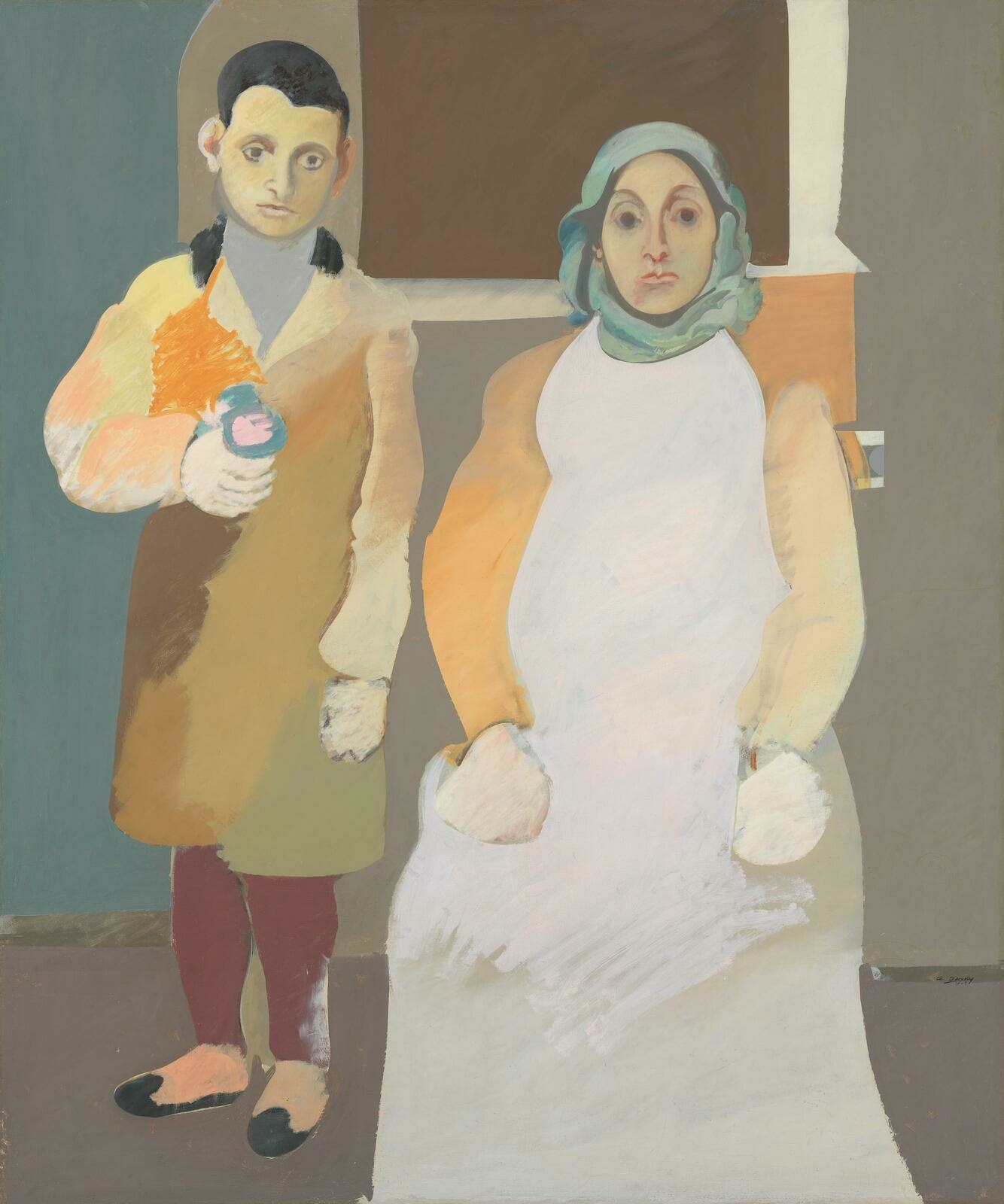
This haunting double portrait is by Arshile Gorky, the Armenian-American painter who is best known as one of the pioneers of abstract expressionism. Gorky was born on this day in 1904, or maybe 1903 or 1902 – he was vague about the year – in a village in Armenia, then part of the Ottoman empire. His father emigrated to America to escape the draft, leaving his family behind, and a few years later, in 1915, Arshile (then known by his birth name, Vostanik Manouog Adolan) and his mother fled the Armenian genocide, escaping into Russian-controlled territory. In the terrible aftermath, his mother died of starvation in Yerevan in 1919.
The double portrait is of The Artist and His Mother. No wonder it is so haunting...
Tuesday, 13 April 2021
Following a Trail

I'm reading, for reasons vaguely connected with something I'm planning to write, The Private Life of Mrs Siddons by Naomi Royde-Smith. Published in 1933, this is a product of that expansive period when (following the example of A.J.A. Symons, among others) biography became something much more than a dutifully exhaustive chronicle of the known facts of a life, and developed into an art form in itself, and a rich and various one for which there was an eager, educated public. 'The plan of this book,' says Miss Royde-Smith at the outset, 'is that of the full-length and ceremonial portraits of the late eighteenth century, the greatest period of English painting till our own day [really?], and the period during which Mrs Siddons lived and was actually painted by Stuart, Hamilton, Romney, Gainsborough, Reynolds, Lawrence and other less important artists.' The author begins by assembling her materials, then painting in the background, then adding some 'cloudy symbols', and finally the sitter herself.
Sarah Kemble (Siddons to be) was the granddaughter of John Ward, manager of a troupe of travelling players, whose daughter had married an aspiring actor, Roger Kemble. Sarah's brother, John Philip Kemble, was to become, like her, one of the leading actors of their time. The Kemble family were a big presence in Hereford, where Roger Kemble was born and spent his first 30 years – and it was in Hereford also that another great actor was born: David Garrick (whose father, I learn, was a Huguenot called Garric). His family moved, not long after his birth, to Lichfield, where he attended Lichfield grammar school.
Where is all this leading, you may ask? Actually it's leading to Bromley, which just goes to show what can happen when you follow a trail of biographical associations.... After leaving the grammar school in Lichfield, David Garrick enrolled at Edial Hall, a small (very small) private school that had been set up by Samuel Johnson, son of a Lichfield bookseller, and his wife Elizabeth ('Tetty'). Elizabeth, some 21 years older than her husband, had invested her dowry of £600 in the school, but it soon failed. Johnson and Garrick, who were now fast friends, headed for London, where Tetty duly followed. Later in life, she was in poor health and seems to have become addicted to alcohol and opiates, but her husband loved her devoutly and grieved for her all his life. 'I tried to compose myself,' he wrote in his diary on an anniversary of her death, 'but slept unquietly. I rose, took tea, and prayed for resolution and perseverance. Thought on Tetty, poor dear Tetty, with my eyes full.'
When Mrs Johnson died, she was buried in, of all places, Bromley, at the church of St Peter and St Paul. The old church was nearly destroyed by wartime bombing and was rebuilt in the 1950s – but Elizabeth Johnson's memorial stone, inscribed with her husband's heartfelt Latin epitaph ('formosae, cultae, ingeniosae, piae' etc.) survived, and can still be seen in the church. If I ever find myself in Bromley, I shall seek it out...

Monday, 12 April 2021
History is wasted on me
So today is the 60th anniversary of the first manned space flight – the Soviet cosmonaut Yuri Gagarin's single orbit of the Earth. I would have been in my last year of primary school at the time, and I have only the vaguest memory of the event, which I think I found mildly exciting, if, like so much else in life, rather bewildering. History is wasted on me.
I think I was more excited by Christopher Cockerell's Hovercraft making its first Channel crossing – this was in the hot summer of 1959 when I was on holiday at Bexhill-on-Sea – and by the unveiling, the same year, of Alec Issigonis's Mini car. These, for some reason, had more impact on my boyhood self. What had no impact at all, as far as I can recall, was the Cuban missile crisis of October 1962, by which time I was at grammar school and should have been paying more attention. The world may have been holding its breath, crossing its fingers, cowering under tables in expectation of the Big One, but this boy's soul was untroubled by a moment's anxiety, and I can't even remember the grown-ups talking about it. There you are – as a witness to history and chronicler of my times I am entirely useless. I seem to have lived through these moments in a state of what Dr Johnson would call 'stark insensibility'. Hey ho.
Saturday, 10 April 2021
'Spring has got into the wrong year'
Another cold grey-white morning, as this stop-start spring continues its latest retreat into winter. Philip Larkin seems to have been having similar weather when he wrote this poem, on today's date in 1970, and it was clearly doing nothing to lift his spirits...
How high they build hospitals!
Lighted cliffs, against dawns
Of days people will die on.
I can see one from here.
How cold winter keeps
And long, ignoring
Our need now for kindness.
Spring has got into the wrong year.
How few people are,
Held apart by acres
Of housing, and children
With their shallow violent eyes.
That pay-off line is unduly harsh (and not even accurate – how many children do you know with shallow violent eyes?). However, the middle stanza is fine and, as it happens, a perfect evocation of how things feel as this lockdown drags on and on, 'ignoring our need now for kindness'.
The image of the hospital building as a cliff was to be reused in Larkin's much more substantial poem of 1972, 'The Building' – 'This clean-sliced cliff'.
More cheeringly, nature, whatever the weather, carries on as near regardless as it can. The trees are coming into leaf ('Like something almost being said'), blossom abounds, and, in rare moments of sunshine in the past few days, the odd butterfly has ventured forth. I've seen a Holly Blue, a Speckled Wood, a few Small Whites – and, best of all, Orange Tips, the cheeriest of spring butterflies. The male of this species, with his orange-tipped wings, is also among the most amorous. In a vivid passage in his Butterflies of Britain & Ireland, Jeremy Thomas writes:
'For as long as the sun shines, the male Orange-Tip flutters along hedges, shrubs and bushes in search of a mate. His initial approach is not discriminating, as he investigates any white object, including the Green-Veined Whites that emerge in abundance on most Orange-Tip sites ... Little will stop a young male once he has recognised a young female of his own species, especially if she is a virgin, whereas older females are examined for no more than three seconds. But once a fresh female is detected, he will force his way through the densest foliage, whereupon she, if receptive, signals her readiness by raising her abdomen at right angles for about four seconds, and mating begins. Curiously, the same posture is adopted by older females in an attempt to deter males that are pestering them.'

Thursday, 8 April 2021
William Herbert
Born on this day in 1580 was William Herbert, 3rd Earl of Pembroke, one of the numerous Herbert clan, which included the poet George (on a collateral branch) and, centuries later, very distantly and obliquely, the Polish poet Zbigniew Herbert – or so he believed. William was one of those Interesting Elizabethans, a man of many parts – nobleman, courtier and politician, founder of Pembroke College, Oxford, holder of a wide range of public offices and honours, and dedicatee of the First Folio, along with his brother Philip, that 'incomparable pair of brethren'. He is also believed by some to be the 'fair youth' of the Sonnets and the 'Mr W.H.', the 'onlie begetter of these sonnets'. One of his lovers, Mary Fitton, has also been suggested as the original of the 'dark lady'. William had an affair with Mary Fitton when he was 20, got her pregnant, admitted paternity but refused to marry her, and was sent to the Fleet prison for a while, where he passed the time writing verse. More interestingly from my particular point of view, he had earlier been urged to marry Elizabeth Carey, granddaughter of the Lord Chamberlain Henry Carey, patron of Shakespeare's company of players. He refused to do so (he seems to have been decidedly averse to matrimony, though he did have one regular marriage, to Mary Talbot, daughter of the Earl of Shrewsbury). This Elizabeth Carey is the remarkable woman whose beautiful monument by Nicholas Stone is in St Dunstan's church, Cranford. I have written about her and her monument on this blog, and also, of course, in this book.

