Sunday, 24 July 2022

Porter and Bach

No apologies for returning again to Peter Porter, the Australian expat poet who seems in danger of being forgotten, despite writing some of the best verse of his time. 
Two themes very prominent in Porter's work were death and music – and, less obviously, religion, which for him was the link between the two: 'I think I was six when first I thought of death./I've been religious ever since./Good taste lay in wait and showed me avenues of music.' This poem, taking its title from the final lines of Larkin's 'Toads Revisited' ('Give me your arm, old toad;/Help me down Cemetery Road.'), was new to me, as was the Bach church cantata at its core.


Down Cemetery Road

The wind brings the Sunday bells. Come to church,
good people. But for me they're simulacra
of the great bell in my chest, clouting out the end.

This comes of keeping one's nose to the moral North
where gods go when they die. Oh how pleased
they are to leave their Babylonian captivity.

And how strange that religion comes from the East
where tourists see only commerce – fanaticism
seeking blue-eyed converts in the claggy fens.

But not the point of this poem. The chorale of Bach's
which moves me most is a tune of 1713,
a real contemporary, Liebster Gott, wann wird ich sterben?

The tune is Daniel Vetter's, the treatment Bach's.
There's the soft flush of earth when corpse and men
move among the matutinal flowers.

Bells like teeth touching, the towers of Leipzig
carving a Lutheran world in friendly slices,
that warm sententiousness we know as death.

Almost chirpy music, but don't ask the corpse
his view. Perhaps he sees that transcendental
radish bed promised by the tame Tibetans.

After a lifetime of blood letting, we deserve
a vegetable future. The flutes and oboes pilfer grief,
we have earned this joyful gruesomeness.

I think I was six when first I thought of death.
I've been religious ever since. Good taste
lay in wait and showed me avenues of music.

Which opened on the road to Leipzig's cemetery,
the alder trees in leaf and the choristers
waiting for their dinner. Herrscher über Tod und Leben!

We Northerners are really Greek. Stoic, old
and held by oracles. Tears are running down like soot.
My daily prayer, Mach einmal mein Ende gut!


And here is the cantata. The glorious opening section is, I think, especially beautiful. That repeated flute motif, in which the same note is played 24 times, suggests the sound of a bird – perhaps the alarm call of a blackbird – but surely also refers to the 24 tolls of the bell that were rung at someone's death in the Leipzig of Bach's time...


Friday, 22 July 2022

Dawn on This Bay

 Born on this day in 1844 was William Archibald Spooner, the famously absent-minded Oxford don after whom the Spoonerism – as in 'It is kisstumary to cuss the bride' – was named. Spooner himself, an albino with poor eyesight, spent 60 years of his life in the service of New College, Oxford (where he was the first non-Wykehamist undergraduate), and was the very image of the unworldly bachelor don, but was actually a married man with five children, one of whom went on to found a large engineering firm and another of whom was a successful portrait painter. He was not very pleased to be associated with the Spoonerism, many of the most famous examples of which were invented by Oxford wags and others. The Oxford Dictionary of Quotations has only one authenticated Spoonerism: 'The weight of rages will press hard upon the employer'. Spooner himself confessed to 'Kinquering Congs their titles take'. Invented Spoonerisms include 'I am tired of addressing beery wenches', 'The Lord is a shoving leopard' and 'You have hissed all my mystery lectures, and were caught fighting a liar in the quad'. 
  Personally, I find the stories of Spooner's absent-mindedness (no doubt equally apocryphal) rather more entertaining. One has him inquiring of an undergraduate, 'Was it you or your brother who was killed in the war?' In another he invites a colleague to tea 'to welcome Stanley Casson, our new Archaeology fellow'. 'But, sir,' the man replies, 'I am Stanley Casson.' 'Never mind,' says Spooner. 'Come anyway.' 
Then there was the long sermon he (allegedly) preached, to an understandably bemused congregation, all about Aristotle. Descending from the pulpit when it was over, he was suddenly struck by a thought, climbed back up and announced, 'I'm sorry – did I say Aristotle? I meant Saint Paul.'  

Wednesday, 20 July 2022

'He sleeps among the dull of ancient days'

 I was pleased (and rather surprised) to see that the distinction of recording the hottest temperature ever in the UK (40.3C) was achieved yesterday by the village of Coningsby in Lincolnshire. Coningsby is just the kind of quiet, unassuming, more or less nondescript Mercian village that I like. Its church, St Michael's, has a one-handed clock, the dial of which is painted onto the tower, which, unusually, has an arched passageway passing under it, part of a footpath from the high street to the old school.
 The Rector here in the 1720s was one Laurence Eusden, the nation's youngest ever Poet Laureate, and one of its least distinguished. Appointed at the age of 30, on the strength of an ode celebrating the Lord Chamberlain, Lord Newcastle's marriage, he succeeded the rather more distinguished Nicholas Rowe, and held the office for 12 years, enduring much derision. His reputation continued to fall after his death. In his Lives of the Poets, Johnson wrote that 'the Laureateship was in this instance preserved and handed down by perhaps our worst poet'. Johnson's brief account of Eusden's poems is peppered with phrases such as 'far-fetched flatteries', 'fulsome fustian' and 'servile adulation and tiresome triplets'. At Coningsby, Eusden took to drink, but still managed to make a translation of Tasso. He died in 1730. 
'The reader,' Johnson concludes, 'will, we fear, agree with us that more than enough has been said of this versifier. Though a clumsy courtier, his flatteries gained for him in that era patronage. In the present one, his powers of puffery would have been turned to a different account. He might have exhausted imagination in celebrating the virtues of blacking, or the praises of cheap clothing.'
'Know, Eusden thirsts no more for sack or praise;
He sleeps among the dull of ancient days.'
(Pope, The Dunciad

Monday, 18 July 2022

One for the Heatwave...

'The heat has come down handsomely upon Lahore: the temperature, even in a room fanned by a punkah, is 95°F and an ill omened pillar of dust is skirmishing outside under an orange coloured sky. The clouds are so low down and so metallic in appearance that one feels as if they could be rapped with the knuckles, and if this were done they would ring like saucepans...' 
That's the teenage Rudyard Kipling writing home to his mother and sister from the scorching summer heat of Lahore (then in India, now in Pakistan). Already the assistant editor of the Civil & Military Gazette, Kipling was left holding the fort while most of his colleagues had decamped to the cool hill country for the summer. Suffering from night terrors and an entirely reasonable fear of cholera, young Rudyard found it all but impossible to sleep, so took to wandering the streets of the Old City at night. This was an unthinkable thing for a respectable white man to do, but it brought him into intimate contact with Indian street life – loud, colourful, chaotic, sometimes menacing – and furnished him with much material not only for his newspaper but for the short stories he was already writing (and, especially, Kim). Those nocturnal wanderings, like the epic night walks of Dickens through London, seem to have done much to fire his creative imagination. In the course of them the teenage Kipling also habitually availed himself of Lahore's prostitutes, and discovered the pleasures of opium and hashish – all apparently without a qualm. The heat can do strange things to a man... 
Incidentally, the drink that got the British through all that Indian heat was weak whisky and soda, the 'chota peg'. Churchill carried on drinking it through most of his life. Cheers!


Saturday, 16 July 2022

The Faultless Painter

 Born on this day in 1486 was Andrea del Sarto, the 'faultless painter' as Browning (following Vasari) calls him. Browning's dramatic monologue in Andrea's voice is a fascinating poem, one of the best of its kind – full text here. Taking his lead from Vasari – an unreliable source, but what can you do? – Browning explores the relationship between the painter and his faithless, frivolous wife, and relates his passivity to the weakness of ambition that allowed him to be overshadowed by his contemporaries Leonardo, Raphael and Michelangelo (surely the most daunting set of rivals any artist could have). All this is probably very unfair on the Andrea del Sarto of real life, but at least posterity now recognises him as a hugely accomplished, important, influential (and, yes, faultless) painter. 
The intense, uneasy, exquisitely painted portrait above is in the National Gallery. Titled Portrait of a Young Man, it could well be a self portrait. It certainly makes a perfect match with Browning's poem.
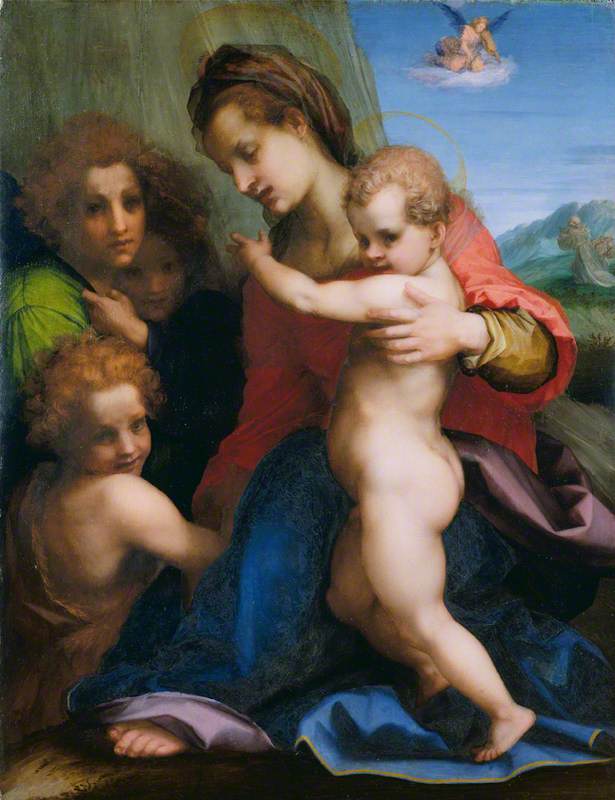
London also has one of his Madonnas – the beautiful Virgin and Child with the Infant Baptist in the Wallace Collection (below). 

Friday, 15 July 2022

Another Cloud

 Talking of clouds, here's a painting that, I think, perfectly illustrates Larkin's 'high-builded cloud moving at summer's pace'. The depth and luminosity of that summer sky is extraordinary. The painting, Noon, Bratsevo (1866), is by Ivan Shishkin, a highly accomplished landscape painter whose work is often almost photorealist in its sharpness and precision, but with a romantic flavour, especially when he is painting his beloved forest scenes. This kind of 'poetic realism' was always a strong force in Russian art, and, alas, all too easily mutated into the propagandistic kitsch of 'socialist realism'. Nowadays, to judge by what I see online, Russian 'neo-impressionism' seems to be all the rage. Some of that is pretty kitsch too.
Here is the Larkin image in context – 

'Cut grass lies frail:
Brief is the breath
Mown stalks exhale.
Long, long the death

It dies in the white hours
Of young-leafed June
With chestnut flowers,
With hedges snowlike strewn,

White lilac bowed,
Lost lanes of Queen Anne's lace,
And that high-builded cloud
Moving at summer's pace.'

Wednesday, 13 July 2022

Wool sack clouds and mare blobs

 Born on this day in 1793 was John Clare, briefly famous in his day as a 'peasant poet', then forgotten about until the early 20th century, and now perhaps rather overpraised for poetry that is decidedly patchy, though at its best eloquent and moving. As a nature poet, he certainly had the advantage of close contact and deep-rooted knowledge, though he was not above a bit of high-toned waffling (no doubt what his early public wanted of him). His poetry is rich in (Northamptonshire) dialect words, and opens a window on a rural way of life that was, as Clare was all too painfully aware, already disappearing. Here, seasonally, is his joyful  'I love to see the summer', a kind of sonnet but written entirely in rhyming couplets –

I love to see the summer beaming forth

And white wool sack clouds sailing to the north

I love to see the wild flowers come again

And mare blobs stain with gold the meadow drain

And water lilies whiten on the floods

Where reed clumps rustle like a wind shook wood

Where from her hiding place the Moor Hen pushes

And seeks her flag nest floating in bull rushes

I like the willow leaning half way o'er

The clear deep lake to stand upon its shore

I love the hay grass when the flower head swings

To summer winds and insects happy wings

That sport about the meadow the bright day

And see bright beetles in the clear lake play

'White wool sack clouds' for the woolly cumulus of summer is good (better than Hopkins's 'silk-sack clouds' in 'Hurrahing in Harvest'). 'Mare blobs' are the yellow, water-loving flowers we now call Marsh Marigolds. The 'insects happy wings' no doubt include those of butterflies, which Clare celebrated in verse more than once, though even he seems to have seen them largely in generic (and symbolic) terms, never mentioning or describing any particular species.