Monday, 28 November 2022

'Every error denoting a feverish attempt...'

 On this day in 1817, Keats completed the first draft of his 'trial' poem Endymion, writing at the foot of it, 'Burford Bridge Nov. 28 1817'. He was staying at what was then the Fox and Hounds inn, but is now the Burford Bridge hotel, the core of the building not much changed from the days when Keats stayed there, in a room overlooking the garden. As I've written elsewhere, the young poet was enchanted by Box Hill, a place that I, too, fondly remember from many a butterfly-hunting walk in those days – now fully two months distant – when I was a Surrey suburban southerner, before Mercia claimed me for its own. 
  When the final version of Endymion was published in April 1818, it carried a positively apologetic preface by Keats, who seemed already to have outgrown it. It begins:


'Knowing within myself the manner in which this Poem has been produced, it is not without a feeling of regret that I make it public.
What manner I mean, will be quite clear to the reader, who must soon perceive great inexperience, immaturity, and every error denoting a feverish attempt, rather than a deed accomplished.'

Later, he declares: 

'The imagination of a boy is healthy, and the mature imagination of a man is healthy; but there is a space of life between, in which the soul is in a ferment, the character undecided, the way of life uncertain, the ambition thick-sighted: thence proceeds mawkishness, and all the thousand bitters which those men I speak of must necessarily taste in going over the following pages.'

Oddly, I used that passage as the epigraph for my first and last attempt at a novel, a work that certainly showed how right Keats was... He concludes: 

'I hope I have not in too late a day touched the beautiful mythology of Greece, and dulled its brightness: for I wish to try once more, before I bid it farewell.'

Try he did, and with wonderful results.


Friday, 25 November 2022

Filth

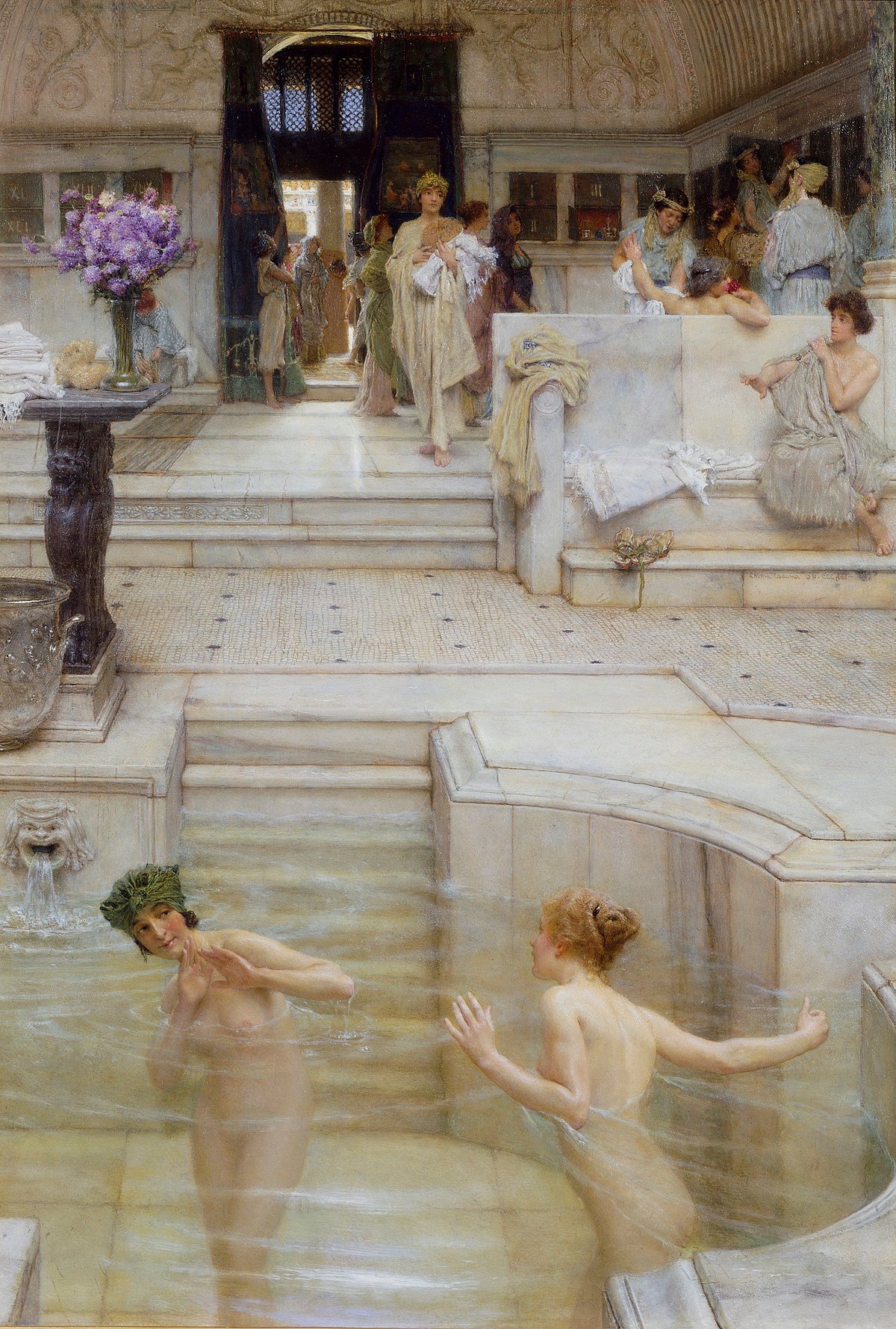
 This kind of filth keeps turning up on my Facebook feed – heaven knows why... Worse things too, in the way of simpering soft porn by French academic painters of the 19th century and their ancien rĂ©gime predecessors. The above picture, however, is good English filth, by Sir Lawrence Alma-Tadema – 'Alma-Tad of the Royal Acad', as I like to think of him – who was actually Dutch but settled in England and became a giant of the British art scene. Ruskin declared him 'the worst painter of the 19th century', though he must have overlooked a lot of competition to arrive at that judgment. Alma-Tad was certainly a master of female flesh and antique marble, with a formidable technique, and his paintings must have given many a Victorian gentleman a lot of not wholly artistic pleasure. 
As for the picture above, it is titled 'A Favourite Custom' – the custom being, apparently, to frolic saucily in the frigidarium, splashing one another with water and taking care to show oneself to advantage from before and behind. The setting is an idealised version of the Stabian baths at Pompeii, and when the painting went on show in 1909 it was such a hit that it was immediately bought for the nation. It now hangs in the Tate, no doubt with a minatory caption to ensure that no one actually enjoys it. 

Thursday, 24 November 2022

Wharton's World

In happier times, English newspapers (and indeed magazines) found space for more than a dash of humour in their pages. J.B. Morton's 'Beachcomber' column was not the only one of its kind, and of the others the doyen was undoubtedly the Telegraph's 'Way of the World' Column, bylined 'Peter Simple'. This, for much of its long life, was written by one Michael Wharton, a man whose political views were off any known scale but could perhaps be summed up as feudal (one of his inventions was the Reactionary Times and Feudal Herald newspaper). Fortunately, he had a true gift for humorous writing that was often (unlike much 'humorous' writing) actually funny – and he had a comic invention every bit as fertile as Morton's, but with less of the Goonish whimsy and more genuine satire.
  His cast of characters included the ghastly champagne socialist Mrs Dutt-Pauker of Hampstead, Dr Spacely-Trellis, the go-ahead Bishop of Bevindon, Lt Gen.'Tiger' Nidgett of the Royal Army Tailoring Corps, psychoanalyst Dr Heinz Kiosk, J. Bonington Jagworth of the Motorists' Liberation Front, the '25-stone, iron-watch-chained, crag-visaged, grim-booted' Alderman Jabez Foodbotham, and dozens of others. And he created a grand dystopian world for them all to live in, based firmly on contemporary reality as he saw it. Some of his fantasies now seem remarkably prescient: take his 'prejudometer', an anti-racist instrument that took precise readings of degrees of racial prejudice, and could be turned on the user until 'at 3.6 degrees on the Alibhai-Brown scale, it sets off a shrill scream that will not stop until you've pulled yourself together with a well chosen anti-racist slogan'. Check your privilege, indeed. Or there's the vibrant Aztec community of Nerdley, constantly asserting their inalienable right to commit human sacrifice on state-funded stepped pyramids.
  For 30 years from 1957, Wharton wrote his column for the Daily Telegraph, working in a tiny, cell-like office with room only for him, a small secretary and a fire escape. His last column was written as the workmen were unscrewing the bronze nameplates from the old Telegraph building on Fleet Street, preparatory to moving to Docklands and a new newspaper world that Wharton would have found unbearable. However, the Sunday Telegraph managed to woo him back, as did the Daily soon after. He filed his last column in 2006,  a few days before he died, aged 92. His successor, for a while, was Auberon Waugh. There is an anthology of Wharton's Peter Simple columns, The Stretchford Chronicles, with an introduction by Kingsley Amis. And there are two volumes of Wharton's autobiography, which sound so intriguing that I've bought the first (The Missing Will) online. I'll report back on that...


Monday, 21 November 2022

Morton and Thomas: Workers

 Partick Kurp writes today about J.B. Morton, best known to English readers as 'Beachcomber', whose humorous newspaper columns ran for half a century in the Daily Express. I must have read a few of them towards the end of his long career, but I remember him chiefly for the radio and TV adaptations of his work, which did not much amuse me. Evelyn Waugh said he had 'the greatest comic fertility of any Englishman', and he certainly created a huge repertory company of comic characters for his columns – Mr Justice Cocklecarrot and the 12 litigious red-bearded dwarves, Dr Strabismus of Utrecht (Whom God Preserve), Captain Foulenough, Roland Milk (a poet), Lord Shortcake, Dr  Smart-Alick, Prodnose, and countless others – but his kind of humour, prefiguring The Goon Show, is really not to my taste (nor is The Goon Show). For American readers, I imagine, the whole world of Beachcomber would be almost entirely incomprehensible. There is a great story about Morton, though. A bit of a prankster, he once covered Virginia Woolf's doorstep with dozens of quart bottles of brown ale (note for American readers: this was the most proletarian of English drinks). Hats off to him for that. 
  Patrick (as well as posting the excellent comic poem, 'Tripe') speaks admiringly of Morton's phenomenal work rate. This set me thinking of Edward Thomas's Stakhanovite labours as a hack writer, desperately trying to support his family, before Robert Frost and the war made a poet of him. Jean Moorcroft Wilson, in her biography, estimates that, for 14 gruelling years, Thomas was writing book reviews – substantial book reviews – at the rate of one every three  days. And between 1910 and the beginning of 1913, while he was still churning out the reviews, thirteen books were published under his name. They don't make them like Thomas – or Morton – any more. 

Sunday, 20 November 2022

'Be British, boys'

 This imposing statue – which, when I first saw it, I took for George V – is of Edward Smith, the captain of the Titanic, who went down with his ship in 1912. It stands in Lichfield's delightful Beacon Park, and is the work of Kathleen Scott, the talented widow of Scott of the Antarctic. According to the official account, Lichfield was chosen as the location for Smith's statue because the Captain was a Staffordshire man and Lichfield is the centre of the diocese. Cynical locals say it was because no one else would have the statue: respect for Smith as a national hero was not universal, and there were rumours (almost certainly untrue) that he attempted to save his life rather than go down with his stricken ship. None of this is reflected in the plaque on the statue's granite plinth, which talks of his 'bequeathing to his countrymen the memory & example of a great heart, a brave life and a heroic death'. It also quotes his supposed last words: 'Be British.' The full version is 'Be British, boys. Be British!' and the words were apparently invented for him by the myth-making British newspapers. Fair enough.
   I paused to admire the Captain's statue while on my morning walk today, before heading out into Lichfield's circumambient (as the city's most famous son might have put it) countryside. It was a gloriously sunny morning, and I followed paths across bumpy pastureland and fallow fields, past Lady Muriel's Belt (a curiously named wood) and Leamonsley House, by Sloppy Wood (another curious name), and back into town, and to Lichfield's premier tourist attraction – Waitrose. There I noticed a fine range of interesting vermouths on sale, something you rarely see in England. I stood a while, impressed but paralysed by indecision, then moved on...

Saturday, 19 November 2022

Jake's Progress

 Lurking unnoticed on one of the digital platforms  (All 4 in fact, which can be viewed free) is a drama series I fondly remember, and which I thought had disappeared for good. Jake's Progress by Alan Bleasdale, first shown in 1995, starred Robert Lindsay and Julie Walters on top form, with a fine support cast and a truly astonishing performance by Barclay Wright as the child around whom the action revolves, the eponymous Jake. Jake is, it's fair to say, troubled and difficult, and only his father, Jamie, has an apparently good relationship with him. Whether that relationship is actually good for Jake, or for anyone else, is another matter. Jamie Diadoni is a feckless manchild, incapable of bearing any responsibility, and living largely in a fantasy world built out of his former, failed career as a rock singer. Like the father in Christina Stead's The Man Who Loved Children, he is in alliance with his child against the adult world and all its demands. Jamie has looks and charm galore, and is able to turn on the latter dazzlingly enough to sustain his marriage to Julie, who is obliged to work all hours as a nurse while he lives the life of a 'house husband' and indulges his musical fantasies. It is all too clear that Jake has grown to hate his mother – all the more so when she gets pregnant and the prospect of a sibling looms – and his maternal grandmother, who is indeed pretty monstrous, as played by Dorothy Tutin. When Jamie and Julie's debts, about which Jamie is of course in total denial, finally become unsustainable, their precarious situation is clearly heading for big trouble. What form it might take is hinted at when a palm reading friend finds something deeply troubling in Jamie's near future...
   Having watched the first couple of hours of Jake's Progress, for the first time since the 1990s, I am hugely impressed, by the acting, the unobtrusively clever direction, and most of all by Bleasdale's brilliant script, with its pinpoint dialogue and complete understanding of the medium. According to Bleasdale, this drama grew out of his shock when, as an only child, he discovered the depths of rivalry and even hatred between his own children – a shock that was only reinforced when he had to rescue a neighbour's child from being burned alive by an elder sibling. The series nearly never happened because no suitable actor could be found for Jake's part. Then, at the last minute, Barclay Wright turned up and, in the event, delivered something that is surely one of the best child performances ever screened. Sadly, and surprisingly, his subsequent acting career never amounted to much. As for Bleasdale, who in my opinion is the equal of any TV dramatist (Dennis Potter included), he tends to be bracketed under 'social realism' and remembered chiefly for Boys from the Blackstuff, rather than Jake's Progress (which doesn't even have a Wikipedia entry) or the great state-of-the-nation drama GBH, or even The Monocled Mutineer. In 1999 he made a controversial adaptation of Oliver Twist (which I loved), with an entirely new backstory for Oliver, and before that a curious misfire, Melissa, inspired by a Francis Durbridge thriller, his last work for Channel 4. Bleasdale, once such a major figure, had nothing on television in the new millennium until, in 2011, he made a fine two-parter, The Sinking of the Laconia, dramatising the Laconia incident of 1942. It seems a shame, to put it mildly, that such a prodigiously gifted dramatist should have spent so much of his later career absent from our screens. If you want a reminder of just how good he was – and how good TV drama can get – seek out Jake's Progress while it's there. Like so much of the best television, it wouldn't get made today.

Tuesday, 15 November 2022

'No killing the Oxfordian thesis'

 The other night on Sky Arts there was a documentary titled Shakespeare: The Man Behind the Name. This, it turns out, is a repackaging of an earlier film, Nothing Is Truer than Truth, and presents the case (such as it is) for Edward de Vere, Earl of Oxford – described as an 'A-list party boy on the continental circuit' – having written the works of 'Shakespeare', a name he took to disguise his bisexuality (?!). Sadly, such big names as Mark Rylance and Derek Jacobi endorse this view, and teaching and researching it are now considered academically respectable. 
  Of course, it is perfectly possible to believe sincerely that the man known as William Shakespeare did not write the works attributed to him, but to do so, one must jettison all the documentary and other evidence to the contrary, and entirely disregard the historical, literary, political and cultural context of Shakespeare's time, replacing it with a wholly anachronistic idea of authorship and 'autobiography' (something that, in the modern sense, didn't even exist in Shakespeare's day). One must, in other words, maintain oneself in a condition of profound ignorance about almost everything but one's chosen candidate for 'the man behind the name' (for which, by the way, if one must make it an aristocrat, William Stanley, Earl of Derby, is a much more plausible candidate). One must also entirely devalue that which makes Shakespeare uniquely Shakespeare – his imagination. As James Shapiro writes towards the end of Contested Will, 'What I find most disheartening about the claims that Shakespeare of Stratford lacked the life experience to have written the plays is that it diminishes the very thing that makes him so exceptional: his imagination.'
  But there you are. It seems there's no killing the Oxfordian thesis. It goes from strength to strength, cheerfully flying in the teeth of every new finding of genuine Shakespearean research. It could even be that, as the sea of general ignorance continues to spread, Shakespeare will end up as one of those historical figures of whom everyone 'knows' one thing, and that one thing wrong: Prince Albert wore a penis ring, Mozart was buried in a pauper's grave, and Shakespeare's works were written by the Earl of Oxford.