The pianist Andras Schiff turns 70 today, as was duly noted on Radio 3 this morning. This reminded me of a link sent to me a while back by the artist formerly known as Mahlerman, still a constant source of musical inspiration. An interview at the piano, in which Schiff talks about Bach and, toward the end, Beethoven, it is well worth watching if you have some free time over Christmas. Schiff's humility, particularly when discussing Bach, is striking, as is his quiet sense of humour. Here's the link...
Thursday, 21 December 2023


Wednesday, 20 December 2023
Haunting, Haunted
The word 'haunting' is one that we perhaps reach for too easily when describing poems and other works of art (mea culpa). However, in the case of Walter de la Mare's best poetry, it is exactly le mot juste. The haunting quality of his verse surely has much to do with the haunted nature of the world he describes: his best poems have an eery, uncanny quality that is quite unique. Take this one, which I came across by chance today, a poem ostensibly about waiting at a railway junction, but of course about so much more. There are echoes of Robert Frost here, and Edward Thomas, but it is unmistakably De la Mare's own – and it is, yes, decidedly haunting...
The Railway Junction
From here through tunnelled gloom the track
Forks into two; and one of these
Wheels onward into darkening hills,
And one toward distant seas.
How still it is; the signal light
At set of sun shines palely green;
A thrush sings; other sound there’s none,
Nor traveller to be seen –
Where late there was a throng. And now,
In peace awhile, I sit alone;
Though soon, at the appointed hour,
I shall myself be gone.
But not their way; the bow-legged groom,
The parson in black, the widow and son,
The sailor with his cage, the gaunt
Gamekeeper with his gun,
That fair one, too, discreetly veiled –
All, who so mutely came, and went,
Will reach those far nocturnal hills,
Or shores, ere night is spent.
I nothing know why thus we met –
Their thoughts, their longings, hopes, their fate:
And what shall I remember, except –
The evening growing late –
That here through tunnelled gloom the track
Forks into two; of these
One into darkening hills leads on,
And one toward distant seas.
Monday, 18 December 2023
A Whall Window
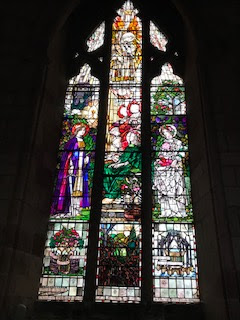
Yesterday I visited St Oswald, Ashbourne, one of the finest town churches in Derbyshire (where I celebrated Advent last tear). My cousin and I paid our respects to poor Penelope Boothby, admired the (mostly) excellent Victorian stained glass, and, in particular, drank in the beauty of the window above, which commemorates the sisters Monica and Dorothea Turnbull, who died in a terrible domestic accident: a lamp held by their father burst into flames, setting fire to Dorothea's dress, and then Monica's, as she tried desperately to save her sister. The distraught parents commissioned Christopher Whall, a brilliant stained glass designer in the Arts & Crafts manner, and he delivered a window of rare beauty. The colours sing, and the drawing, particularly of the faces, is superb. Monica is shown as St Barbara, Dorothea as the saint of the same name, and between them is St Cecilia, falling asleep to the sound of celestial music. Beneath her is an image of the Celestial City, visible though a thicket of thorns. Needless to say, my photograph does scant justice to this magnificent window.
Friday, 15 December 2023
The Return of Chloris

At this time of year, with the garden largely dormant or frost-blighted, the chief pleasure it affords is watching the flurries of birds jostling for a place at the feeders. I have what claims to be a totally squirrel-proof bird feeder, but I wouldn't be surprised if my squirrels find a way to breach its defences: they're all over it, testing it out, probing for a weak point, experimenting with different approaches. I suppose I should take my hat off to the resourceful little blighters, but I'm afraid that, despite having read this book, I still find the grey squirrel hard to like, and would sooner the birds had the feeders to themselves. Charm after charm of goldfinches – 'proud tailors', as they are called in Staffordshire, according to Johnson's dictionary – are visiting, as well as tits blue, great, coal and long-tailed, sparrows, chaffinches, and the odd starling. But the happy surprise has been the large numbers of greenfinches coming to feed. Down south I had seen very few greenfinches since they suffered a dramatic population crash in the 1990s, the result of a parasite-borne disease. The greenfinch (which has the pleasing binomial Chloris chloris, from a Greek root meaning greenish yellow) is a beautiful bird – and, it has to be said, a pugnacious character that likes to have its own way at the bird feeder. It's a joy to see it back, and I hope it's busy repopulating the rest of the country.
Wednesday, 13 December 2023
According to Beryl
On this day – St Lucy's Day, 'the year's midnight' – in 1784 Samuel Johnson, after many travails physical and mental, died. After his death, his body was opened and examined, and an autopsy report written. It was with this report, read by Beryl Bainbridge, that the 2001 Arena documentary According to Beryl, which I watched on BBC iPlayer last night, began. In the film Bainbridge talks about Johnson's last years, in particular his relationship with the Thrales, and about her Johnson-and-Thrale-themed novel, According to Queeney (which I wrote about here). Readings from Johnson's letters and personal writings, and from Bainbridge's novel, enlarge the narrative. It's a typically well made and illuminating Arena documentary, and the slightly dotty but endearing Bainbridge comes over well on television. Towards the end of her film she encounters Johnson's extraordinary death mask, which lives in the National Portrait Gallery. Shortly after Johnson's autopsy, his friend Sir Joshua Reynolds sent the cast maker from the Royal Academy schools to take a cast of the dead Johnson's face. The result [below] is, as Bainbridge points out, strikingly lifelike (though looking quiet unlike the standard image of Johnson) and extremely present: Johnson is very much there. And he looks happy and at peace. I hope he was playing with his childhood friends by the pools of Lichfield, or eating apples in his nurse's garden on George Lane...

Tuesday, 12 December 2023
Moore's Steam Roller
This morning I happened upon this poem by Marianne Moore, intriguingly titled 'To A Steam Roller'. It is not, needless to say, an address to a piece of road-making equipment but a springy, pithy little poem about a more general and pervasive tendency – very much apparent in the academic/critical mind – to crush the glittering particulars of life into a flattened, generalised amalgam. This is, of course, to be resisted.
The illustration
is nothing to you without the application.
   You lack half wit. You crush all the particles down
      into close conformity, and then walk back and forth
         on them.

Sparkling chips of rock
are crushed down to the level of the parent block.
   Were not 'impersonal judgment in aesthetic
      matters, a metaphysical impossibility,' you

might fairly achieve
It. As for butterflies, I can hardly conceive
   of one's attending upon you, but to question
the congruence of the complement is vain, if it exists.Sunday, 10 December 2023
Park Life
With the world apparently trundling towards hell in an accelerating handcart, it is cheering to come across a good news story, so I was delighted to read that a new species of moth – one entirely new to science – has been discovered, in, of all places, a park in that 'queen of suburbs', Ealing. Indeed, it was found in the very park where, as a lad, I used to play with my brother and friends: Walpole Park, developed from the grounds of Sir John Soane's Pitzhanger Manor, which in my day was the public library (the park also, in my day, contained a small zoo or menagerie). The moth is a new species of microlepidopteron, so cannot be described by any stretch as spectacular – but that it should have been discovered at all, let alone in such a location, is quite astonishing: these things very rarely happen. Tachystola mulliganae – named for Barbara Mulligan, the moth enthusiast who found it – belongs to a genus originating from Australia, and an unidentified microplepidopteron in the Natural History Museum's collection turned out to be an exact DNA match. That specimen was found back in 1886, in the Western Australian town of... Walpole.
You can read the full story here.
Subscribe to:
Posts (Atom)
