Tuesday, 31 January 2012

Samuel Palmer's Father in Law

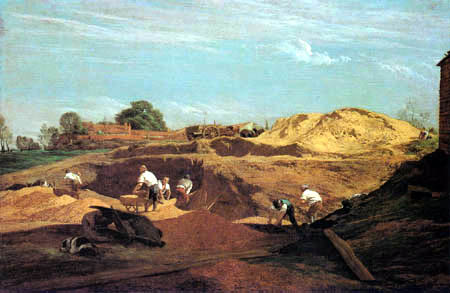
I was up at Tate Britain yesterday, mooching among the rehung Romantics, when this very accomplished oil painting caught my eye. Its subject is Kensington Gravel Pits, and it was painted in 1811/12 - when Kensington was still a village surrounded by market gardens - by John Linnell, who would become the father in law of Samuel Palmer (represented in Romantics only by one very lovely mezzotint, Evening, engraved by one of the Ancients, Welby Sherman).
The most remarkable thing about Kensington Gravel Pits is that Linnell was only 19 or 20 when he painted it. It's an extraordinarily assured piece of work for such a young artist, everything about it executed with absolute confidence. In particular, he is already displaying the masterly rendering of cloud and sky and bold effects of sunlight and shade (you have to see the original to get the richness of colour) that were to be his trademark for the rest of his long life, in the course of which he developed landscape painting into a hugely productive and profitable family business. All his numerous brood were in various ways involved in the business, turning out landscape after landscape, typically with toiling figures, rolling (Surrey) hills and big skies. He ran this patriarchal, quasi-industrial enterprise from a hilltop mansion in Redhill, Surrey, close to the ugly Gothic villa he had bought for his daughter and that husband of hers who seemed incapable of making money from his talents - Samuel Palmer.
This Linnell is the same John Linnell who was the friend and patron of William Blake, and of Palmer and the Ancients, whom he introduced to Blake, thereby inspiring one of the great flowerings of English romantic art. But Linnell became the artistic equivalent of a Victorian industrial baron, while poor Palmer, a fish out water in his Reigate villa, looked down upon in every sense by his father in law, remained an Ancient all his life.

Sunday, 29 January 2012

An Unfortunate Misunderstanding

I pass on this affecting tale from my local paper, simply because it made me laugh rather a lot.
It's the story of an unfortunate misunderstanding in a local park that resulted in charges of attempted dog theft and being drunk in charge of a vehicle - charges of which The Defendant has, happily, now been acquitted. From his photograph, The Defendant does not look to be the sharpest knife in the box, but he has a nice turn of phrase. Here's his account of what happened.
One day, The Defendant was walking his dog, a Staffordshire bull terrier called Ebony, in a local park that, according to the newspaper, is 'a dognapping hot spot'. (I've walked there many times and never seen a dog being napped.) At some point, The Defendant received a call on his mobile from a friend who lived nearby, inviting him to drop in for a drink. He obliged, joining his friend for 'six or eight cans' of Fosters lager, characterised by The Defendant as 'glorified lemonade'.
On emerging from his friend's house, The Defendant decided that he was rather too full of 'glorified lemonade' to drive, so he returned to his car to pick up his mobile and walk home. Unfortunately, while he was making his way to the car, Ebony ran off. Arriving at his car, The Defendant spotted a bull terrier he thought was Ebony and beckoned it towards him. The dog bounded up to the car and leapt over The Defendant into the passenger seat, followed immediately by a Shih Tzu. The Defendant told the court: 'I'd seen two women with those two fluffy things, and the Staffy looked like Ebony. When it sat next to me in the car I realised it wasn't Ebony. Before I knew it, I had two women hammering on my window and screaming at me. I was trying to tell her that I had got the wrong dog, but she hit me with the chain end of the leash. Why and how a Shi Tzu ended up in my car, I have no idea.' This mystery had in fact been cleared up at an earlier hearing, when the Shi Tzu owner explained that her dog 'followed her Staffordshire bull terrier everywhere it went at all times'.
'On the face of it, this could seem quite funny,' said the defence lawyer, summing up. 'If dogs could talk, we could have saved a lot of time.' Indeed.

Thursday, 26 January 2012

Rip's Walt

I've long had a soft spot for the American actor Rip Torn - crazy name, crazy guy - not least for his brilliant performance as the ineffable Artie on The Larry Sanders Show, one of the all-time great TV comedies. His off-screen antics are good stuff too - like the time he whacked Normal Mailer with a hammer (who wouldn't? The ensuing brawl actually ended up on-screen, in the film Maidstone, with Mailer chewing off some of Torn's ear). And the time he broke into his local bank under the impression it was his house (we've all been there...). But what I didn't know, until I came across a passing reference in a Guy Davenport essay, is that Rip Torn played Walt Whitman in a 1990 movie called Beautiful Dreamers. This recounts Whitman's reforming work at a Canadian insane asylum with Dr Maurice Bucke, who became a close friend and one of Walt's biographers. There's a review and a clip here. It doesn't look like a great movie, but Torn's Whitman comes across pretty convincingly. And it's good to see that cricket plays a key part in Whitman and Bucke's reforms. Very sound. Has anyone out there seen this film?

Dabbler Ladder

There's something of mine up on the Dabbler, about a Kay Ryan poem. Read on for Worm's inspired comment...

Wednesday, 25 January 2012

Ouida


On this day in 1908, the novelist known as Ouida died, in poverty, at Viareggio. That's her surprisingly restrained tomb, in the English cemetery at Bagni di Lucca, above.
In her day, Ouida was a fabulous figure and a hugely successful writer. She shot to fame as the author of sensational racy novels set in high society ('For the comparatively small sum of £1, 11s, 6d one is introduced to the best society,' wrote Oscar Wilde of one of her three-deckers) - and of the much-filmed Under Two Flags, a military adventure set in Algeria. Revelling in her well merited (as she saw it) success, Ouida set herself up in the Langham Hotel in London, where she wrote by candlelight (a la Byron), surrounded by mountains of flowers. In the evenings she held court at soirees to which eminent men - artists, writers (including Wilde, Swinburne and Browning), politicians and soldiers - flocked. Their attentions flattered her sense that she was controlling the nation's - nay, the world's - destiny.
Eventually she moved to Italy, taking up residence in the Villa Farinola in Florence, where she continued to live in high style, extending her lavish hospitality to the local dogs, whom she regarded as innately superior to humans (the hero of one of her novels is a Maltese Terrier called Puck). This attitude to the canine population - combined with her native hauteur - did not endear the novelist to her Italian neighbours.
At some point, her banker made off with most of her money (and a ballet dancer), leaving her obliged to keep turning out big sellers simply to stay afloat. Her life was further complicated by an unfortunate habit of falling in unreciprocated love with married men, but her unshakable self-belief kept her bouncing back from every reversal - at least until increasing blindness and deafness and other health problems made her life all but unlivable. Ouida still had her admirers, who tried to help her with gifts of money, but she turned them down on the grounds that such help was only suitable for lower-class persons. In the end, pneumonia took her.
They don't make lady novelists like that any more - though there was perhaps a dash of Ouida about Barbara Cartland. But, even if her books are forgotten, she lives on in Elizabeth Taylor's wonderful novel Angel. Taylor's monstrous tragicomic creation is surely, to a large extent, a version of the fabulous Ouida.
'Though she is rarely true, she is never dull' - Oscar Wilde.

Tuesday, 24 January 2012

Crise? Quel Crise?

With its credit rating downgraded, its economy faltering and the Eurozone in meltdown, it's good to see that France has its mind, as ever, on higher things. Top priority, clearly, is to deal with the ever present menace of Armenian genocide deniers. You know what it's like - you're at a party and someone sidles up to you and starts: 'That Armenian genocide - I tell you straight, squire, that never happened...'
So, having acted decisively to blow diplomatic relations with Turkey out of the water, the French move on, with typical Gallic shrewdness, to cultivate relations with that fast-rising global superpower, the Australasian Tiger, New Zealand - by returning some Maori heads. Good thinking.
Back in Blighty, I've been monitoring the progress of the great cravat revival, so confidently predicted here - oh, years ago... There have been promising signs - for example, I recently spotted a young fellow sporting a well-tied cravat on BBC1's The Magicians - but I think the campaign needs a fiscal boost. So, let's make the cravat tax-exempt, thereby giving it a competitive edge over the tie. There's a cause the French could embrace.
'Qu-est-ce que nous voulons?'
'Nous voulons une exemption de taxe pour les cravates!'
'A quelle heure nous le voulons?'
'Mais nous le voulons maintenant, bien sur!'

Sunday, 22 January 2012

The Sound of England

What is the sound of England? Increasingly, down my way, it's the ear-splitting screech of overflying Ring-Necked Parakeets - but that is a most unEnglish sound and, happily, confined to southern parts (for now). If there is one sound that truly defines the English soundscape, it is surely that of change ringing - bells ringing out from a church belfry, rung to patterns of 'changes', rather than for melody. This kind of ringing is popular elsewhere, but generally among hand ringers; even in the lands of the former Empire, church towers hung with bells are few and far between. Only in England is the clangorous music of change ringing from church towers an everyday sound. Mix in the convivial cawing of a rookery and the gentle sound of willow on leather (neither of them unique to England), and there you have just about the most evocatively English soundscape imaginable.
As it happens, over on The Dabbler, Mahlerman has posted a typically luminous piece on the use of bells and bell sounds in music (that Khachaturian!). The continentals, of course, use bells in a different way from us - tolling single notes or playing melodies with the aid of a carillon (a kind of giant keyboard hung with bells). Does the sound of English bell ringing make its way into English music? It certainly does in this glorious anthem by Purcell.
Rejoice indeed!
There must be other examples - perhaps Mahlerman could devote a future Dabbler piece to them...