
Wednesday, 31 October 2012
Birthday Boy


Tuesday, 30 October 2012
Reasons to Be Cheerful. 4

My Cricket
Farther in summer than the birds,
Pathetic from the grass,
A minor nation celebrates
Its unobtrusive mass.
No ordinance is seen,
So gradual the grace,
A pensive custom it becomes,
Enlarging loneliness.
Antiquest felt at noon
When August, burning low,
Calls forth this spectral canticle,
Repose to typify.
Remit as yet no grace,
No furrow on the glow,
Yet a druidic difference
Enhances nature now.
Or there is this, perhaps more apt to the time of year:
'Twas later when the summer went
Than when the cricket came,
And yet we knew that gentle clock
Meant nought but going home.
'Twas sooner when the cricket went
Than when the winter came,
Yet that pathetic pendulum
Keeps esoteric time.
Monday, 29 October 2012
Reading Fast and Slow
I see there are quite a few appreciative reviews of A Lost Lady out there in the blogscape - and rightly so. Many of them speak of reading the book at a sitting, or even, in one case, in an hour. Well, it's only 160 pages, but I can't imagine quite how it could be read - properly read - at such a pace. That kind of speed reading is fine for workaday formulaic prose - or indeed for the wodges of verbal Polyfilla that pad out many a contemporary novel - but for writing as subtle and sinuous, as delicately nuanced as Willa Cather's, surely it is not enough. For myself, when I'm reading really good - or just demanding - prose, I habitually sound it in my head as I read, like reading aloud but silently. I think prose of real quality has to be sounded. But what do I know? The rest of the world, it seems, careers through books at a terrifying speed. Take Andrew Marr, who has just published a big History of the World (to go with his all but unwatchable TV series). Marr claims to have read 2,000 books in the process of researching his own. This surely is a very loose use of the word 'read'. Think about it - if he managed two a week, in among his many other activities (which include much reading for other purposes), that would be 20 years of reading. Hmmm...
Anyway, I see I'm on The Dabbler today, praising an American sonneteer.
Anyway, I see I'm on The Dabbler today, praising an American sonneteer.
Sunday, 28 October 2012
A Lost Lady
I've just finished reading A Lost Lady by Willa Cather, an apparently slight novel of some 160 pages that achieves the kind of depth and makes the kind of impact you'd expect from something twice the length. It's the story of a beautiful and fascinating woman, married to a much older man - a retired railway pioneer - and living in a small town in Nebraska. She is first presented to us through the adoring eyes of a boy, Niel Herbert, who swiftly falls in love with her - and no wonder. Marian Forrester is deftly and vividly brought to life, with all her entrancing ways - but, as we soon discover, there are hidden depths to Mrs Forrester, there is much that we don't know. She is as vulnerable as she is seductive, as weak as she is strong, as faithless as she is steadfast. A Lost Lady delivers shock after shock beneath its apparently tranquil surface, not all of them related to its heroine.
As well as being the portrait of a lady, the novel is also a picture of changing times, as the old ways of the pioneering days, based on honour and trust and mutuality, die away in the face of ruthless amoral commercialism (embodied in the book by the aptly named 'Poison' Ivy, a memorably vile young man). Marian Forrester seems to be herself a victim of this process after her husband dies, but this is a woman who never stays a victim for long. Young Niel, who observes her through increasingly disapproving eyes as his idealism turns to priggishness, never has the true measure of her...
Willa Cather manages the story with quiet but exquisite skill, never missing a word, a fragment of dialogue, a gesture or look that might illuminate the action and reveal character. We don't, happily, see everything through Niel Herbert's eyes; other viewpoints are deployed, including the author's own. All of this is put to the single overriding purpose of giving us Marian Forrester in the round and as if alive. It succeeds brilliantly, and movingly. It is - like the portrait of the heroine in My Antonia - written with that rare quality among novelists: love.
As well as being the portrait of a lady, the novel is also a picture of changing times, as the old ways of the pioneering days, based on honour and trust and mutuality, die away in the face of ruthless amoral commercialism (embodied in the book by the aptly named 'Poison' Ivy, a memorably vile young man). Marian Forrester seems to be herself a victim of this process after her husband dies, but this is a woman who never stays a victim for long. Young Niel, who observes her through increasingly disapproving eyes as his idealism turns to priggishness, never has the true measure of her...
Willa Cather manages the story with quiet but exquisite skill, never missing a word, a fragment of dialogue, a gesture or look that might illuminate the action and reveal character. We don't, happily, see everything through Niel Herbert's eyes; other viewpoints are deployed, including the author's own. All of this is put to the single overriding purpose of giving us Marian Forrester in the round and as if alive. It succeeds brilliantly, and movingly. It is - like the portrait of the heroine in My Antonia - written with that rare quality among novelists: love.
Friday, 26 October 2012
Another Brook
One of the things I love about blogging is how it so often leads to unexpected connections and happy discoveries. In her comment below my 'Otherwhere' post, Susan from NYC - having expressed surprise at my schoolboy reading of Frost (not unusual I think - he's a kind of honorary English poet over here, and I believe his Selected Poems was a GCE set book) and asked about Emily Dickinson (no, never read at school, discovered much later) - asks if Edward Thomas ever wrote about a brook. I couldn't think of anything off hand, so had a browse - and here's what I found (in Last Poems):
The Brook
Seated once by a brook, watching a child
Chiefly that paddled, I was thus beguiled.
Mellow the blackbird sang and sharp the thrush
Not far off in the oak and hazel brush,
Unseen. There was a scent like honeycomb
From mugwort dull. And down upon the dome
Of the stone the cart-horse kicks against so oft
A butterfly alighted. From aloft
He took the heat of the sun, and from below.
On the hot stone he perched contented so,
As if never a cart would pass again
That way; as if I were the last of men
And he the first of insects to have earth
And sun together and to know their worth.
I was divided between him and the gleam,
The motion, and the voices, of the stream,
The waters running frizzled over gravel,
That never vanish and for ever travel.
A grey flycatcher silent on a fence
And I sat as if we had been there since
The horseman and the horse lying beneath
The fir-tree-covered barrow on the heath,
The horseman and the horse with silver shoes,
Galloped the downs last. All that I could lose
I lost. And then the child’s voice raised the dead.
“No one’s been here before” was what she said
And what I felt, yet never should have found
A word for, while I gathered sight and sound.
Well, that's quite a poem, isn't it? After getting off to a rather clunky start, it picks up as soon as that butterfly lands on the sun-heated stone and warms himself, from aloft and from below, and Thomas watches him (I wonder what kind he was). 'Frizzled' for water running over gravel is just the word - pure Thomas. And then the shift of perspective, the swoop back into the deep past, and that terse, unexpected 'All that I could lose I lost' - and the call back to life from the voice of the child in the brook. 'No one's been here before.'
And I might never have come across this poem if it wasn't for Susan from NYC.
The Brook
Seated once by a brook, watching a child
Chiefly that paddled, I was thus beguiled.
Mellow the blackbird sang and sharp the thrush
Not far off in the oak and hazel brush,
Unseen. There was a scent like honeycomb
From mugwort dull. And down upon the dome
Of the stone the cart-horse kicks against so oft
A butterfly alighted. From aloft
He took the heat of the sun, and from below.
On the hot stone he perched contented so,
As if never a cart would pass again
That way; as if I were the last of men
And he the first of insects to have earth
And sun together and to know their worth.
I was divided between him and the gleam,
The motion, and the voices, of the stream,
The waters running frizzled over gravel,
That never vanish and for ever travel.
A grey flycatcher silent on a fence
And I sat as if we had been there since
The horseman and the horse lying beneath
The fir-tree-covered barrow on the heath,
The horseman and the horse with silver shoes,
Galloped the downs last. All that I could lose
I lost. And then the child’s voice raised the dead.
“No one’s been here before” was what she said
And what I felt, yet never should have found
A word for, while I gathered sight and sound.
Well, that's quite a poem, isn't it? After getting off to a rather clunky start, it picks up as soon as that butterfly lands on the sun-heated stone and warms himself, from aloft and from below, and Thomas watches him (I wonder what kind he was). 'Frizzled' for water running over gravel is just the word - pure Thomas. And then the shift of perspective, the swoop back into the deep past, and that terse, unexpected 'All that I could lose I lost' - and the call back to life from the voice of the child in the brook. 'No one's been here before.'
And I might never have come across this poem if it wasn't for Susan from NYC.
Thursday, 25 October 2012
Otherwhere
On the Today programme this morning, Iain Duncan Smith inadvertently used the lovely word 'otherwhere' in the course of answering a question. He instantly corrected himself, which was a shame.
'Otherwhere' is a word I've liked ever since first coming across it, as a schoolboy, in Robert Frost's beautiful poem Hyla Brook -
By June our brook's run out of song and speed.
Sought for much after that, it will be found
Either to have gone groping underground
(And taken with it all the Hyla breed
That shouted in the mist a month ago,
Like ghost of sleigh-bells in a ghost of snow)--
Or flourished and come up in jewel-weed,
Weak foliage that is blown upon and bent
Even against the way its waters went.
Its bed is left a faded paper sheet
Of dead leaves stuck together by the heat--
A brook to none but who remember long.
This as it will be seen is other far
Than with brooks taken otherwhere in song.
We love the things we love for what they are.
'Otherwhere' is a word I've liked ever since first coming across it, as a schoolboy, in Robert Frost's beautiful poem Hyla Brook -
By June our brook's run out of song and speed.
Sought for much after that, it will be found
Either to have gone groping underground
(And taken with it all the Hyla breed
That shouted in the mist a month ago,
Like ghost of sleigh-bells in a ghost of snow)--
Or flourished and come up in jewel-weed,
Weak foliage that is blown upon and bent
Even against the way its waters went.
Its bed is left a faded paper sheet
Of dead leaves stuck together by the heat--
A brook to none but who remember long.
This as it will be seen is other far
Than with brooks taken otherwhere in song.
We love the things we love for what they are.
Paxo vs Maxo
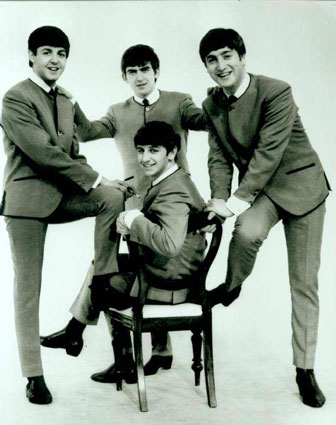
Hmm, if he really believes that, he clearly doesn't get out much - but leaving that aside, what about his objection that the tie is 'utterly useless'? So are lapels, of course, which no longer serve any practical function. Perhaps Paxo will be switching to a Beatle suit next? It wouldn't do much for his authority but it would give us all a laugh, and it would be one more 'utterly useless' item dispensed with.
The fact is, as Paxo surely knows, that clothes carry a freight of meanings, adding up to a message - often a very nuanced on - about who we are. That's why we have fashion: the fashion industry is semiology in action, creating and decoding tiny meanings (Barbey d'Aurevilly described dandyism as 'une maniere de vivre composee entierement des nuances'). If David Cameron were to appear on, say, Newsnight, in a tight pink tee-shirt, tartan braces and PVC trousers, his dress alone would say more than anything that came out of his mouth (and it wouldn't exactly be nuanced).
Paxman is of course taking a deliberately bluff, utilitarian view of male dress. In these reductionist terms, everything we wear is 'entirely useless', except in maintaining a comfortable body temperature and protecting our flesh. As well as carrying meanings and messages, the uses of dress are also aesthetic. As Max Beerbhom puts it in his essay on Beau Brummell, 'So to clothe the body that its fineness be revealed and its meanness veiled has been the aesthetic aim of all costume.' Indeed, and this is where the well chosen tie plays its part, completing the effect of the suit, adding an elegant vertical and a splash of harmonious colour, and (mark well, Paxo) veiling the meanness of the ageing male throat. I have a suggestion for Paxman: if you hate ties so much, why not do the sensible thing and switch to a cravat? The nation would love you for it.
Subscribe to:
Posts (Atom)
