Well, I am back from my latest jaunt into Derbyshire - and, this time, Nottinghamshire. The highlights included a walk in glorious autumn sunlight in Chee Dale - a dale I'd never even heard of, but a ravishingly beautiful one - and another good haul from the never-failing Wirksworth Bookshop: Sylvia Townsend Warner's The Corner that Held Them, J.G. Farrell's A Girl in the Head (which I've never read) and Pevsner's Nottinghamshire. It's the first edition (1951, price three shillings and sixpence) of what was only the second in the Buildings of England series, and hence it is comfortably small enough to slip into the pocket. It was to come in very handy as we made our way towards Southwell Minster...
My cousin was keen to take a look at Maplebeck, a village she had visited before years ago, and the Pevsner listing of a nearby, even smaller village, Winkburn, was intriguing enough to make us stop there and investigate. Winkburn has a manor house and church right next to each other - the house briefly visible from the road some way outside the village, but not the church; and when we arrived both had disappeared amid the trees. What was there was a large yard full of gleaming heavy machinery and the offices of some kind of contracting firm. Deep rural quiet, a cloudy Midland sky, and not a soul in sight, until a man in a white van drew up to ask us to move the car. From him we learnt that there was a path through the trees that would, despite appearances, lead to the church and the house.
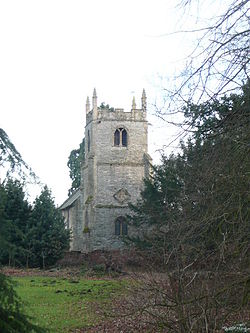
The trees were a mix of tall deciduous standards, all in their autumn colours, and dense plantings of laurel and holly and holm oak, and between them they did a very effective job of keeping house and church well hidden. Until suddenly, there was Winkburn Hall - a solid, elegant but unpretentious house of the early18th century - and, after a while, the church of St John of Jerusalem, Winkburn, also came into view, right by the house but more deeply hidden among the greenery. 'Platonic England, house of solitudes,/ rests in its laurels and its injured stone,/ replete with complex fortunes that are gone,/ beset by dynasties of moods and clouds...' (as Geoffrey Hill put it).
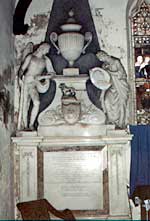
The church is small, unspoilt, essentially Norman, its tiny sunless graveyard almost overgrown, moss-greened baroque headstones just topping the lush grass. John Piper would have loved it. A plain, dark interior that feels as if little has changed since the family - the Burnells - inhabited (for nine generations) the big house. Their 'complex fortunes that are gone' are memorialised in a sober Jacobean monument (William Burnell, kneeling in conventional prayer) and a very much more flamboyant memorial to the last of the line, D'Arcy Burnell, who died in 1774. On either side the pedestal of a large urn stand Death, in the guise of a rather beautiful, underdressed young man holding an inverted torch, and Fame, in female form, holding a portrait profile of D'Arcy Burnell, Esquire. His long epitaph ends with a couplet from Pope's Essay on Man: 'A wit's a feather, and a chief a rod:/ An honest man's the noblest work of God.'
I'm tempted to say 'Only in England', but of course there are similarly well hidden, richly atmospheric and rewarding house-and-church ensembles to be found embedded among the byways of Normandy, and far beyond. Yet there is something peculiarly English about the atmosphere of a place - almost a non-place but for these two survivors - like Winkburn. And we, uniquely, have Pevsner to guide us toward them.
On a grander, more glorious scale, Southwell Minster did not disappoint. I hadn't been there for a good many years and had forgotten just how beautiful and astonishing the carved stonework of the chapter house - Pevsner's Leaves of Southwell (King Penguin, 1945) - and the screen/pulpitum is. The very ideal of Gothic craftsmanship - exquisitely wrought but spirited and mischievous, naturalistic, richly human and individual.
Then, on the final day, to Haddon Hall, my favourite Derbyshire house, 'the English castle par excellence', as Pevsner puts it, 'the unreasonable dream castle of those who think of the Middle Ages as a time of chivalry and valour and noble feelings'. Here all was as I remembered it, apart from a bizarre object plonked in the middle of one of the rooms. Clad in a grubby, hideously coloured textile (a kind of Seventies mustard yellow) and resembling a disassembled delta-wing aircraft, this was, I learnt, a sofa designed by Zaha Habib. How anyone would contrive to sit on it I have no idea; why anyone would buy it and put it on display, still less.
As for butterflies, the visit began with three Tortoiseshells and ended with two Speckled Woods, just as the sun came out, at Haddon Hall.
[The curious image at the top is a photograph of a sconce in Winkburn church, with a patch of baroque wall painting behind.]
Thursday, 29 October 2015
Sunday, 25 October 2015
A Sunday Ramble
Ever since seeing the Sickert in Dieppe exhibition in Chichester, I've been dipping into the accompanying book by its curator Katy Norris. It's a handsome volume, but better to look at than to read, the text being rather heavy on sociological-historical-political 'context' and critical jargon, and none too elegantly written. It is also, like so many books these days, peppered with solecisms and misprints. One that I've just come across is positively surreal:
'As Robert Upstone has noted, Sickert's painting of fisher-girls in Venice seem to fit this template [don't ask]. Similar to his exploration of Costa girls in London, for Sickert these women exemplified an outmoded working-class existence that had survived in spite of the upheavals in urban living...'
Leaving aside the illiterate use of 'similar to', what, you may ask, are 'Costa girls'? Surely the coffee-house chain had made no inroads into London in Sickert's time? I stared at the phrase for some while before the penny dropped - of course: coster girls! As portrayed above in a painting by William Rothenstein.
The young Rothenstein appears in person in Max Beerbohm's Enoch Soames, the first of the stories in Seven Men. The artist lands in Oxford from Paris like a meteorite, with a commission to draw 24 lithograph portraits: 'Dignified and doddering old men, who had never consented to sit to anyone, could not withstand this dynamic little stranger. He did not sue: he invited; he did not invite: he commanded. He was twenty-one years old. He wore spectacles that flashed more than any other pair ever seen. He was a wit. He was brimful of ideas. He knew Whistler. He knew Edmond de Goncourt. He knew everyone in Paris. He knew them all by heart. He was Paris in Oxford...' And among the subjects of his portraits is Max himself, who introduces Rothenstein to Enoch Soames, an obscure poet with a burning, wholly unfounded conviction that posterity will judge him the greatest of his age.
This conviction leads him to make a pact with the Devil, no less, that will grant him a visit to the Reading Room of the British Museum exactly 100 years hence, to examine the shelves and catalogues and determine the full extent of his posthumous fame. The date of his visit would be the 3rd of June, 1997, the time 2.10pm.
In November 1997, the Atlantic Monthly published 'A Memory of the Nineteen-Nineties (Being a faithful account of the events of the designated day when the man who had disappeared was expected briefly to return)' - an article by the illusionist 'Teller', of Penn and Teller fame. It's a great read - follow the link...
Which has taken us rather a long way from Costa girls and coster girls but, hey, it's Sunday. And tomorrow, DV, I'm off to Derbyshire for a few days.
'As Robert Upstone has noted, Sickert's painting of fisher-girls in Venice seem to fit this template [don't ask]. Similar to his exploration of Costa girls in London, for Sickert these women exemplified an outmoded working-class existence that had survived in spite of the upheavals in urban living...'
Leaving aside the illiterate use of 'similar to', what, you may ask, are 'Costa girls'? Surely the coffee-house chain had made no inroads into London in Sickert's time? I stared at the phrase for some while before the penny dropped - of course: coster girls! As portrayed above in a painting by William Rothenstein.
The young Rothenstein appears in person in Max Beerbohm's Enoch Soames, the first of the stories in Seven Men. The artist lands in Oxford from Paris like a meteorite, with a commission to draw 24 lithograph portraits: 'Dignified and doddering old men, who had never consented to sit to anyone, could not withstand this dynamic little stranger. He did not sue: he invited; he did not invite: he commanded. He was twenty-one years old. He wore spectacles that flashed more than any other pair ever seen. He was a wit. He was brimful of ideas. He knew Whistler. He knew Edmond de Goncourt. He knew everyone in Paris. He knew them all by heart. He was Paris in Oxford...' And among the subjects of his portraits is Max himself, who introduces Rothenstein to Enoch Soames, an obscure poet with a burning, wholly unfounded conviction that posterity will judge him the greatest of his age.
This conviction leads him to make a pact with the Devil, no less, that will grant him a visit to the Reading Room of the British Museum exactly 100 years hence, to examine the shelves and catalogues and determine the full extent of his posthumous fame. The date of his visit would be the 3rd of June, 1997, the time 2.10pm.
In November 1997, the Atlantic Monthly published 'A Memory of the Nineteen-Nineties (Being a faithful account of the events of the designated day when the man who had disappeared was expected briefly to return)' - an article by the illusionist 'Teller', of Penn and Teller fame. It's a great read - follow the link...
Which has taken us rather a long way from Costa girls and coster girls but, hey, it's Sunday. And tomorrow, DV, I'm off to Derbyshire for a few days.
Saturday, 24 October 2015
An (Almost) Invisible Poet
No Fool Like an Old Fool
From the shaving mirror peers a half truth:
Broken veins, pouches below the eyes, false teeth,
Grey stubble fringing the wet mouth.
When I tweak neck skin between finger and thumb,
It uncreases slowly. Hairs clog my comb.
I die in bits, yet stay the same.
My wife has had her own bedroom for years.
She used to say, taking guests' coats, 'He snores.'
The act died slowly. Now who cares?
She couldn't be bothered with children. She plays bridge.
These days even our minds rarely engage.
Other men's wives revive the itch.
I salivate for typists of seventeen.
A child trips: my knee registers his pain.
Behold a (quotes) dirty old man.
I weaken with wanting twenty times a day.
My loves, my executioners, turn away.
Timor mortis conturbat me.
Who wrote this cheery little number - Larkin perhaps? No, not Larkin but a now forgotten poet he much admired, Jonathan Price. He wrote it, incidentally, in his early thirties, so it's not autobiographical (which is a mercy).
I had never heard of Price until I read a short informal obituary of him in P.J. Kavanagh's collection, People and Places. Kavanagh and Price were contemporaries at Oxford in the early 50s, where Price co-edited several collections of new Oxford verse, including some of Geoffrey Hill's first published poems. Price was already getting his own work published in national magazines, and was clearly one of the most accomplished of his generation, admired by his contemporaries for his sure craftsmanship. 'His poems were small in scale and few in number,' writes Kavanagh, 'but the accuracy of their making gave them a force which shamed us in our windier attempts, or should have.'
Unlike many in the poetry world, Price projected almost nothing in the way of 'personality', seeming determined, as Kavanagh puts it, to be the Most Forgettable character you ever met. In drab postwar England, 'he wore the time's drabness like a cloak, a cloak of invisibility almost'. He spoke little, but something about his eyes - full of intelligence, laughter, even wisdom - showed that there was plenty going unsaid.
That 'curious and attractive laughter' in his eyes remained with him through life - as did his reluctance to project his personality or in any way push himself forward, with the result that he never really built, or attempted to build, a literary career. The poems remained small in scale and few in number, appearing at intervals in literary magazines and others that in those days published poetry. A few were anthologised, including this one, which turned up, rather improbably, in the Oxford Book of Love Poetry...
A Considered Reply to a Child
'I love you', you said between two mouthfuls of pudding.
But not funny; I didn't want to laugh at all.
Rolling three years' experience in a ball,
You nudged it friendlily across the table.
A stranger, almost, I was flattered - no kidding.
It's not every day I hear a thing like that;
And when I do my answer's never pat.
I'm about nine times your age, ten times less able
To say - what you said; incapable of unloading
Plonk at someone's feet, like a box of bricks,
A declaration. When I try, it sticks
Like fish-bones in my throat; my eyes tingle.
What's called 'passion', you'll learn, may become 'overriding'.
But not in me it doesn't: I'm that smart,
I can give everything and keep my heart.
Kisses are kisses. No need for souls to mingle.
Bed's bed, what's more, and you'd say it's meant for sleeping;
And, believe me, you'd be absolutely right.
With luck you'll never lie awake all night,
Someone beside you (rather like 'crying') weeping.
Price held down a succession of unglamorous editing jobs in publishing, and generally passed unnoticed through the world, except by those admirers who looked out for his poems and pounced on them as and when they turned up. Eventually, his old Oxford friend Anthony Thwaite persuaded him to collect together some of his poems for book publication and got Secker and Warburg to publish them. The resulting slim volume, Everything Must Go, was published in 1985 and attracted little notice, though a grateful Larkin wrote that 'this book will enable us to throw away the tattered cuttings we have kept so long'.
Here are a couple of poems from Everything Must Go (which can still be bought online for under a tenner)...
A Forked Radish
Small men make love on stilts, and hold their poise
A step or two; then tumble heavily.
Others dream up frail ladders to the stars:
They teeter at the end in empty sky.
Who strains the laces of his boots will fly
Sprawling to earth, lace broken, balance gone.
All fool themselves who wink at gravity,
And later hit the ground they should have won.
Wise to a body's pull, a few have done
Nothing but stand still, both feet on the ground.
These lovers grew together in the sun,
While a dark root a dark root gripped and bound.
Augury
Swift paused before a dying tree one day,
Whose rotten top told where his death would start.
There was no means of checking the decay.
The patient seldom sees his fever-chart
(A thoughtful doctor hides the thing away),
But guesses much from what he knows in part.
Knowledge of madness suffers a delay:
When the mind rots, no introspective art
Gives it a check upon its own decay.
When once the patient finds it in his heart,
It does not matter what the doctors say.
He guesses all from what he knows in part.
There is no means of checking the decay.
Looking back to Oxford days, Kavanagh writes 'Whereas our poems were carpentered from hope, bluff, half-understood emotion, his were those of a cabinet-maker who knew how to get the best from his materials; we put ours together with nails and glue and his were dowelled and mortised, his ideas slid in and out noiselessly, and hung true on their hinges.' And so it remained throughout his writing life - the more closely you examine Price's poems, the more impressive is the inconspicuous craftsmanship. They are spare, laconic and precise (note those punchy Larkinesque monosyllables), always formal in construction, but there is something more - an understated but strong personal voice - and it is easy to see why that voice, and that formalism, appealed to Larkin.
Sadly, Price died soon after Everything Must Go was published. This last poem is, alas, autobiographical...
Night Thoughts
Things past include a boy dangling a string,
Baited with meat scraps, into a dark pool.
Harmless and unharmed, small crabs sidle round
The bottom of a can. The wind turns cool,
The crabs are counted and tipped back where found,
The boy runs home for tea. A timeless thing.
Things change in time: it's the crab's turn tonight.
It gorges now on liver, will move on
From that to who knows what, and won't be caught.
I launch pills down to stun it. It has gone.
It has not gone. I wonder if I ought
To turn us both off like a bedside light.
From the shaving mirror peers a half truth:
Broken veins, pouches below the eyes, false teeth,
Grey stubble fringing the wet mouth.
When I tweak neck skin between finger and thumb,
It uncreases slowly. Hairs clog my comb.
I die in bits, yet stay the same.
My wife has had her own bedroom for years.
She used to say, taking guests' coats, 'He snores.'
The act died slowly. Now who cares?
She couldn't be bothered with children. She plays bridge.
These days even our minds rarely engage.
Other men's wives revive the itch.
I salivate for typists of seventeen.
A child trips: my knee registers his pain.
Behold a (quotes) dirty old man.
I weaken with wanting twenty times a day.
My loves, my executioners, turn away.
Timor mortis conturbat me.
Who wrote this cheery little number - Larkin perhaps? No, not Larkin but a now forgotten poet he much admired, Jonathan Price. He wrote it, incidentally, in his early thirties, so it's not autobiographical (which is a mercy).
I had never heard of Price until I read a short informal obituary of him in P.J. Kavanagh's collection, People and Places. Kavanagh and Price were contemporaries at Oxford in the early 50s, where Price co-edited several collections of new Oxford verse, including some of Geoffrey Hill's first published poems. Price was already getting his own work published in national magazines, and was clearly one of the most accomplished of his generation, admired by his contemporaries for his sure craftsmanship. 'His poems were small in scale and few in number,' writes Kavanagh, 'but the accuracy of their making gave them a force which shamed us in our windier attempts, or should have.'
Unlike many in the poetry world, Price projected almost nothing in the way of 'personality', seeming determined, as Kavanagh puts it, to be the Most Forgettable character you ever met. In drab postwar England, 'he wore the time's drabness like a cloak, a cloak of invisibility almost'. He spoke little, but something about his eyes - full of intelligence, laughter, even wisdom - showed that there was plenty going unsaid.
That 'curious and attractive laughter' in his eyes remained with him through life - as did his reluctance to project his personality or in any way push himself forward, with the result that he never really built, or attempted to build, a literary career. The poems remained small in scale and few in number, appearing at intervals in literary magazines and others that in those days published poetry. A few were anthologised, including this one, which turned up, rather improbably, in the Oxford Book of Love Poetry...
A Considered Reply to a Child
'I love you', you said between two mouthfuls of pudding.
But not funny; I didn't want to laugh at all.
Rolling three years' experience in a ball,
You nudged it friendlily across the table.
A stranger, almost, I was flattered - no kidding.
It's not every day I hear a thing like that;
And when I do my answer's never pat.
I'm about nine times your age, ten times less able
To say - what you said; incapable of unloading
Plonk at someone's feet, like a box of bricks,
A declaration. When I try, it sticks
Like fish-bones in my throat; my eyes tingle.
What's called 'passion', you'll learn, may become 'overriding'.
But not in me it doesn't: I'm that smart,
I can give everything and keep my heart.
Kisses are kisses. No need for souls to mingle.
Bed's bed, what's more, and you'd say it's meant for sleeping;
And, believe me, you'd be absolutely right.
With luck you'll never lie awake all night,
Someone beside you (rather like 'crying') weeping.
Price held down a succession of unglamorous editing jobs in publishing, and generally passed unnoticed through the world, except by those admirers who looked out for his poems and pounced on them as and when they turned up. Eventually, his old Oxford friend Anthony Thwaite persuaded him to collect together some of his poems for book publication and got Secker and Warburg to publish them. The resulting slim volume, Everything Must Go, was published in 1985 and attracted little notice, though a grateful Larkin wrote that 'this book will enable us to throw away the tattered cuttings we have kept so long'.
Here are a couple of poems from Everything Must Go (which can still be bought online for under a tenner)...
A Forked Radish
Small men make love on stilts, and hold their poise
A step or two; then tumble heavily.
Others dream up frail ladders to the stars:
They teeter at the end in empty sky.
Who strains the laces of his boots will fly
Sprawling to earth, lace broken, balance gone.
All fool themselves who wink at gravity,
And later hit the ground they should have won.
Wise to a body's pull, a few have done
Nothing but stand still, both feet on the ground.
These lovers grew together in the sun,
While a dark root a dark root gripped and bound.
Augury
Swift paused before a dying tree one day,
Whose rotten top told where his death would start.
There was no means of checking the decay.
The patient seldom sees his fever-chart
(A thoughtful doctor hides the thing away),
But guesses much from what he knows in part.
Knowledge of madness suffers a delay:
When the mind rots, no introspective art
Gives it a check upon its own decay.
When once the patient finds it in his heart,
It does not matter what the doctors say.
He guesses all from what he knows in part.
There is no means of checking the decay.
Looking back to Oxford days, Kavanagh writes 'Whereas our poems were carpentered from hope, bluff, half-understood emotion, his were those of a cabinet-maker who knew how to get the best from his materials; we put ours together with nails and glue and his were dowelled and mortised, his ideas slid in and out noiselessly, and hung true on their hinges.' And so it remained throughout his writing life - the more closely you examine Price's poems, the more impressive is the inconspicuous craftsmanship. They are spare, laconic and precise (note those punchy Larkinesque monosyllables), always formal in construction, but there is something more - an understated but strong personal voice - and it is easy to see why that voice, and that formalism, appealed to Larkin.
Sadly, Price died soon after Everything Must Go was published. This last poem is, alas, autobiographical...
Night Thoughts
Things past include a boy dangling a string,
Baited with meat scraps, into a dark pool.
Harmless and unharmed, small crabs sidle round
The bottom of a can. The wind turns cool,
The crabs are counted and tipped back where found,
The boy runs home for tea. A timeless thing.
Things change in time: it's the crab's turn tonight.
It gorges now on liver, will move on
From that to who knows what, and won't be caught.
I launch pills down to stun it. It has gone.
It has not gone. I wonder if I ought
To turn us both off like a bedside light.
Friday, 23 October 2015
Eleanor Glanville: Butterfly Mad
Good to
hear that the National Trust is buying more land on the Isle of Wight
by way of encouraging the rare and beautiful Glanville Fritillary, a butterfly
that occurs only on the extreme southern fringes of the British Isles - Wight
and the Channel Islands. Actually that's not quite true: the Glanville has been
reintroduced several times over the years in various parts of Southern England,
with varying degrees of success, usually short-term. One reintroduction that
seems to be working is, improbably, at a small nature reserve on the fringes of
Croydon - I'll be heading there next summer to have a look...
The Glanville Fritillary is almost the only British butterfly that is named after an individual (the other is Berger's Clouded Yellow, which hardly counts) - and what an individual! Eleanor Glanville, who died in 1709, was a pioneer lepidopterist, working at a time when very few men and no women were studying butterflies. Her collection and the extent of her knowledge astonished the men: she had, wrote William Vernon, 'the noblest collection of butterflies, all English, which has sham'd us'.
Though she was generally referred to as Lady Glanville, Eleanor had no such title, but was 'of good family' (her parents, great horticulturalists, first cultivated the delicious Ribston Pippin apple). She seems to have developed her interest in butterflies in her middle age, after the breakdown of her second marriage, to Richard Glanville, a violent man who once held a loaded and cocked pistol to her breast and threatened to shoot her dead.
She started corresponding with the small (all-male) band of butterfly collectors, and sending them specimens - one of which was to become the Glanville Fritillary, though it began life as the rather more prosaic Lincoln Fritillary, as Eleanor first caught it near that fine city. Eleanor Glanville was seriously interested in every stage of the butterfly - and moth - life cycle (and might have been the first person to refer to Geometrid larvae as 'loopers'). There's an incredulous eye-witness account of her larva-collecting methods: 'She and her two female apprentice girls would carry a sheet out under the hedges and bushes and with a long pole beat the said hedges and catch a parcel of worms.' Recently three original specimens from Eleanor Glanville's collection were rediscovered in the Sloane collection in the Natural History Museum.
After the marital breakdown, Eleanor's husband was determined to get his hands on her money by hook or by crook, on one occasion kidnapping one of her sons in the hope of getting him to disclaim his inheritance and transfer it to him and his new mistress. This kind of thing led Eleanor to arrange to leave the disposal of her estate in the hands of trustees. However, on her death, the will was disputed by her eldest son, on the grounds that his mother had gone mad. One of the signs, sure enough, was her pursuit of butterflies. As well as beating bushes to knock worms out, she had been seen chasing around all over the locality, often 'without all necessary cloathes' and even dressed 'like a gypsey'. In the end, the will was indeed upset and the eldest son inherited. It was agreed by one and all that no one 'not deprived of their sense should go in pursuit of butterflyes'.
The Glanville Fritillary is almost the only British butterfly that is named after an individual (the other is Berger's Clouded Yellow, which hardly counts) - and what an individual! Eleanor Glanville, who died in 1709, was a pioneer lepidopterist, working at a time when very few men and no women were studying butterflies. Her collection and the extent of her knowledge astonished the men: she had, wrote William Vernon, 'the noblest collection of butterflies, all English, which has sham'd us'.
Though she was generally referred to as Lady Glanville, Eleanor had no such title, but was 'of good family' (her parents, great horticulturalists, first cultivated the delicious Ribston Pippin apple). She seems to have developed her interest in butterflies in her middle age, after the breakdown of her second marriage, to Richard Glanville, a violent man who once held a loaded and cocked pistol to her breast and threatened to shoot her dead.
She started corresponding with the small (all-male) band of butterfly collectors, and sending them specimens - one of which was to become the Glanville Fritillary, though it began life as the rather more prosaic Lincoln Fritillary, as Eleanor first caught it near that fine city. Eleanor Glanville was seriously interested in every stage of the butterfly - and moth - life cycle (and might have been the first person to refer to Geometrid larvae as 'loopers'). There's an incredulous eye-witness account of her larva-collecting methods: 'She and her two female apprentice girls would carry a sheet out under the hedges and bushes and with a long pole beat the said hedges and catch a parcel of worms.' Recently three original specimens from Eleanor Glanville's collection were rediscovered in the Sloane collection in the Natural History Museum.
After the marital breakdown, Eleanor's husband was determined to get his hands on her money by hook or by crook, on one occasion kidnapping one of her sons in the hope of getting him to disclaim his inheritance and transfer it to him and his new mistress. This kind of thing led Eleanor to arrange to leave the disposal of her estate in the hands of trustees. However, on her death, the will was disputed by her eldest son, on the grounds that his mother had gone mad. One of the signs, sure enough, was her pursuit of butterflies. As well as beating bushes to knock worms out, she had been seen chasing around all over the locality, often 'without all necessary cloathes' and even dressed 'like a gypsey'. In the end, the will was indeed upset and the eldest son inherited. It was agreed by one and all that no one 'not deprived of their sense should go in pursuit of butterflyes'.
Wednesday, 21 October 2015
Latekeeper
Yesterday afternoon being warm and sunny, I was drawn magnetically to the Surrey Hills to enjoy the mellow sunshine and the glorious autumn hues, and to see what was flying. The sun did not disappoint, the trees and shrubs were in their autumn glory - maple and dogwood spectacular, beeches turning golden-bronze, abundant hips and haws, sloes, buckthorn and pink spindle berries - and the sun-raked views were breath-taking, but disappointingly little was flying. Apart, that is, from a number of red-bodied ichneumon wasps and tiresome swarms (I use the word advisedly) of ladybirds - the all-conquering Harlequin invaders, sadly. I had to knock dozens of the blighters off my clothes and hair. As for butterflies... well, none of the late fliers I might have expected (I was walking in prime butterfly country) - Brimstone, Red Admiral, Peacock, Tortoiseshell, Small Copper - not even a Speckled Wood. What I did see were two tired and faded Meadow Browns and - a real surprise, this - one remarkably fresh-looking Gatekeeper basking in the sun. A lovely sight, and extraordinarily late - I know Gatekeepers have been flying later in recent years, but October 20th, for heaven's sake? I wonder if anyone else has seen one recently...
Tuesday, 20 October 2015
Cuyp Cows
Born on this day in 1620 was Aelbert Cuyp, one of the great landscape painters of the Dutch Golden Age - and one of the most problematical for the experts. The biographical record is notably scant (and he seems to have given up painting, perhaps for religious reasons, while still at the height of his powers); he didn't date his pictures; and he was widely imitated, in his own time and long after. The scene above, bathed in a quite ravishing oblique golden light, shows him at his best. Only some cows standing by a river - but never so beautiful, so glorious...
Meanwhile, in another corner of the blogscape, I've written something about John Betjeman's Ghastly Good Taste.
Monday, 19 October 2015
En Retraite: Not Life Minus Work
So, Nige, they ask me, How are you finding this retirement lark? My immediate - and honest - response is, It's flippin' brilliant. What's not to like? No more hauling myself out of bed at an uncivilised hour, no more commuting, no more sitting for long hours glued to the tyrannical computer, no more 'management' nonsense and office politics, no more stupefying exhaustion, etc, etc - I'm sure you get the idea. But has retirement been what I expected it to be? Not entirely, no. For a start, what every recently retired person says is quite true: 'I'm so busy, I've no idea how I fitted the job in.' (Equally, I know I could never do the job again - all that ended within days of my retirement, falling away as if it had never been.)
When I looked forward to retirement, I made the elementary mistake of simply subtracting work from my everyday life, thereby (I assumed) opening up vast expanses of time in which I'd be doing all the things work prevented me from doing. Of course it doesn't work like that; retirement isn't life minus work, but rather a new life. For a start, all those things you couldn't do turn out to include a lot of things you'd no particular desire to do (e.g. shopping, jobs around the house and garden) - and the whole configuration of your life changes as all manner of things large and small flow in to fill the space opened up by retirement. At the same time, Parkinson's Law comes into operation, as work (in the widest sense) expands to fill the time available; it is now possible to take longer over something that once would be dashed off in no time, if done at all.
Another things is that life in retirement is still decidedly tiring - not in the bone-deep, spirit-sapping way that work tiredness is, but still tiring. Especially after a day spent with the adorable granddaughter, who, like all two-year-olds, is enchanting but exhausting company. And another unexpected development is that I no longer feel the urge to blog as often as I used to (though I still feel the urge, still enjoy blogging, and have no intention of giving it up). I realise now that much of my blogging was driven by the need to turn away from the tedium of work and engage my mind elsewhere - and now that imperative is no longer there. Which is great for me, but will probably mean that I'll be posting rather less often than I used to (if, perhaps, at greater length).
Happily, for all the busyness, there are plenty of occasions when I can and do savour my newfound leisure and put it to good use, taking more walks, visiting more places, devoting more time to reading and writing. Sometimes I even have the pleasurable, hitherto unknown sensation of not having anything in particular to do: time to do nothing, a vital element in life, I think, and all too rare, at least while we have to work. What's more, I feel no puritanical guilt about it: I figure that I've earned a good 25 years of leisure. That will take me to my 90s, at which point I might review the situation. Meanwhile, yes, it's pretty flippin' brilliant.
When I looked forward to retirement, I made the elementary mistake of simply subtracting work from my everyday life, thereby (I assumed) opening up vast expanses of time in which I'd be doing all the things work prevented me from doing. Of course it doesn't work like that; retirement isn't life minus work, but rather a new life. For a start, all those things you couldn't do turn out to include a lot of things you'd no particular desire to do (e.g. shopping, jobs around the house and garden) - and the whole configuration of your life changes as all manner of things large and small flow in to fill the space opened up by retirement. At the same time, Parkinson's Law comes into operation, as work (in the widest sense) expands to fill the time available; it is now possible to take longer over something that once would be dashed off in no time, if done at all.
Another things is that life in retirement is still decidedly tiring - not in the bone-deep, spirit-sapping way that work tiredness is, but still tiring. Especially after a day spent with the adorable granddaughter, who, like all two-year-olds, is enchanting but exhausting company. And another unexpected development is that I no longer feel the urge to blog as often as I used to (though I still feel the urge, still enjoy blogging, and have no intention of giving it up). I realise now that much of my blogging was driven by the need to turn away from the tedium of work and engage my mind elsewhere - and now that imperative is no longer there. Which is great for me, but will probably mean that I'll be posting rather less often than I used to (if, perhaps, at greater length).
Happily, for all the busyness, there are plenty of occasions when I can and do savour my newfound leisure and put it to good use, taking more walks, visiting more places, devoting more time to reading and writing. Sometimes I even have the pleasurable, hitherto unknown sensation of not having anything in particular to do: time to do nothing, a vital element in life, I think, and all too rare, at least while we have to work. What's more, I feel no puritanical guilt about it: I figure that I've earned a good 25 years of leisure. That will take me to my 90s, at which point I might review the situation. Meanwhile, yes, it's pretty flippin' brilliant.
Subscribe to:
Posts (Atom)