Friday, 30 June 2017

Beddoes: Algae and Pearls

Born on this day in 1803 was the death-obsessed poet Thomas Lovell Beddoes (son of the founder of the fun-loving Pneumatic Institute). He spent much of his troubled, rather short life abroad, studying and practising medicine, apparently in the hope of finding physical evidence of the immortal soul, and writing lyrical pieces, often fragmentary, and tragic dramas in a heightened Jacobean mode.
  As a dramatist, he lacked all the essentials (as did so many would-be playwright poets of the Romantic period) - but the best of his lyrics are something else, something quite unique. Edmund Gosse, in the preface to his 1890 edition of Beddoes' works, puts it like this: 'At the feast of the muses he appears bearing little except one small savoury dish, some cold preparation, we may say, of olives and anchovies, the strangeness of which has to make up for its lack of importance. Not every palate enjoys this hors d'oeuvre, and when that is the case, Beddoes retires; he has nothing else to give. He appeals to a few literary epicures, who, however, would deplore the absence of this oddly flavoured dish as much as that of any more important piece de resistance.' Ezra Pound talks of Beddoes in terms of 'a mass of algae and pearls' and 'the odour of eucalyptus or sea wrack'...
 This is his best-known, most anthologised lyric, a thing of seamless perfection:

Dream-Pedlary
 i

If there were dreams to sell,
     What would you buy?
Some cost a passing bell;
     Some a light sigh,
That shakes from Life's fresh crown
Only a roseleaf down.
If there were dreams to sell,
Merry and sad to tell,
And the crier rung the bell,
     What would you buy?

      ii

A cottage lone and still,
     With bowers nigh,
Shadowy, my woes to still,
     Until I die.
Such pearl from Life's fresh crown
Fain would I shake me down.
Were dreams to have at will,
This would best heal my ill,
     This I would buy.

      iii

But there were dreams to sell,
     Ill didst thou buy;
Life is a dream, they tell,
     Waking, to die.
Dreaming a dream to prize,
Is wishing ghosts to rise;
     And, if I had the spell
     To call the buried, well,
     Which one would I?

      iv

If there are ghosts to raise,
     What shall I call,
Out of hell's murky haze,
     Heaven's blue hall?
Raise my loved longlost boy
To lead me to his joy,
     There are no ghosts to raise;
     Out of death lead no ways;
     Vain is the call.

      v

Know'st thou not ghosts to sue?
     No love thou hast.
Else lie, as I will do,
     And breathe thy last.
So out of Life's fresh crown
Fall like a rose-leaf down.
     Thus are the ghosts to woo;
     Thus are all dreams made true,
     Ever to last!


  Here is Beddoes in livelier, but more macabre mode:

Old Adam, the carrion crow,
The old crow of Cairo;
He sat in the shower, and let it flow
Under his tail and over his crest;
And through every feather
Leak'd the wet weather;
And the bough swung under his nest;
For his beak it was heavy with marrow.
Is that the wind dying? O no;
It's only two devils, that blow,
Through a murderer's bones, to and fro,
In the ghosts' moonshine.

Ho! Eve, my grey carrion wife,
When we have supped on king's marrow,
Where shall we drink and make merry our life?
Our nest it is queen Cleopatra's skull,
'Tis cloven and crack'd,
And batter'd and hack'd,
But with tears of blue eyes it is full:
Let us drink then, my raven of Cairo!
Is that the wind dying? O no;
It's only two devils, that blow
Through a murderer's bones, to and fro,
In the ghosts' moonshine. 


  Here is one of Beddoes' favourite forms - a 'dirge':

If thou wilt ease thine heart 
Of love and all its smart, 
Then sleep, dear, sleep; 
And not a sorrow 
Hang any tear on your eye-lashes; 
Lie still and deep, 
Sad soul, until the sea-wave washes 
The rim o’ the sun to-morrow, 
In eastern sky. 

But wilt thou cure thine heart 
Of love and all its smart, 
Then die, dear, die; 
’T is deeper, sweeter, 
Than on a rose bank to lie dreaming 
With folded eye; 
And then alone, amid the beaming 
Of love’s stars, thou ’lt meet her 
In eastern sky. 


  And here's another dirge celebrating the romantic allure of death:

We do lie beneath the grass
In the moonlight, in the shade
Of the yew-tree. They that pass
Hear us not. We are afraid
They would envy our delight,
In our graves by glow-worm night.
Come follow us, and smile as we;
We sail to the rock in the ancient waves,
Where the snow falls by thousands into the sea,
And the drowned and the shipwrecked have happy graves.

  Finally, one more - an exquisite lyric that might have come straight from a Jacobean (even a Shakespearean) drama:


The swallow leaves her nest,
The soul my weary breast;
But therefore let the rain
On my grave 
Fall pure; for why complain?
Since both will come again
O'er the wave.
The wind dead leaves and snow
Doth hurry to and fro;
And, once, a day shall break
O'er the wave, 
When a storm of ghosts shall shake
The dead, until they wake
In the grave.

  The death-loving Beddoes took his own life (with poison) in Basel, at the age of 45, having written the same day to his executor, Revell Phillips: 'I am food for what I am good for - worms.'

Thursday, 29 June 2017

They Know Me So Well

'We know you better than you know yourself' declared Amazon in their latest email to me. Well, that's a bold claim, even for Amazon, so I thought I'd open this one and have a look...
  It seems the 'me' they know so well is some kind of alter ego of mine, with a lively interest in 'joggers' (they appear to be some kind of misshapen trousers) and 'combat work pants' (ditto), a chap who might well be tempted by the prospect of owning 140 jam/pickle jars, fancies owning a Hornby OO train set, and is keen to buy, er, women's dresses. Sometimes I wonder if these algorithm things are quite all they're cracked up to be.

Wednesday, 28 June 2017

A Momentous Withdrawal

Yesterday, unaccountably, I missed a momentous 50th anniversary - that of the first use of a bank cash machine (in Enfield, by cockney twinkler Reg Varney). Clearly it's time to dig this one out from the archives... Enjoy.

Monday, 26 June 2017

A Different Church

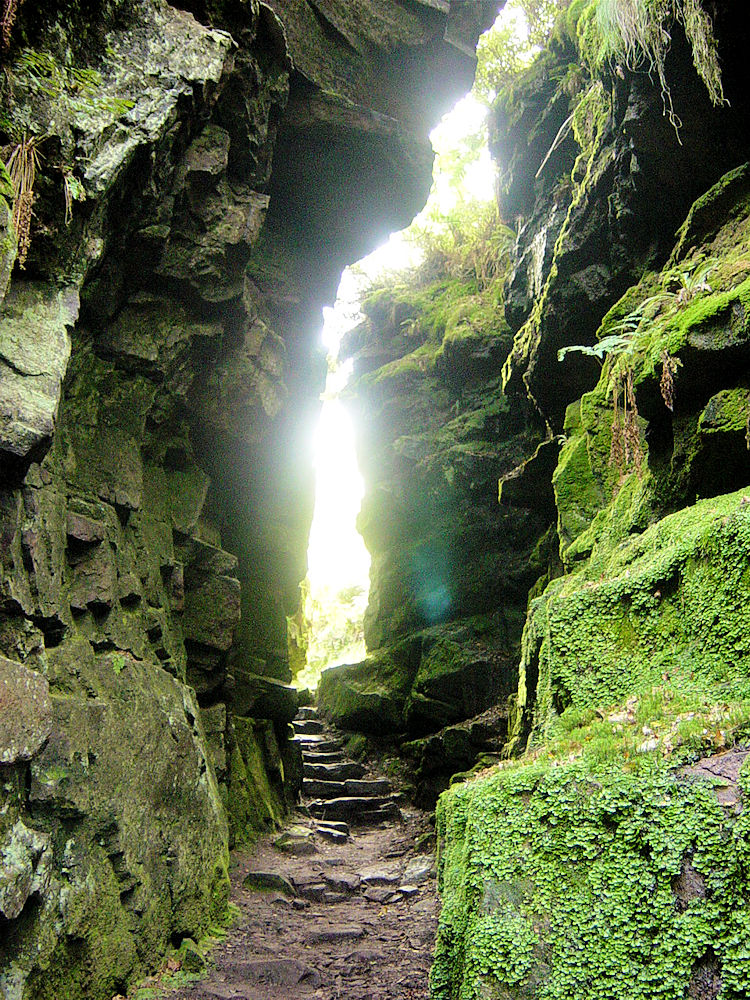
My church crawling took a new turn over the weekend when, with my cousin, I visited this one - Lud's Church in Staffordshire. Hidden away in woodland known as the Back Forest, in the White Peak, this deep, narrow, moss-grown chasm in the rocks can only be entered through even narrower passages at either end, from which steps lead down into a dank sunless world, with craggy rock faces towering on either side, and trees outlined against a narrow strip of sky above.
 It's a quite extraordinary place, with something of the feel of a naturally formed cathedral nave; indeed one of the more plausible legends about Lud's Church is that it was used for secret worship by persecuted Lollards. More fanciful tales about this handy hiding place have linked it to Robin Hood and Friar Tuck, Bonnie Prince Charlie and local Luddites  - from Lud, the legendary King of England who gave his name to London and Ludgate, to the equally legendary leader of the machine-smashers, Captain Ludd, by way of some local Lud whose name is otherwise lost.
 Others have identified Lud's Church with the Green Chapel where Sir Gawain kept his fateful appointment with the fearsome Green Knight. As the poem describes the chapel as a hollow grass-grown mound (suggesting a barrow), this seems more than fanciful. However, Lud's Church would have made a perfect setting for the climactic drama; it's easy to imagine the sound of the Green Knight's axe-grinding echoing off the walls of the chasm as a trepidatious Gawain steps down into its depths.

Thursday, 22 June 2017

Donald's Dream

Here's Donald Tusk, president of the European Council, quoting John Lennon's Imagine today, a propos his dream of a repentant UK seeing the error of its ways and rejoining the EU: 'You may say I'm a dreamer [twinkly pause] but I'm not the only one.' And here's me quoting the late Fleet Street legend Sir John Junor: 'Pass the sick bag, Alice.'
  Donald Tusk is a distressing enough phenomenon in himself, but Donald Tusk quoting Imagine is beyond endurance. Maybe it's time for the EU to drop the Ode to Joy as its anthem (I'm sure Beethoven would be relieved) and replace it with Imagine. 'Imagine there's no countries, It isn't hard to do...' (Isn't it? I can't even imagine no counties - talking of which, I'm off to Derbyshire for the weekend.)

Wednesday, 21 June 2017

Monuments and Fritillaries

Having made a fine job of cataloguing some 210,000 paintings in public collections in the UK - many of them in store or otherwise unavailable to the public - Art UK now plans to do the same for the nation's sculpture. This is excellent news - but, if I read the description of the project's remit rightly, it seems to omit a hugely significant part of the national sculpture collection: the monuments that stand in our churches. Those in Westminster Abbey alone constitute one of our greatest national collections, but more to the point, so many of the very best sculptures of every period (but particularly the 16th, 17th and 18th centuries) are scattered around the country, often in very out-of-the-way churches, many of which are more or less permanently locked. To be able to access images and descriptions of these works online would surely enhance appreciation of an undervalued treasury of sculpture (as well as, ahem, being an invaluable resource for those of us engaged in writing about English church monuments)...


Meanwhile, the heat wave continues - rather wearing for us humans, but great news for the butterflies. On Monday I was out among them on a favourite hillside haunt, where Marbled Whites were flying in great abundance - even more perhaps than last year - and I saw not one, not two (the suspense!) but six Dark Green Fritillaries [below], each seen individually and all in flight, but unmistakable, and very beautiful. Then this morning, on Ashtead common, I found large numbers of my favourite White Admirals flying, along with slightly smaller numbers of spectacular Silver-Washed Fritillaries. After a run of dismal Junes, these past couple of weeks have been a joyful reminder of what this glorious month can be.

Monday, 19 June 2017

Still a Serious House on Serious Earth

I was delighted to come across this story - not only because it contradicts the received (wishful?) thinking that church congregations are old and dying out, but because of what it says about the church's attempts to woo young people. It is not, it seems, 'youth groups' or the infantile Youth Alpha course that are attracting them, but the 'old hat' stuff: prayer, bible reading, spiritual experiences - and visiting churches and cathedrals. The numinous force field of these buildings - regarded by some of the more go-ahead clergy as nothing more than 'plant' - is drawing young people into the world of faith.
 And yet - as I, an inveterate church-crawler, know only too well - many of these churches stand more or less permanently locked against the world. Let's hope these new findings will boost the Bishop of Worcester's admirable campaign to persuade more parishes to keep their churches open. If you want to 'bring people in' to the church, it would surely make sense to let them in to our churches.