For Ronald Firbank, a man of few coherent words, the highest praise he could give a work of art or literature was to describe it as 'very restful'. Now we live in a time where the great assertive cliche about art - used to defend new art and retrospectively to boost older art - is that it is the opposite of restful, that it shakes you up and disturbs you. Clearly this is not definitive, any more than 'very restful' is, but I wonder if we shouldn't be standing up for the restful quality of much of the best art. Think Bach, think Matisse, think Wallace Stevens. Think Geoffrey Hill? Surely not - but the reason I'm writing this is that, in the midst of my current difficulties, I'm settling down at the end of the day in a thoroughly restful way with Hill's The Triumph of Love, a few stanzas of which has me, to my surprise, in a state of mental repose just right for entering the realm of sleep (no, scoffers, he is not actually sending me to sleep). This is odd, as Hill is a notoriously obscure and rebarbative poet, and The Triumph of Love has been described as 'a raw exposed nerve of a work', 'hectoring, philosophical, bitter', 'exacting, academic, unbending' and more in the same vein. It is, after all, the poem in which Hill forces himself to tell us what a poem 'ought to be' - 'a sad and angry consolation'. On the other hand, Elaine Feinstein, describes The Triumph of Love as 'an extraordinarily lucid and often luminous poem' - and that is more like how it strikes me. Not lucid in the sense of easily (or, in some places, at all) understood, but in the sense of at least seeming to carry forward an argument, a process, with a kind of stately clarity of purpose, whatever the bitter and angry notes. Perhaps, in the end, it is simply the conformation of words - the flow of those mighty measures, the epic sweep - that I feel as restful, as they wash over me in my drowsy state...
'So what is faith if it is not
inescapable endurance? Unrevisited, the ferns
are breast-high, head-high, the days
lustrous, with their hinterlands of thunder.
Light is this instant, far-seeing
into itself, its own
signature on things that recognize
salvation. I
am an old man, a child, the horizon
is Traherne’s country.'
That is lucid and luminous enough, surely (and beautiful). Restful? Maybe that's only me, and only this week...
Wednesday, 27 January 2010


Tuesday, 26 January 2010
Still Read
A while back, I mentioned as a forgotten giant of English letters Hugh Walpole - now, I assumed, one of the great unreads. Picture my surprise then (no, don't - it was early in the morning and I was not at my best) when on the train I noticed that the damned thick square book the woman opposite me was reading was The Fortress by Hugh Walpole, the second of the Herries Chronicles. The reader, in her 30s I'd say, seemed thoroughly engrossed - and it wasn't a dusty old edition from a charity shop but a very recent reprint. Walpole, it seems, is still read.
Sunday, 24 January 2010
Two and a Half Men and One Novel

Sorry the posting has been so scant lately. My working life (roll on its end) is in a peculiarly demanding phase at the moment and, as a result, is occupying far far more of my time, attention and mental activity than is compatible with doing anything much else. Typically, working days have been ending with the wrung-out wreckage of me slumped in front of Comedy Central watching back-to-back Two And A Half Men and wishing it was Frasier. Actually, though, Two And A Half Men is a pretty remarkable sitcom of the 'no hugs, no learning' school. Charlie Sheen plays a rich, sex-addicted sociopath (no typecasting there) who shares his home with his uptight divorced brother - equally sex-obsessed but fiasco-prone - and the brother's weird kid. In the background is the brothers' sex-addicted sociopath mother, and in the foreground, acting as a kind of Chorus, is their sharp-tongued, biker-built housekeeper, the force that actually rules the household and keeps it together. In most episodes the plot revolves around the sexual rivalry of the brothers, culminating in Charlie's invariable routing and humiliation of his sad sap of a brother. See - what's not to like? The fact that it's actually funny says much for the sharpness of the scriptwriting. A British version of this would be utterly witless and unwatchable... So those are my well-spent evenings, followed by coma-like but too brief sleep, then back into the workstorm. On a more exalted level, I have managed to read along the way another William Maxwell, They Came Like Swallows. As short as So Long See You Tomorrow, but from much earlier in Maxwell's career, it is every bit as deft and heartbeakingly precise, with never a word wasted and the author's immersion in his characters and their world total. Set in 1918 during the influenza epidemic, it tells its desperately sad (and semi-autobiographical) story through the eyes of two very different brothers and their father. To say more would be to give too much away to any who haven't read it, but it is a quite extraordinary book, one that is impossible to finish without tears. And now I'm reading more V.S.Pritchett short stories... Life goes on - and will return to something much more liveable and leisurely before long. It can't be too soon. (The picture is in honour of Edouard Manet's birthday yesterday.)
Tuesday, 19 January 2010
Such Sad News...
Any Excuse for a Cezanne
 And the excuse is that it's his birthday (born 1839), and that this - L'Etang des Soeurs - is a very beautiful painting, before which I've stood many a time in the Courtauld Gallery, and that I'm up to the oxters in work at NigeCorp and my spirits need a lift. So why not share that lift? And, talking of lifting the spirits, the Venice Daily Photo blog is on great form, full of glorious images of Venice in winter.
Sunday, 17 January 2010
How's About You?
I've been listening to an album, Friend of a Friend, by David Rawlings, long-time collaborator of Gillian Welch (and Ryan Adams), this time in the guise of the Dave Rawlings Machine. Gillian features throughout, as writer and performer, but David is in the foreground. It's a little too patchy to be a great album - you get the impression that without the ferociously driven Gillian in the driver's seat, Rawlings is quite happy to idle (and he's such a damn fine guitarist that it's a pleasure to hear him even when he's not trying). The high point is an extraordinary 'medley' in which Conor Oberst's Method Acting merges into Neil Young's Cortez the Killer (a song in which, by contrast with Oberst's, it's best not to listen to the words). But there's one song that perfectly illustrates the Welch-Rawlings ability to write new songs that sound as if they've been around for ever - it's How's About You?, which anyone would confidently date to 1930 or thereabouts, but is fresh minted by Gillian and David. Enjoy it here - and be warned, it's damnably catchy...
The School Prints
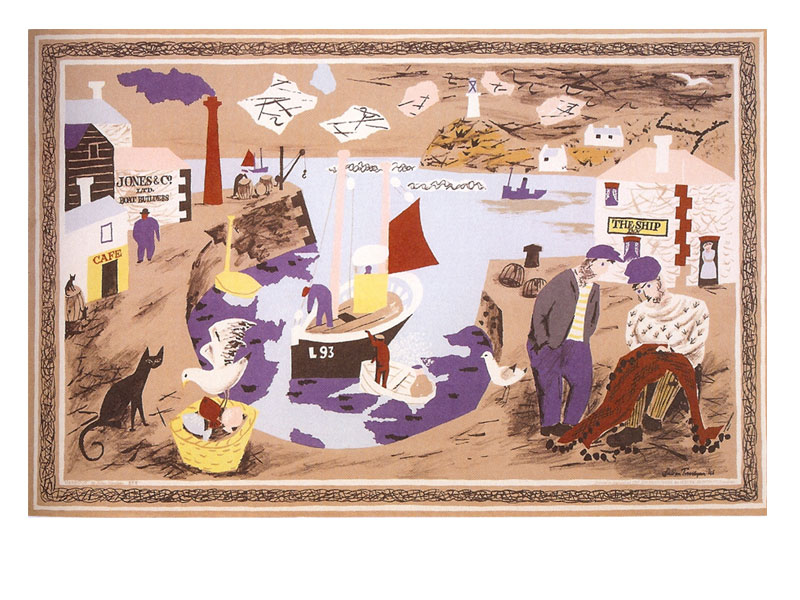 For me, it was Rembrandt's Portrait of His Mother (the one in the Royal Collection), in a black-and-white reproduction in an encyclopaedia. I was 9 or 10 at the time, and this was the first picture I saw that moved me, and gave me an inkling of what a painting can do to a person. Later, at grammar school, I found the main corridor dotted with colour reproductions, faded and cyanosing, among which I remember The Fighting Temeraire, Flatford Mill, a Matisse with a bowl of goldfish, a blue period Picasso. All these tooks me farther along the path, inspiring me to seek out art books at the library, begin my (amateur) education in art, and discover what was to be a major source of pleasure and much more for the rest of my life. What I did not see - and wish I had - in my formative years were the School Prints. These were the brainchild of a remarkable woman, Brenda Rawnsley, arts campaigner, art education activist and wartime WAAF Squadron Officer, who in 1945 took over a company called School Prints Ltd and gave it a new lease of life by getting an impressive roster of contemporary artists to create limited-edition prints which could be sold at low price to schools, giving them a taste of good modern work to sharpen children's appreciation and enjoyment of art. She soon had the likes of John Nash, Julian Trevelyan (that's his jolly Harbour above) and Feliks Topolski signed up, producing characteristic work that made little or no concession to being 'for the children'. These colourful and lively works would at the time have seemed far more avant-garde than they do now, when they have gained a nostalgic period charm. Before long Rawnsley was going international, persuading the likes of Dufy, Matisse, Picasso and Braque to sign up. Sadly, however, the launch of the international series coincided with Sir Alfred Munnings' idiotic but highly influential tirade against Picasso and Matisse at the Royal Academy's 1949 annual dinner. British public opinion naturally swung behind Munnings, and the series flopped, leaving Rawnsley with large numbers of unsold prints and larger debts. This was the end of a brave and brilliant experiment, which must have done much to open the eyes and stir the imaginations of those children lucky enough to have had School Prints on the walls of their school. Rather wonderfully, a lot of them can still be bought (at rather higher prices than Brenda Rawnsley envisaged) - you can see them, with a short account of the School Prints project, here.
Subscribe to:
Posts (Atom)
