My recent fiction reading has been something of a rollercoaster ride. Reeling from the impact of the horrific Lord Jim at Home, I took refuge in P.G. Wodehouse, whose works are a sovran balm for most of life's ills. I read and enjoyed Service with a Smile (1961), a Blandings novel in which the eternally youthful Uncle Fred sorts out a range of knotty problems presented by various combinations of misunderstandings, impostures, disapproving aunts and crossed wires, all to universal satisfaction – service with a smile indeed. I laughed several times in every chapter – what more could you ask? With my spirits restored, I next took from the shelf a volume I had been meaning to read for some while – Peter de Vries's The Blood of the Lamb. A long time ago – it would have been in the late Seventies and early Eighties – I was a huge fan of Peter de Vries's comic novels, reading them voraciously, and I know that at some point I did read The Blood of the Lamb, but I cannot remember how I responded, nor had I remembered anything about the book itself. I think now that, at the time, it simply bounced off me: I was too young.
The fine line between comedy and tragedy has often been remarked upon, and it's commonly said that the best comedy comes edged with something dark, even tragic (which clearly does not apply to P.G. Wodehouse). It's certainly true that few writers can write equally convincingly in the comic and the tragic mode, especially in the course of a single work – yet that is what De Vries does in The Blood of the Lamb, which is, for much of its length, an essentially comic novel, but one in which tragedy strikes again and again: I can't recall another modern novel in which so many leading characters die (most of them, in this case, of a single affliction – TB). The narrator is one Don Wanderhope, raised in a strict Dutch Reformed household in Chicago, and his voice is much like that of any other Peter De Vries narrator, except that while telling his tale he is engaged in an epic argument, a battle even, with God, the God who could allow all these cruel deaths to happen. For about the first two thirds of the book, the comedy somehow remains dominant, despite all that is going on, but the rest of the novel is something else, something utterly heartbreaking, at times almost unbearably so. A reviewer in the TLS wrote that 'those who have laughed with De Vries in the past and during this book will not begrudge him their tears'. And I did not begrudge him mine, but once again I was left shaken and in need of a fictional calmative.
Happily I found just the thing on the shelves of my favourite charity bookshop – a Barbara Pym that I hadn't read, The Sweet Dove Died. I'm about two thirds of the way through, and loving it. I'll probably have more to say about it soon...
Wednesday, 6 March 2024
Novels


Monday, 28 September 2009
Peter de Vries
I remember reading him voraciously, back in the day, finding him an uneven but fascinating, and often very funny, novelist. Daniel Dennett has described him as 'probably the funniest writer on religion ever', and there always seemed to be in his better writings a strong tension between his fascination with religious questions and his easy way with a reductive witticism. He was raised in the Dutch Christian Reformed Church, and yet his wisecracking often sounds distinctly Jewish, in the key of Woody Allen. In the end, it was the wisecracking that won out, as De Vries turned out comedy after comedy with an almost garrulous facility. This array of quotes catches his distinctive flavour, that mix of easy gags and deeper insights. One of his aphorisms that doesn't make the cut is 'I've got a big crush on myself, but it's not reciprocated', which strikes me as a pretty good summing-up of how many of us feel about ourselves - or is that just me? And one that's guaranteed to fall every bit as flat in real life as it does in the book it's taken from - 'For I have premises to keep, and miles to mow before I sleep...' You've got to like it though - just as you've got to like De Vries, surely, if nothing else, one of the most likeable of writers.
Saturday, 27 February 2010
Centenary
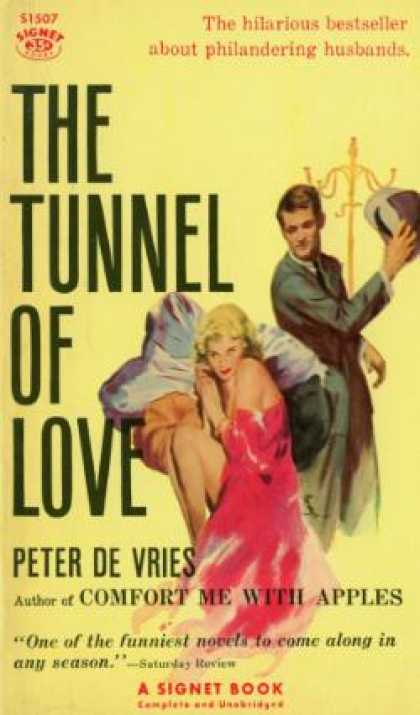 Today is the centenary of the birth of Peter De Vries. Having marked the anniversary of his death a while back, I could hardly let the date pass. The accompanying illustration is a piquant reminder of how De Vries was marketed at the height of his fame, at the time when, as he put it himself, 'Everybody hates me because I'm so universally liked'. Those were the days...
Sunday, 9 June 2024
Cole, Ella, Ernest
Born on this day in 1891 (in Peru – Peru, Indiana, that is) was one of the 20th century's greatest songwriters, Cole Porter. Let's mark the occasion with perhaps his greatest interpreter, the incomparable Ella Fitzgerald, singing 'Alway True to You in My Fashion'...
The title and refrain of this song were inspired by a poem by the Decadent 1890s poet Ernest Dowson, 'Non Sum Qualis Eram Bonae Sub Regno Cynarae' (or, more simply, 'Cynara'). The poem also includes the phrases 'gone with the wind', which became the title of an epic novel and film, and 'madder music', which gave its name to a Peter de Vries novel. It is, as you might expect, an altogether different kettle of fish from Cole Porter's song, but is very fine in its way:
There fell thy shadow, Cynara! thy breath was shed
Upon my soul between the kisses and the wine;
And I was desolate and sick of an old passion,
Yea, I was desolate and bowed my head:
I have been faithful to thee, Cynara! in my fashion.
All night upon mine heart I felt her warm heart beat,
Night-long within mine arms in love and sleep she lay;
Surely the kisses of her bought red mouth were sweet;
But I was desolate and sick of an old passion,
When I awoke and found the dawn was grey:
I have been faithful to thee, Cynara! in my fashion.
I have forgot much, Cynara! gone with the wind,
Flung roses, roses riotously with the throng,
Dancing, to put thy pale, lost lilies out of mind;
But I was desolate and sick of an old passion,
Yea, all the time, because the dance was long:
I have been faithful to thee, Cynara! in my fashion.
I cried for madder music and for stronger wine,
But when the feast is finished and the lamps expire,
Then falls thy shadow, Cynara! the night is thine;
And I am desolate and sick of an old passion,
Yea, hungry for the lips of my desire:
I have been faithful to thee, Cynara! in my fashion.
Wednesday, 3 February 2010
Mottos
Monday, 5 May 2025
Swifts and Mowing
Time was when this blog could be relied on to hail the arrival of the first swift of the summer – a moment as thrilling and heart-lifting (for me) as the sighting of the first butterfly – but somehow I seem to have got out of the habit. For the record, though, I saw my first Lichfield swift this year on the 2nd of May, a little earlier than usual, no doubt because of the unusually welcoming spring weather. Just the one, passing over, but then, the next day, a pair putting on a fine aerial ballet as they circled and swooped, fluttered and raced, chasing down the airborne insects.
These have been busy days chez Nige, with much family activity, but this afternoon I had time for an activity I find quietly therapeutic and, in its way, pleasingly productive – mowing the lawn. The whole business has been so much more pleasurable since I ditched the electric mower and converted to manual – no cables, no fuss, no hideous noise, just a soft nostalgic clatter and rasp as the blades rotate and cut. Now I am on to my second hand mower, much superior to the first, and bearing the reassuringly English name of Webb (the first was a Bosch, of all things). Always, inevitably, when I'm mowing, Larkin's 'Cut Grass' comes into my head – one of the very few poems I still have by heart:
Cut grass lies frail:
Short is the breath
Mown stalks exhale.
Long, long the death
They die in the white hours
Of young-leafed June
With chestnut flowers,
With hedgerows snow-like strewn,
White lilac bowed,
Lost lanes of Queen Anne's lace,
And that high-builded cloud
Moving at summer's pace.
Larkin was a reluctant but diligent mower, who, when he moved to a house in Newland Park, Hull, had a lot of lawn to deal with ('for I have premises to keep, and miles to mow before I sleep' – not Larkin but a wag in a Peter de Vries novel). 'It has a huge garden –,' he wrote to Judy Edgerton, a regular correspondent, 'not a lovely wilderness (though it soon will be) – a long strip between wire fences – oh god oh god – I am 'taking over' the vendor's Qualcast (sounds like a character in Henry James).' It was an incident involving the Qualcast – a machine that is now preserved for posterity in the Larkin archive in Hull – that inspired Larkin's other great mowing poem, 'The Mower' –
This would not have happened with a hand mower – just sayin'.
(Incidentally, the ending of 'The Mower' was once quoted on The Archers – a moment almost as surreal as the time Nigel Pargetter, not the sharpest knife in the box, suddenly started spouting lines from the Georgics, in the original Latin. Even more incidentally, Larkin was a fan of The Archers, and used to fantasise about writing for them. That might have been interesting...)
Tuesday, 14 April 2026
'These touching lines...'
I have never seriously kept a commonplace book, but I have long had a habit of jotting down, usually in scrappy little notebooks, short quotations from things I'm reading or have come across. I lost several such notebooks some years ago when my bag mysteriously disappeared in the course of a Tube journey (presumably nicked), but I did start another one – and yesterday, while looking for something else altogether, I came across it in a pocket of my current bag, and spent a while browsing in its dog-eared pages.
The first entry is this, written by an early reader of the anonymously published In Memoriam: 'These touching lines evidently come from the full heart of the widow of a military man.' The last is a quotation from Michael Oakeshott (one of several): 'All great works of art have a touch of lightness, happiness, almost inconsequence, and this saves us from being oppressed, and having to turn away from them.' There's even a quotation from Nietzsche along similar lines: 'What is good is light. Everything divine runs on delicate feet.' Near these are a couple of God quotations: 'Believe in God, and don't put anything past Him' (Peter de Vries, The Blood of the Lamb) and 'The bastard! He doesn't exist!' (Samuel Beckett: Endgame). Beckett turns up several times: I particularly like 'Ah yes, I was always subject to the deep thought, especially in the spring of the year' (Malone Dies), and – this in response to the question 'What's the matter with you?' – 'I tried to look like one with whom that only is the matter which is native to him' (The Calmative). Don't we all?
Here is Oscar Wilde on Max Beerbohm: 'God has conferred on him the priceless gift of perpetual middle age.' And James Russell Lowell on Keats: 'The moral seems to have so perfectly interfused the physical man, that you might almost say he could feel sorrow with his hands.' And Ivy Compton-Burnett on Trollope: 'Yes, he is good. He is so good one wonders why he isn't better.' And Guy Davenport on Kafka: 'Like Kierkegaard, he saw the absurdity of life as the most meaningful clue to its elusive vitality. His humour authenticates his seriousness: "Only Maimonides may say there is no God; he's entitled"' – there's God again. I think that's enough for now.
