Tuesday, 31 March 2009
The Clinching Plug
It's the 88p bathplug that really does it, isn't it? Well, that and claiming for both the fireplace and the coal to burn in it. Mind you, she did well getting her cooker connected for £15 - that must have been cash in hand...


A Darwinian Crunch?
I don't suppose this is an original insight (if insight it be), but I wonder
if - accepting, for the sake of argument, the Darwinian paradigm - the
current credit crunch-recession-depression fiasco wer'e living through, or
are about to, illustrates the fact (proposition rather) that not only can
human kind not bear very much reality, it cannot cope with much success, or
excess, or even achieving the ends of its various compelling drives. Could
it be that, programmed by scarcity and endless struggle and strife, we have
yet to learn how to cope, what to do, when we achieve a degree of security
and abundance and comfort - and that when we find ourselves living amid the kind of superabundance and unheard-of security and comfort that the 'developed world' (a Darwinian notion in itself) has achieved, the likelihood is that we'll go completely off the rails, the very drives and imperatives that got us there now herding us over the cliff, like so many Gadarene swine, and down to perdition? 'Adaptive' becomes destructive. Is this a factor at least in the cyclical collapses and depressions that seem to plague all advanced economies - that we simply don't know when or where to stop, that we have to keep pressing on until we hit the jagged rocks and are sunk and done for? I guess if I fully believed in the Darwinian paradigm, I might ask if and when human kind might adapt to cope with success and not turn it into catastrophe
- though surely the time scales involved in such calculations are too short for evolutionary processes to be involved. We might be wiser, I suspect, to turn away from Darwinism and consult wisdoms more ancient, yet more far-seeing, if we wish to be saved from ourselves - those wisdoms that tell us to rein ourselves in, to examine our hearts and souls, to stop and think and look around us, and consider what we are. If it's not too late.
Meanwhile, there's the racist argument. According to the South Americans, it was us blue-eyed gringos who got the world into this mess; and Sarko blames everything on the 'Anglo-Saxons' and is muttering about walking out on the London G20whateveritis jamboree. Zut alors!
if - accepting, for the sake of argument, the Darwinian paradigm - the
current credit crunch-recession-depression fiasco wer'e living through, or
are about to, illustrates the fact (proposition rather) that not only can
human kind not bear very much reality, it cannot cope with much success, or
excess, or even achieving the ends of its various compelling drives. Could
it be that, programmed by scarcity and endless struggle and strife, we have
yet to learn how to cope, what to do, when we achieve a degree of security
and abundance and comfort - and that when we find ourselves living amid the kind of superabundance and unheard-of security and comfort that the 'developed world' (a Darwinian notion in itself) has achieved, the likelihood is that we'll go completely off the rails, the very drives and imperatives that got us there now herding us over the cliff, like so many Gadarene swine, and down to perdition? 'Adaptive' becomes destructive. Is this a factor at least in the cyclical collapses and depressions that seem to plague all advanced economies - that we simply don't know when or where to stop, that we have to keep pressing on until we hit the jagged rocks and are sunk and done for? I guess if I fully believed in the Darwinian paradigm, I might ask if and when human kind might adapt to cope with success and not turn it into catastrophe
- though surely the time scales involved in such calculations are too short for evolutionary processes to be involved. We might be wiser, I suspect, to turn away from Darwinism and consult wisdoms more ancient, yet more far-seeing, if we wish to be saved from ourselves - those wisdoms that tell us to rein ourselves in, to examine our hearts and souls, to stop and think and look around us, and consider what we are. If it's not too late.
Meanwhile, there's the racist argument. According to the South Americans, it was us blue-eyed gringos who got the world into this mess; and Sarko blames everything on the 'Anglo-Saxons' and is muttering about walking out on the London G20whateveritis jamboree. Zut alors!
Monday, 30 March 2009
Great Boots 2: Van Gogh
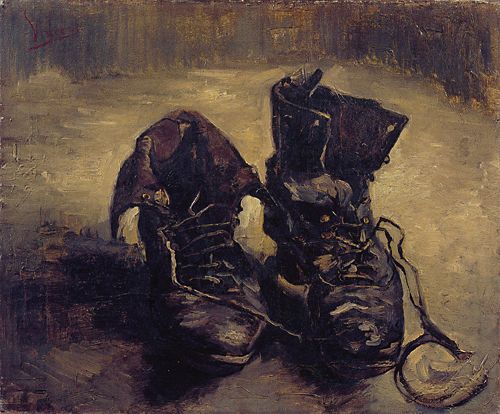
Van Gogh, eh? What is one to make of Vincent Van Gogh (born on this day in 1853)? Famously obscure and uncommercial in his day, famously mad and insortbale, now famouly popular, famously expensive, and the model for every would-be self-expressive wielder of a laden brush and a springy palette knife. His late work, so easily approximated, so loud and shrill in its effects, I now find hard to take - but as an adolescent, of course, I was besotted by the spectacle and by its dangerous psychotic edge (a taste we all lose, I think, if we have any contact with the unglamorous realities of psychosis). Certainly Van Gogh painted masterpieces in his Provencal years, and they survive, I think, their popularity and endless reproduction. But as I grow older, I prefer the quieter, less insistent works that he created before the sun and the psychosis got to him - even those muddy scenes of Dutch peasant life - and some of his drawings are wonderfully rewarding; he was undoubtedly a great draughtsman. The auction prices Van Gogh's canvases fetch now have long floated free from any notions of intrinsic value, but what does seem extraordinary is that works regarded barely a century ago as so challenging that they could hardly be looked at are now 'easy' default art for money-burners, and hang on a million suburban living room walls. Will it last? I suspect that, as with the French Impressionists (who have followed a similar trajectory), it will: Van Gogh is instantly identifiable, easily read (now), had obvious sock-in-the-eye appeal - and, on top of all that, he is, in the end, I think, a great artist.
The title of this post, by the way, refers back to this one.
Sunday, 29 March 2009
In the Busy Traffic's Boom...
A feature of my Kentish walk (see below) that is already, I suspect, being discreetly edited out of my memory is that it involved twice crossing the M25 - once by footbridge, once by underpass. Crossing a motorway by pedestrian bridge is a strange experience, the very opposite of driving along one in a car. Cosily insulated within a quiet, smooth-running modern motor car, one has little sensation either of speed or of noise. Looking down from a bridge at the passing traffic, one is only too aware both of the relentless din of traffic and of the astonishing speed at which it hurtles past, each vehicle creating its own Dopler whoosh as it passes. The necessity of making two crossings meant that a portion of the route was walked within the extensive 'aural footprint' (as I suppose it is called) of the motorway. To the eye, all was glorious, convincingly 'unspoilt' countryside - but the ear told another story, the sad truth that we live in a car-dominated, car-connected, car-ravaged land. The insistent roar of the motorway was an unwelcome accompaniment, but it gave the walking a certain bittersweet edge, making the survival of such beautiful country so close to the ever-spreading suburbs seem even more precarious, and even more to be cherished.
Then, today, out for a local stroll, I was walking at speed along an always busy (yes, even on a Sunday) main road, hurrying to escape into the fine large park that adjoins it, when an extraordinary thing happened. Suddenly there was not a car to be seen in either direction (a couple of hundred yards each way) and an unaccustomed, friendly silence had fallen - the car-free silence, full enough of birdsong and sporadic human voices, that only a few decades ago would have been commonplace, but now, in such a place, seemed almost a miracle. It lasted maybe 20 seconds, and then the din of traffic - the din we no longer even notice - resumed its sorry sway.
Then, today, out for a local stroll, I was walking at speed along an always busy (yes, even on a Sunday) main road, hurrying to escape into the fine large park that adjoins it, when an extraordinary thing happened. Suddenly there was not a car to be seen in either direction (a couple of hundred yards each way) and an unaccustomed, friendly silence had fallen - the car-free silence, full enough of birdsong and sporadic human voices, that only a few decades ago would have been commonplace, but now, in such a place, seemed almost a miracle. It lasted maybe 20 seconds, and then the din of traffic - the din we no longer even notice - resumed its sorry sway.
Saturday, 28 March 2009
Windflowers

I was out walking yesterday - essentially the same walk as reported here, but in less sunny, more blowy weather, and in different, more numerous company (a loose but long-standing fraternity of walkers with interests in historic buildings and landscapes - the nearest thing to a group to which I, as a chronic non-joiner, can be said to 'belong'). The snowdrops are now gone, but in their place, in ancient woodland sites (and, in smaller clumps, on occasional hedgebanks) are glorious dark-green, white-starred carpets of Wood Anenomes. This is their moment of glory, before the leaf canopy blocks out the light and the windflowers retreat underground until the next time. To me the Wood Anenomes seem, in their simple understated way, among the most beautiful of all English flowers - and every year more so.
Thursday, 26 March 2009
The Stage of London Life

This is Edward Bawden's poster for Hyde Park, done in 1925. The original artwork (in watercolour) is in an excellent little exhibtion of London Transport posters at the London Transport Museum (the only drawback to which is that you have to pay for the entire London Transport Museum 'experience' in order to see the exhibition - oh and it ends on the last day of the month). Also on display is this lovely watercolour of Greenwich observatory by Eric Ravilious, which was rejected by LT on the grounds that, nice painting though it was, it wasn't going to get more people going to the observatory - which seems harsh...
Word of the Day: Colleague
Earlier today, the following announcement came over the tannoy at my local supermarket:
'Will all colleagues go to the colleague restaurant for the colleague huddle, which is happening now.'
What the...?
'Will all colleagues go to the colleague restaurant for the colleague huddle, which is happening now.'
What the...?
Subscribe to:
Posts (Atom)
