Friday, 30 April 2010

First Swift


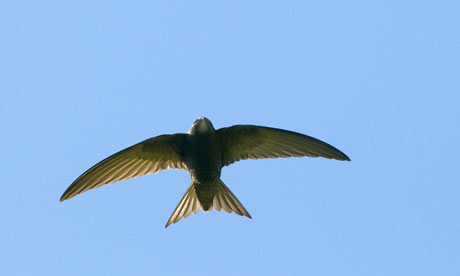
'Spring is incomplete for me – no, it does not even begin – until the swifts are back. I spend the last days of April and first few of May in a fever of anxiety, wondering if the most thrilling birds in Britain – whose return from Africa Ted Hughes said "means the globe’s still working , the Creation’s / Still waking refreshed" – will make it again this year. Evening means binocular peerings over the spires of the town, or dashes down to Sunnyside where our local birds have their biggest colonies, for a glimpse of those careering scimitar wings. If they’re late, which they increasingly are, it’s on to the websites for those with Swift Obsessive Disorder, and hopes for messages like that posted from Spain last May: "For those lacking common swifts in northern Europe, this afternoon was evidence of a huge arrival over Torremolinos." Sure enough, two days later they brought the Costa del Sol to our shores. Enough for emails to begin flashing between swift addicts: "They’re back."'

That's not me, of course; it's Richard Mabey. Anyone who has read his wonderful Nature Cure will know all about his very personal relationship with swifts, those deeply mysterious birds, and their epic journeys. Happily, I saw my first swift yesterday (they probably arrived over the south coast the day before - I haven't been able to find the swift addicts' website Mabey mentions. Anyone?). It was a single bird, gliding high up, with those occasional shivering motions of the wings as it swooped and turned. I haven't seen another since, but I'm sure they will soon be congregating in the skies.
Swifts for me are the soundtrack of many of my childhood memories, especially of those long summer evenings when, like all children in those days, I would have to go to bed while it was still broad daylight. As the bright evening light shone through the curtains, the swifts would be careering, screaming, past the window. They'd still be going when eventually I fell asleep - and they'd be the first thing I heard when I woke in the morning. Many years later, I lived on a similarly swift-haunted street, and one morning woke to find a swift trapped immobile, wings spread, between the two panes of the bedroom sash window, as if on an oversized microscope slide. It was an astonishing, faintly sinister sight - so strange to be seeing this always distant, always flying bird close up and stationary. After a while I managed to manoeuvre the two window panes into a position that offered the swift a way out - and off it flew like a shot from a gun, apparently unscathed by its strange experience. Heaven knows how it had managed to end up in such a strange position - presumably sheer reckless speed... It was not the only swift casualty of that house. When we came to move, I pulled out the wardrobe in the bedroom, and there behind it on the floor was a dead swift. It must have flown in through the window at speed and hurtled fatally into the bedroom wall. A swift death.

Wednesday, 28 April 2010

Sparrowhawks: The Truth

I'm indebted to Beleaguered Bryan for passing on this titbit:

Sparrowhawk Blitz Caused Sparrow Plunge

Newly published research provides compelling evidence that the decline of House Sparrows in Britain has been caused by intense predation pressure from resurgent Sparrowhawk populations.

Sparrowhawks were wiped out over much of Britain in the 1950s because of the effects of organochlorine pesticides, but since these were banned in the 1970s the number of Sparrowhawks has quadrupled, and they started to colonise cities for the first time in the 1980s. Urban sparrows were easily picked off because of their bold behaviour, which had developed in the absence of a significant threat from an aerial predator.

Dr Christopher Bell, who led the research, said “The study shows that variation in the timing of the disappearance of Sparrows from gardens across Britain can be explained by variation in the year that Sparrowhawks began to be seen hunting birds in the same gardens. This overturns previous assumptions about the effects of predation on bird populations, and exposes flaws in studies apparently showing that Sparrowhawk predation has no effect.“

Several puzzling aspects of Sparrow decline are explained by these results. Urban Sparrows have tended to disappear from the more affluent districts of cities such as London, Bristol and Norwich, while continuing to thrive in less well-off areas, such as large council estates. This is because the affluent parts of cities provide safe nesting places for Sparrowhawks in the large gardens of grand houses, and in private grounds and restricted areas of parkland, whereas no such nesting opportunities occur in poorer districts.

The results also explain why Sparrow decline happened later in the cities than in the countryside. Sparrowhawks re-occupied most of the British countryside during the 1970s, coinciding with the decline of rural Sparrow populations, but only started to move into urban areas in the late 1980s and 1990s, which coincides with urban Sparrow declines.

The study also explains regional variation in the extent of Sparrow decline across Britain. Scottish and Welsh Sparrows experienced a relatively small decrease in numbers, and have since recovered strongly, whereas Sparrow numbers in southern and eastern England have continued to plummet. Meanwhile, Sparrowhawk numbers in Scotland and Wales have been stable for many years, after undergoing a relatively small increase in the 1960s and 70s, but in south and east England Sparrowhawks have undergone a massive increase in numbers, which has continued until quite recently.

The results emerging from this study are potentially embarrassing for organisations involved in Sparrow research and conservation such as the RSPB, which have consistently denied that increasing numbers of Sparrowhawks and other predators can affect populations of wild birds. Instead they have promoted the idea that food shortage caused by changes in agriculture and urban development is behind Sparrow decline, but have found little evidence for this theory despite investment of at least £500,000 in Sparrow research. Conservation organisations have also promoted measures known as ‘agri-environment schemes’ to reverse the supposed effects of agricultural changes on wild birds. Farmers are now required to implement these measures to receive their subsidies under EU legislation, with £½ billion spent on such schemes each year in the UK alone. However, despite the fact that over two-thirds of farmland in England is now managed under agri-environment schemes, bird populations show no signs of recovery, suggesting that predators may be the real reason behind bird declines in the countryside.


Quite so. This is typical of that sinister organisation the RSPB, which won't hear a word against any of our feathered friends. Anyone with a garden could tell them that there have been dramatically fewer songbirds since predators started moving in from the countryside - magpies, jays, crows and raptors. Most of us have seen them at work, taking eggs and killing both adult and juvenile birds - but the RSPB (and others) insist on blaming it all on cats. Sparrowhawks are particularly effective killers, seldom seen until they've struck. The RSPB line has always been that they are misnamed as they rarely if ever attack sparrows. The old Duke of Wellington knew better. When Queen Victoria, concerned at the numbers of sparrows nesting on the partly finished Crystal Palace, asked his advice on how to get rid of them, he replied, 'Sparrowhawks, ma'am'. He was right; when the Palace opened, there was not a sparrow to be seen.

D'Oh!

Watching Gordon Broon, scary rictus in place, out and about gladhanding 'ordinary British people' was always like watching one of those many episodes of The Simpsons in which a robot is featured - you just know that sooner or later it's going to malfunction and mayhem will ensue. And now it's happened. No doubt by the time tomorrow's papers come out, Broon's dirt diggers will have established that the unfortunate woman is a Nazi gauleiter and stalwart of the Ku Klux Klan, with a sideline in ripping the heads off puppies. So that's all right then.

Tuesday, 27 April 2010

Blossom

It has been a quite astonishing spring for blossom - I can't remember one like it (perhaps the last was after one of the cold winters of the 80s?). On my Mole Valley walk last Saturday, there were stands of blossoming shrubs and trees - thorns, wild cherries, plums and pears - so dense and bright in the sun that they literally dazzled the eye. There's a piece about this year's prodigious cherry blossom in the Times today, with the obligatory meteorological explanation. But in reality this extravagance of blossom hits the eye and the receptive mind as a miracle, a wonder. Of course it is the product of natural forces, but that fact seems a pretty paltry thing against the fact of beauty so startling it stops you in your tracks. I don't think I've ever been stopped in my tracks so often as I have this glorious, blue-skied, blossom-bright spring.

Serious Money - for Poetry!

Talking of literary prizes, I heard this poetess interviewed on the World Service in the small hours. She has, I'm afraid, a rather harsh and unattractive voice but a powerful delivery, and she certainly deserves serious respect and admiration for ignoring death threats and carrying on regardless. She actually won the judges' vote, but the Great Saudi Public had other ideas. Look at that prize money, though, and weep, all aspiring poets. Why such huge prizes? It seems the Arabs value their poetry very highly indeed, and the ruler of Dubai is himself a keen and prolific exponent of Nabati poetry - here's an example of his work. I hope it has lost something in translation.

Comedy

I pass this titbit on for its comedy value - Ian McEwan has been nominated for the P.G. Wodehouse prize for comic fiction. I heard the clodhoppingly unfunny Solar when it was read as Radio 4's Book At Bedtime (in heavily abridged form - I dread to imagine what reading the whole thing must be like). I laughed aloud all right - but not in a good way... Never mind, Wodehouse will be chuckling at all this, somewhere.

Monday, 26 April 2010

Porter

And I even missed the death of Peter Porter, surely one of 'our' best poets. Even at the last, in his 80s, it seems he was writing more than well... RIP.