I recently mentioned A.E. Coppard, a writer whose name was unknown to me when I came across it - and seems to be generally forgotten, though a book of selected stories, Weep Not My Wanton, was issued only last year by Turnpike Books (a paperback, with Eric Ravilious's Chalk Paths on the cover - a perfect choice). I have just read this selection and I have to report that Coppard is one very fine short-story writer.
Weep Not My Wanton contains, in a mere 100 pages, seven stories: Dusky Ruth, the sad tale of a subjunctive sexual encounter at an inn; the title story, a horribly vivid vignette of human cruelty; Adam & Eve & Pinch Me, an eerie account of an out-of-body experience; The Higgler, a kind of love story, the longest in the book and perhaps the most gripping of them all; The Wife of Ted Wickham, a surprising character study; The Watercress Girl, a kind of tragic love story; and The Field of Mustard, in which a group of women, out gathering kindling, talk about men.
What these very different stories have in common, above all, is a haunting quality that makes them hard to forget. They are often almost painfully vivid, and always told with a skill that is quite breath-taking. Frank O'Connor called Coppard 'the greatest of all the English storytellers' and that, I think, is not far wide of the mark. It seems astonishing, then, that he should be so nearly forgotten - except that the stories have a flavour of their time, at least in the prose style, which sometimes shows signs of a Georgian fondness for strained locutions and 'fine writing'. But this is incidental, for these are tough, sinewy, clear-sighted stories that never lapse into anything like whimsy or sentimentality; Coppard knew too much of the realities of poverty and rural life for that.
V.S. Pritchett - who admired Coppard hugely - also thought that he was unlucky in being a 'folkish' writer at the wrong time:
'I don't think he had any views about life in general, any kind of
intellect, but he had a marvellous appreciation of the instant; he could
describe a squirrel very well, he could describe a game‑keeper, he
could describe a couple of old farmers arguing about whether, beef is
better than veal to eat, or what pork is like, and things like that. He
had a great decorative sense of comedy. He was unfortunately, when I
look back upon it, a rather folkish writer; he came at a period when the
peasantry were dead really and they only existed in pockets in England,
in little places, and their traditional customs by that time had almost
gone. It was when suburbia spread out and the countryside died. That
curious old England went out...'
Well, that's true enough, but stories as good, as well crafted and as grippingly told as Coppard's surely deserve to survive. Try them yourself and see if you agree.
Wednesday, 30 April 2014


Tuesday, 29 April 2014
Familiar?
Does this sonnet sound familiar?
When I in dreams behold thy fairest shade
Whose shade in dreams doth wake the sleeping morn
The daytime shadow of my love betray’d
Lends hideous night to dreaming’s faded form
Were painted frowns to gild mere false rebuff
Then shoulds’t my heart be patient as the sands
For nature’s smile is ornament enough
When thy gold lips unloose their drooping bands
As clouds occlude the globe’s enshrouded fears
Which can by no astron’my be assail’d
Thus, thyne appearance tears in atmospheres
No fond perceptions nor no gaze unveils
Disperse the clouds which banish light from thee
For no tears be true, until we truly see
Yes, you're probably thinking, it does sound familiar; it sounds rather like Shakespeare. And yet, there are, to put it mildly, a few problems, notably duff lines that Shakespeare could never have written (including a truly painful last line) and the overriding fact that it doesn't actually make any kind of sense. The music - or a fair simulacrum of it - is there, intermittently, but nothing else. The 'sonnet' reads, indeed, like what it is - a poem generated by a computer algorithm. All you need, apparently, is a dataset of Shakespeare's favourite words and a machine-learning Android app, and Bob - or rather Will's - your uncle. This piece gives a decidedly upbeat account of how it's done, overlooking the obvious fact that such a technique could never generate anything other than, at best, a pastiche. I don't think Shakespeare need fear for for his laurels any time soon.
When I in dreams behold thy fairest shade
Whose shade in dreams doth wake the sleeping morn
The daytime shadow of my love betray’d
Lends hideous night to dreaming’s faded form
Were painted frowns to gild mere false rebuff
Then shoulds’t my heart be patient as the sands
For nature’s smile is ornament enough
When thy gold lips unloose their drooping bands
As clouds occlude the globe’s enshrouded fears
Which can by no astron’my be assail’d
Thus, thyne appearance tears in atmospheres
No fond perceptions nor no gaze unveils
Disperse the clouds which banish light from thee
For no tears be true, until we truly see
Yes, you're probably thinking, it does sound familiar; it sounds rather like Shakespeare. And yet, there are, to put it mildly, a few problems, notably duff lines that Shakespeare could never have written (including a truly painful last line) and the overriding fact that it doesn't actually make any kind of sense. The music - or a fair simulacrum of it - is there, intermittently, but nothing else. The 'sonnet' reads, indeed, like what it is - a poem generated by a computer algorithm. All you need, apparently, is a dataset of Shakespeare's favourite words and a machine-learning Android app, and Bob - or rather Will's - your uncle. This piece gives a decidedly upbeat account of how it's done, overlooking the obvious fact that such a technique could never generate anything other than, at best, a pastiche. I don't think Shakespeare need fear for for his laurels any time soon.
Monday, 28 April 2014
Dingy

Also, no trip to Wirksworth would be complete without a visit to my favourite bookshop (helpfully called The Bookshop, and mentioned more than once on this blog). I never leave it empty-handed (or empty-pocketed - prices tend to be almost unbelievably low), and this time I picked up a copy of Kay Ryan's The Best of It: New and Selected Poems (a handsome Grove Press paperback) and Samuel Beckett's Mercier and Camier (a 1999 reprint, marking the 50th anniversary of John Calder's publishing firm). It's a very long time since I read the latter (it might even have been in the French original) and I remember little about it, so I am looking forward to the reread.
Friday, 25 April 2014
Breughel's Winter
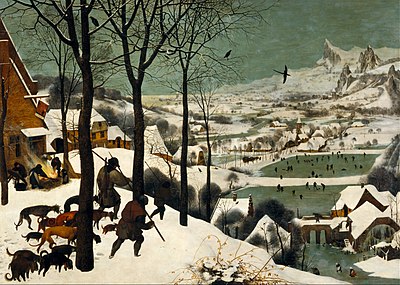
Jagg'd mountain peaks and skies ice-green
Wall in the wild, cold scene below.
Churches, farms, bare copse, the sea
In freezing quiet of winter show;
Where ink-black shapes on fields in flood
Curling, skating, and sliding go.
To left, a gabled tavern; a blaze;
Peasants; a watching child; and lo,
Muffled, mute--beneath naked trees
In sharp perspective set a-row--
Trudge huntsmen, sinister spears aslant,
Dogs snuffling behind them in the snow;
And arrowlike, lean, athwart the air
Swoops into space a crow.
But flame, nor ice, nor piercing rock,
Nor silence, as of a frozen sea,
Nor that slant inward infinite line
Of signboard, bird, and hill, and tree,
Give more than subtle hint of him
Who squandered here life's mystery.
Thursday, 24 April 2014
'And shall Trelawny Die?'
From the radio this morning came the stirring sound of a Cornish male voice choir belting out the county's 'national anthem', Trelawny. This was in honour of Cornwall having been granted national minority status under EU rules (so the rest of us will no longer be able to persecute this oppressed minority with impunity). Trelawny (or The Song of the Western Men), long believed to be of ancient origin, was actually written by the Victorian parson-poet Robert Stephen Hawker, and the Trelawny in question could be one of two rebellious Cornishmen, both of whom fell foul of the English and were imprisoned.
'A good sword and a trusty hand!
A merry heart and true!
King James's men shall understand
What Cornish lads can do!
And have they fixed the where and when?
And shall Trelawny die?
Here's twenty thousand Cornish men
Will know the reason why!
Chorus
A merry wight was he:
Though London Tower were Michael's hold,
We'll set Trelawny free!
'We'll cross the Tamar, land to land:
The Severn is no stay:
With "one and all," and hand in hand;
And who shall bid us nay?
Chorus
A pleasant sight to view,
Come forth! come forth! ye cowards all:
Here's men as good as you.
'Trelawny he's in keep and hold;
Trelawny he may die:
Here's twenty thousand Cornish bold
Will know the reason why
Chorus
'A good sword and a trusty hand!
A merry heart and true!
King James's men shall understand
What Cornish lads can do!
And have they fixed the where and when?
And shall Trelawny die?
Here's twenty thousand Cornish men
Will know the reason why!
Chorus
- And shall Trelawny live?
- And shall Trelawny die?
- Here's twenty thousand Cornish men
- Will know the reason why!
A merry wight was he:
Though London Tower were Michael's hold,
We'll set Trelawny free!
'We'll cross the Tamar, land to land:
The Severn is no stay:
With "one and all," and hand in hand;
And who shall bid us nay?
Chorus
- And shall Trelawny live?
- And shall Trelawny die?
- Here's twenty thousand Cornish men
- Will know the reason why!
A pleasant sight to view,
Come forth! come forth! ye cowards all:
Here's men as good as you.
'Trelawny he's in keep and hold;
Trelawny he may die:
Here's twenty thousand Cornish bold
Will know the reason why
Chorus
- And shall Trelawny live?
- And shall Trelawny die?
- Here's twenty thousand Cornish men
- Will know the reason why!'
- Hawker of Morwenstow was, even by the standards of Victorian parson-poets, a prime fruitcake, though some of the stories about him - dressing up as a mermaid, excommunicating his cat for mousing on a Sunday - are probably mythical. He certainly dressed in a most unclerical manner, sporting a claret-coloured coat, a fisherman's jersey and sea-boots, and a kind of poncho made from a yellow blanket, in imitation (he claimed) of the Welsh saint Padam. And he talked to the birds, entertained his nine cats in the church, and had a lively belief in the 'little people' and a Lord Emsworth-like attachment to his pet pig. He spent much time writing, brooding - and smoking opium - in a driftwood hut (now known as Hawker's Hut, and the National Trust's smallest property) overlooking the Atlantic breakers.
But if Hawker was eccentric - and addicted to opium - it is hardly surprising. His Cornish parish was poor, weatherbeaten and extremely remote (there was no railway at all into Cornwall until 1859: Wilkie Collins's early Rambles Beyond Railways describes what it was like to travel there in the earlier 1850s). The worst of it was that Morwenstow was a notorious haunt of wreckers, happy to lure ships onto the treacherous rocks of the coastline, regardless of the cost in human lives. Hawker, humanely determined to give every drowned man a Christian burial, had to cope with the grisly consequences of these frequent wrecks, as well as witnessing the hopeless struggles of drowning men just off the rocky shore. Despite these tribulations, he produced several volumes of antiquarian studies and verse, including the first part of an Arthurian epic, The Quest of the Sangraal, that was praised by Tennyson. He also, in 1843, instituted the Harvest Festival as we know it today - a tradition no more ancient than The Song of the Western Men.
Wednesday, 23 April 2014
Red Letter Day

This is the 450th anniversary of his presumed birth date. The last Big One, the 400th, was marked, rather reluctantly, by a special issue of postage stamps (then an infrequent event), designed by the brilliant David Gentleman. At the time they were highly controversial. Not only were these the first British stamps to feature an image of a commoner - that commoner's head was the same size as the Queen's. 'This caused a fuss that would be unimaginable now,' Gentleman wrote later, 'and there were jokes in Parliament about the proximity of the Queen's head to Shakespeare's Bottom.' How times change. But the greatness of Shakespeare does not.
Tuesday, 22 April 2014
A Kingsley Amis Reread
I guess I first read Kingsley Amis's The Green Man some time in the early Seventies (it was published in 1969), and perhaps again not many years later. It struck me at the time as being in many ways the best of Amis's post-Lucky Jim novels, and I thought it was maybe time to reread it and see what I made of it now.
I haven't read an Amis in quite some while. I gave up on him somewhere around the time of The Old Devils (but was pleased that it won him the (right author, wrong book) Booker), but I've had a niggling feeling for some while that he might be one to revisit - partly because his reputation seems to have survived in better shape in the US than it has in his home country (this is usually a good sign).
So, The Green Man. The first thing to say is that it is an extremely well crafted novel, one that deftly weaves together a ghost story, a sexual comedy and the portrait of a crumbling marriage (and a man very close to crumbling), with a bit of social satire thrown in - and it really keeps you turning the pages. The narrator, Maurice Allington, is the hard-drinking, womanising landlord of The Green Man - an establishment we would now class as a high-end gastropub - in a village in rural Hertfordshire. He is also, of course, a surrogate Kingsley Amis, with very much the same outlook on life, not to mention the compulsive drinking and leching.
The novel's weakness is in its characterisation, much of which is flimsy, and as a result some of the dialogue reads rather clunkily. But of course the tale is being told by someone for whom other people barely exist. For Maurice, nearly all other people divide into nuisances to be endured (most males) or sexual opportunities to be exploited (most females - and they too must be endured, for the sake of sexual conquest). The very lack of characterisation, then, is part of the characterisation of Maurice Allington, terrible man that he is - and yet somehow (perhaps because he is telling the tale) almost sympathetic, often engagingly funny, and refreshingly honest about himself.
What is remarkable about The Green Man is its strikingly original rethinking of the ghost story genre. Amis makes it disturbingly believable by exploring the uncertain perceptual world in which Allington lives - one of drunken absences, corner-of-the-eye misperceptions, troubled states of mind and strange hypnagogic hallucinations due to heart problems (and drink). Locating the ghostly phenomena in this penumbra is often brilliantly effective. The visions, the horrors creep in at the edges, and are the more convincing for that.
The ghost story has to come to a climax and find resolution - and, as with most ghost stories, the climax is the weakest part (suggestion is so much more effective than display). But happily there is a lot more going on in The Green Man than the ghost story, so it ends like what it has been all along - a fine novel, every bit as good as I remember it being. This probably means that I should reread more Amis, and perhaps I shall, in due course...
I haven't read an Amis in quite some while. I gave up on him somewhere around the time of The Old Devils (but was pleased that it won him the (right author, wrong book) Booker), but I've had a niggling feeling for some while that he might be one to revisit - partly because his reputation seems to have survived in better shape in the US than it has in his home country (this is usually a good sign).
So, The Green Man. The first thing to say is that it is an extremely well crafted novel, one that deftly weaves together a ghost story, a sexual comedy and the portrait of a crumbling marriage (and a man very close to crumbling), with a bit of social satire thrown in - and it really keeps you turning the pages. The narrator, Maurice Allington, is the hard-drinking, womanising landlord of The Green Man - an establishment we would now class as a high-end gastropub - in a village in rural Hertfordshire. He is also, of course, a surrogate Kingsley Amis, with very much the same outlook on life, not to mention the compulsive drinking and leching.
The novel's weakness is in its characterisation, much of which is flimsy, and as a result some of the dialogue reads rather clunkily. But of course the tale is being told by someone for whom other people barely exist. For Maurice, nearly all other people divide into nuisances to be endured (most males) or sexual opportunities to be exploited (most females - and they too must be endured, for the sake of sexual conquest). The very lack of characterisation, then, is part of the characterisation of Maurice Allington, terrible man that he is - and yet somehow (perhaps because he is telling the tale) almost sympathetic, often engagingly funny, and refreshingly honest about himself.
What is remarkable about The Green Man is its strikingly original rethinking of the ghost story genre. Amis makes it disturbingly believable by exploring the uncertain perceptual world in which Allington lives - one of drunken absences, corner-of-the-eye misperceptions, troubled states of mind and strange hypnagogic hallucinations due to heart problems (and drink). Locating the ghostly phenomena in this penumbra is often brilliantly effective. The visions, the horrors creep in at the edges, and are the more convincing for that.
The ghost story has to come to a climax and find resolution - and, as with most ghost stories, the climax is the weakest part (suggestion is so much more effective than display). But happily there is a lot more going on in The Green Man than the ghost story, so it ends like what it has been all along - a fine novel, every bit as good as I remember it being. This probably means that I should reread more Amis, and perhaps I shall, in due course...
Subscribe to:
Posts (Atom)
