These light mornings, I am often drifting in and out of sleep - or, sometimes, annoyingly wide awake - in the early hours, so I frequently catch that glorious incantation, the Shipping Forecast, on Radio 4 at 5.20am. Or at least the start of it, for this recitation of sea areas and meteorological formulas ('falling slowly', 'fair becoming poor', 'backing westerly', 'losing its identity') is notoriously soporific. This morning I must have been sound asleep, so I missed a national calamity - at 5.20am Radio 4 listeners heard not the Shipping Forecast but the continuing World Service, which carried on until 5.40am before the BBC was able to repair matters - too late, too late. There was the inevitable Twitter mini-storm, some listeners inquiring if this was a sign of imminent nuclear armageddon (there's a vague urban myth to the effect that not broadcasting the Shipping Forecast will be a secret signal to our nuclear submarines to fire their missiles). Well, it is all a sign of how deeply entrenched the Shipping Forecast is in our national culture. For most of us, of course, it serves no useful purpose and is largely incomprehensible, but it operates at some deeper level as a quasi-liturgical celebration of our maritime heritage and our status as a sea-girt island afloat on mysterious waters, storm-prone but somehow ordered.
I have posted the Shipping Forecast poems of Seamus Heaney and Carol Ann Duffy often enough - here they both are, with a Larkin thrown in - so instead, as a service to readers, I have topped this post with a handy, cut-out-and-keep chart of all those sea areas whose names we love to hear.
Friday, 30 May 2014
Thursday, 29 May 2014
A Scene from Nature
Spring being nearly over and the weather having taken a turn for the dismal, Springwatch is back with us. You know - the seasonal wildlife extravaganza fronted by creepy Chris Packham, gurning Michaela Strachan and eminently slappable Martin Hughes-Games.
Last night's show offered an especially edifying vignette from nature. The Springwatch cameras have been trained round the clock on a bitterns' nest, where three chicks were successfully hatched - but alas, early yesterday morning one of the chicks was dead in the nest. Mother bittern tenderly took her late offspring in her beak, tilted her head back and painstakingly swallowed it. This was not easy - it was a well-grown chick - but mother bittern persevered until she had swallowed it entirely. But that was not an end of it: next mealtime, there she was again, regurgitating the semi-digested chick as food for her remaining brood, who tackled their sibling with gusto, but did not get very far with it. So the mother scooped up the remains and subjected them to further digestion. A second regurgitation proved successful and popular, and very little remained of the unfortunate chick.
Nature, eh - don't you just love it...
'Are God and Nature then at strife, That Nature lends such evil dreams? So careful of the type she seems,
So careless of the single life' As Tennyson put it in In Memoriam A.H.H. - writing a full decade before Darwin went public and confirmed Tennyson's darkest intuitions about how Nature works. The poets always get there first.
Last night's show offered an especially edifying vignette from nature. The Springwatch cameras have been trained round the clock on a bitterns' nest, where three chicks were successfully hatched - but alas, early yesterday morning one of the chicks was dead in the nest. Mother bittern tenderly took her late offspring in her beak, tilted her head back and painstakingly swallowed it. This was not easy - it was a well-grown chick - but mother bittern persevered until she had swallowed it entirely. But that was not an end of it: next mealtime, there she was again, regurgitating the semi-digested chick as food for her remaining brood, who tackled their sibling with gusto, but did not get very far with it. So the mother scooped up the remains and subjected them to further digestion. A second regurgitation proved successful and popular, and very little remained of the unfortunate chick.
Nature, eh - don't you just love it...
Dabbler alert
There's a little something by me on The Dabbler today, about the 'funniest woman in the world'...
Wednesday, 28 May 2014
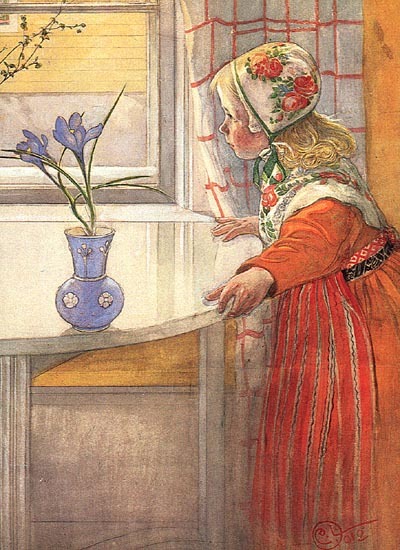
Carl Larsson: More than Charm
Born on this day in 1853 was the Swedish painter Carl Larsson. Perhaps it should come as no surprise that this supreme master of the blissful, love-infused domestic interior (and exterior) and celebrator of the joys of family living had a wretched start in life. He was born into poverty and lived his early years in squalor, thanks largely to his drunken, emotionally incontinent father, who rejected Carl with the words 'I curse the day you were born'. Amazingly, the young Carl was rescued by a teacher at his ragged school who spotted his talent and urged him to enrol in the art school of the Swedish Royal Academy of Art. He took a while to find his feet, but once he had married his beloved Karin, switched from oils to watercolours and found his theme, he never looked back.
Larsson and Karin between them virtually created the 'Swedish style' that ultimately conquered the world under the dread name of Ikea. Carl's paintings have never lost their popularity, but there is more to them than their obvious and immediate charm. Larsson is a deft colorist and a formidable draughtsman, with an astonishingly sure line, and his composition and framing are often extraordinarily bold and original. His pictures remain fresh and even arresting, offering something much more interesting than a mere celebration of cosy gemutlichkeit.
Tuesday, 27 May 2014
Lost and Found
Two pieces of good news over the long, rainy Bank Holiday weekend. One was that the lovely and vanishingly rare Fen Violet has been found again at Wicken Fen after a decade-long absence which had seemed final - rediscovered in the course of a routine plant audit, not of a specific search. The other cheering news was the discovery in the Congolese jungle of a peat bog the size of England that had somehow escaped the attention of the scientists until now. It's good to know - and salutary to remember - that there are still vast areas of the planet that even now are essentially uncharted territory (not to mention virtually the entire floor of the deep oceans, of which we know less than we do of the Moon). And, of course, the more you look, the more you see - and the more you see there is to see. There is always more...
Monday, 26 May 2014
'Human murmurs for example...' Mercier and Camier
I mentioned a few weeks ago that on my last visit to Derbyshire, I picked up in My Favourite Bookshop (The Bookshop, Market Place, Wirksworth) a copy of Samuel Bekett's Mercier and Camier. I have now read it - and it was, as I suspected, a reread; there were passages, especially early in the book, that rang familiar after, what, 40 years? It was, I must report, better and much funnier and more readable than I was expecting; indeed this one is a veritable page-turner, a joy to read, for its dark comedy, the seething life in its every sentence, and above all its preechoes of the great Beckett that was to come.
Mercier and Camier is a transitional work - the transitional work - in Beckett's canon, the first he wrote in French and the one in which the old Beckett, with his hyperintellectual fireworks and Joyce-soaked Dublinism, makes his last appearance, and the Beckett who would write the trilogy, the great short fictions and the plays speaks clearly for the first time. It was written in 1946, and for a long time Beckett withheld it from publication - until 1970 in fact. Then, four years later, came Beckett's own translation - substantially different from the original - and that of course is what I've just read (in a 1999 reprint).
Mercier and Camier themselves - two queer, young-old, tramp-like figures who try and fail first to meet up, then to make a journey out of a city (of course Dublin), reason and destination unknown - clearly foreshadow Vladimir and Estragon, while the landscapes of bog and moor, and the darkening tone, towards the end suggest Molloy. But it is the emergence of the true Beckett voice that matters most. The novel begins complete with omniscient narrator - who from time to time loses patience with his work: 'What stink of artifice', 'End of descriptive passage' - and it is even (at least as compared to the glorious mess that is Watt) almost shapely, with a helpful synopsis of the story so far, every two chapters. But along the way come sentence like this:
'With what relief the eyes from this clutter to the empty sky, with what relief back again.'
Or passages like this:
'Here would be the place to make an end. After all it is the end. But there is still day, day after day, afterlife all life long, the dust of all that is dead and buried rising, eddying, settling, burying again. So let him wake, Mercier, Camier, no matter, Camier, Camier wakes, it's night, still night, he doesn't know the time, no matter, he gets up and moves away, in the dark, lies down again a little farther on, still in the ruins, they are extensive. Why? No knowing. No knowing such things any more.'
Toto, I've a feeling we're not in Kansas any more...
Mercier and Camier ends with a chapter described in the synopsis as 'The life of afterlife'. The final paragraph is very beautiful. I shall end with it:
'Alone he watched the sky go out, dark deepen to its full. He kept his eyes on the engulfed horizon, for he knew from experience what last throes it was capable of. And in the dark he could hear better too, he could hear the sounds the long day had kept from him, human murmurs for example, and the rain on the water.'
Mercier and Camier is a transitional work - the transitional work - in Beckett's canon, the first he wrote in French and the one in which the old Beckett, with his hyperintellectual fireworks and Joyce-soaked Dublinism, makes his last appearance, and the Beckett who would write the trilogy, the great short fictions and the plays speaks clearly for the first time. It was written in 1946, and for a long time Beckett withheld it from publication - until 1970 in fact. Then, four years later, came Beckett's own translation - substantially different from the original - and that of course is what I've just read (in a 1999 reprint).
Mercier and Camier themselves - two queer, young-old, tramp-like figures who try and fail first to meet up, then to make a journey out of a city (of course Dublin), reason and destination unknown - clearly foreshadow Vladimir and Estragon, while the landscapes of bog and moor, and the darkening tone, towards the end suggest Molloy. But it is the emergence of the true Beckett voice that matters most. The novel begins complete with omniscient narrator - who from time to time loses patience with his work: 'What stink of artifice', 'End of descriptive passage' - and it is even (at least as compared to the glorious mess that is Watt) almost shapely, with a helpful synopsis of the story so far, every two chapters. But along the way come sentence like this:
'With what relief the eyes from this clutter to the empty sky, with what relief back again.'
Or passages like this:
'Here would be the place to make an end. After all it is the end. But there is still day, day after day, afterlife all life long, the dust of all that is dead and buried rising, eddying, settling, burying again. So let him wake, Mercier, Camier, no matter, Camier, Camier wakes, it's night, still night, he doesn't know the time, no matter, he gets up and moves away, in the dark, lies down again a little farther on, still in the ruins, they are extensive. Why? No knowing. No knowing such things any more.'
Toto, I've a feeling we're not in Kansas any more...
Mercier and Camier ends with a chapter described in the synopsis as 'The life of afterlife'. The final paragraph is very beautiful. I shall end with it:
'Alone he watched the sky go out, dark deepen to its full. He kept his eyes on the engulfed horizon, for he knew from experience what last throes it was capable of. And in the dark he could hear better too, he could hear the sounds the long day had kept from him, human murmurs for example, and the rain on the water.'
Thursday, 22 May 2014
'That Katy Perry... She's nice, her'
Having always believed that Sir Geoffrey Boycott's sole connection with the world of pop music is that he shares his date of birth with the artist known as Manfred Mann, I was rather startled to come across this story of our Boycs securing a backstage rendezvous with his favourite singer, Katy Perry (at what, according to Mrs B, was the only concert he's ever been to). I wonder what they talked about - England's prospects for the summer, the intricacies of the LBW law, the Duckworth-Lewis Method? Or was our Geoffrey just, like, Wow?
Subscribe to:
Posts (Atom)