Last night I had a convoluted dream, apparently set in grimy North London circa 1970, but also - such is the way of dreams - in the present day. I've forgotten everything about this dream (cheers of relief all round) except for one detail. In the course of events, two double-decker buses went past, and each of them bore a wraparound poster carrying a quotation from Homer. The word 'Homer' was emblazoned on the front of the bus, above the driver's cab, while the quotation unfolded along the side wall of the upper deck. The graphics were not in the best of taste - rather along the lines of the Biblical quotations displayed outside fundamentalist churches - and I was unable to read either quotation (one from the Iliad, one from the Odyssey). But I was impressed by what I took to be a splendid initiative - Homer on buses! It certainly beats the notorious 'atheist bus' of 2008.
I made a mental note to mention it on the blog. And now I have.
Sunday, 30 April 2017


'An Explosion of Freshness' in the Face of Death
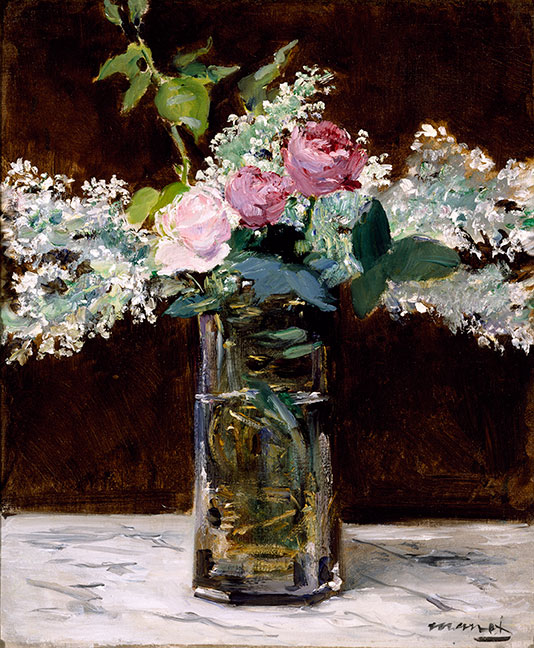
Manet died, like so many in his time, of complications of syphilis. He had a gangrenous leg amputated below the knee in the hope of a cure, but this only postponed the inevitable. However, he retained his good humour and ready wit to the end. One of his last visitors, Gaston Latouche, left an account of the dying Manet:
'Death came slowly, but it came. The last time I saw poor Manet, he had undergone the painful operation on his leg that we all remember. I can still see his fine head silhouetted against the white pillow that emphasised the ashen colour his face had assumed, already invaded by the shadows of death.
I stayed with him only a few moments; he was supposed to avoid fatigue. We said little - I tried to keep a smile on my lips for his sake, and I felt the sobs tightening my throat. Yet Manet managed to laugh, and to make me laugh - I, who had promised to cheer up the dear companion, to whom I was so deeply devoted. I left without finding a word to say, pressing Madame Manet's hands and those of the good Leenhoff [Leon Leenhoff, Mme Manet's 'brother', in fact her son, either by Manet or possibly Manet's father].
Two days later Manet died.'
Thursday, 27 April 2017
Mugwumps Old and Young
This deeply dull election campaign has become a tad livelier thanks to our old friend Boris Johnson, who has lobbed a few verbal firecrackers the way of Jeremy Corbyn. In the course of pointing out, quite rightly, that a JC government would be a serious national security worry, Boris describes the Labour leader, mildly, as a 'benign Islingtonian herbivore' and, more vigorously, as a 'mutton-headed old mugwump'. Now, this is noun seldom heard on this side of the Atlantic except in a Harry Potter context. Politically, it means an independent who stands apart from, and even against, his own party - which was certainly true of JC before, thanks to a badly misfiring joke, he found himself leading it. However, it's unlikely Boris had that angle in mind - or even the Harry Potter angle. More likely he just went for a word that sounded silly and sat well with 'mutton-headed'.
Self-described Mugwumps were the short-lived Sixties combo of that name, which has its place in the complex archaeology of the Mamas and Papas and the Lovin' Spoonful, since Cass and Denny of the former and Zal Yanovsky and John Sebastian of the latter were involved. One LP was released, after the band had broken up, and I once owned it, but I have to say that, despite all the talent involved, it is really of curiosity value only. This track is about as good as it gets...
Self-described Mugwumps were the short-lived Sixties combo of that name, which has its place in the complex archaeology of the Mamas and Papas and the Lovin' Spoonful, since Cass and Denny of the former and Zal Yanovsky and John Sebastian of the latter were involved. One LP was released, after the band had broken up, and I once owned it, but I have to say that, despite all the talent involved, it is really of curiosity value only. This track is about as good as it gets...
Tuesday, 25 April 2017
The Assistant
I've just finished a novel I'd been meaning to read for some while - Bernard Malamud's The Assistant - and it's left me moved, shaken, and quite convinced that I have encountered a true modern classic.
Malamud's second novel, The Assistant is set in a poor district of New York, where Morris Bober, a Jewish grocer (who, importantly, has lost a young son) lives with his wife and daughter, and struggles to keep his failing business going. His life hits a new low when his store is raided by two holdupniks, one of whom hits him ferociously over the head. While he is still recovering, a mysterious young man begins to haunt the store, offering to work, for nothing, as an assistant. Morris, against his wife's objections, takes him on, and the grocery's fortunes begin to improve. But who is the young man? Can Morris trust him? And what will happen when he begins to fall in love with Morris's daughter?
This seems at first like a familiar narrative structure, but in Malamud's hands it serves as the framework for a fascinating and profound moral drama, one in which nothing is simple and everything is difficult. The unfolding events, expertly unwound through a process of revelation and concealment, are never predictable and the ground is never firm beneath our feet - which is to say that this novel feels a lot like life itself. The main characters are, like the story, many-layered - they draw us into their lives, eager to find out more, to know them, though they are ultimately unknowable, even to themselves. None is more compelling than Frank Alpine, 'the assistant', the young man at the centre of the novel, a man set on a terribly difficult path of redemption, one from which he is all too liable to stray, but which is the only thing that can save him from himself - and in saving himself, he might save others.
This is a wholly convincing tale of suffering and penance, love and forgiveness, the all but impossible making of a new life. It exerts an unshakable grip and feels, from beginning to end, like a classic. I suspect Malamud is better known and more highly valued in the States than over here. I'd previously only read one of his novels - the rather atypical A New Life - but I'll surely be reading more now. Recommendations welcome.
Malamud's second novel, The Assistant is set in a poor district of New York, where Morris Bober, a Jewish grocer (who, importantly, has lost a young son) lives with his wife and daughter, and struggles to keep his failing business going. His life hits a new low when his store is raided by two holdupniks, one of whom hits him ferociously over the head. While he is still recovering, a mysterious young man begins to haunt the store, offering to work, for nothing, as an assistant. Morris, against his wife's objections, takes him on, and the grocery's fortunes begin to improve. But who is the young man? Can Morris trust him? And what will happen when he begins to fall in love with Morris's daughter?
This seems at first like a familiar narrative structure, but in Malamud's hands it serves as the framework for a fascinating and profound moral drama, one in which nothing is simple and everything is difficult. The unfolding events, expertly unwound through a process of revelation and concealment, are never predictable and the ground is never firm beneath our feet - which is to say that this novel feels a lot like life itself. The main characters are, like the story, many-layered - they draw us into their lives, eager to find out more, to know them, though they are ultimately unknowable, even to themselves. None is more compelling than Frank Alpine, 'the assistant', the young man at the centre of the novel, a man set on a terribly difficult path of redemption, one from which he is all too liable to stray, but which is the only thing that can save him from himself - and in saving himself, he might save others.
This is a wholly convincing tale of suffering and penance, love and forgiveness, the all but impossible making of a new life. It exerts an unshakable grip and feels, from beginning to end, like a classic. I suspect Malamud is better known and more highly valued in the States than over here. I'd previously only read one of his novels - the rather atypical A New Life - but I'll surely be reading more now. Recommendations welcome.
Monday, 24 April 2017
Trout
I know the Wandle, my local river - biologically dead in my boyhood - is now very much alive, with enough life in it to support kingfishers, egrets and a large population of herons. Even so, I was amazed and delighted to see, this morning, way upriver, a decent-sized brown trout - maybe a foot long - swimming in the shallow water, and even rising to snap at something, before retreating into the shadows of the riverbank undergrowth. For some reason, it put me in mind of a piece of music... Any excuse for enjoying this joyful performance again.
Sunday, 23 April 2017
Snap
As soon as I was safely out of the country, Theresa May cheekily called a snap election - a development not unnoticed by the walking party. One of our number declared authoritatively that she was obliged to do this in order to deal with right-wing 'troublemakers' in her party who wouldn't accept any Brexit deal that didn't precisely meet their demands (he didn't explain how the security of an increased majority would encourage them to pipe down - and I fear by 'troublemaker' he meant anyone who actually wants the UK out of the EU). He also predicted a mighty surge in support for the Lib Dems - who wouldn't accept any Brexit deal that involved, er, Brexit - under their wildly charismatic leader, Tim Thingy. Well, from where they are, the only way is up of course, but it's not likely to make any real difference, is it - unless our friend was looking forward to an unholy alliance of Lib Dems, Scot Nats and others somehow thwarting Brexit. Now there's a depressing thought. Old Nige will call the election result in due course. Meanwhile I hope not to be returning to this subject very often.
Back from Greece...

And mountainous it was - we were walking in the Taygetos range, climbing endlessly along zig-zagging mule tracks, in places reduced to a rubble of rocks, scree and boulders, then at last descending equally endlessly through similarly challenging terrain. But we all survived, without so much as a twisted ankle - and, by golly, it was worth the exertion. The views were immense and dramatic, upwards to the snow-capped peaks of the principal mountains of the range, downwards into immensely deep canyons and river valleys, and all around to rocky and wooded bluffs, flower-covered slopes, distant glimpses of the wide Spartan plain...
As for the wildlife - the walk began with a yard-long head-to-tail crocodile of Pine Processionary Moth larvae making its wiggly way across the car park of the inn where we stopped en route to our base in Mystras (their huge cocoons were hanging from the trees like grubby plastic bags). On our last afternoon we heard a cuckoo calling in the wooded valleys below us, and on the first day we spotted two wild tortoises resting in the undergrowth. Wild flowers were everywhere - cyclamen and red anemones, muscari (grape hyacinths) and blue pimpernel, sea squill and giant fennel, Judas trees and acacias in full flower, and orchids, orchids galore: I must have seen at least half a dozen spectacular species new to me, and some of the commoner ones were gloriously abundant (there's one in the foreground below).All this, and butterflies too - swallowtails both Greek and English, clouded yellows in profusion, small coppers and brown arguses, several species of orange tips and blues, and a number of Greek browns I couldn't name. I must have seen the best part of thirty species in all - it was, when the sun was out (which was more than half the time), butterfly heaven.
We made no literary pilgrimages this time, but I can report that Patrick Leigh Fermor's house remains just as it was a year ago. Nothing has been put into storage, and no concrete progress made towards the projected Leigh Fermor museum house. This is no great surprise.

Subscribe to:
Posts (Atom)
