Apart from shared membership of the human race, my father had but one thing in common with Marcel Proust – a fascination with that endlessly absorbing painting, A View of Delft by Jan Vermeer (born on this day in 1632). He – my father, that is – saw it in the Hague some time in the early Sixties and was so impressed that he bought a reproduction of it, which hung in our breakfast room, and in my parents' subsequent homes, for years. It certainly played a major part in my awakening to the power of art.
Proust saw the View of Delft at the Jeu de Paume in May 1921, in a loan exhibition of Dutch paintings. This shaky excursion from his apartment proved to be his last. It began with a severe attack of dizziness before Proust had even made it down the stairs, but, supported by his friend Vaudoyer, he soldiered on and made it to the Jeu de Paume, where he tottered up to the View of Delft and, after spending a while in contemplation, found himself sufficiently revived to move on to a concurrent Ingres exhibition and lunch at the Ritz before making his way home, still, according to Vaudoyer, 'shaken and alarmed'.
In The Captive, the last volume of A La Recherche, Proust transfers his Vermeer experience to the writer Bergotte, who, sleepless and ill, ventures out from his home to see the View of Delft on display. Like Proust, he is initially overcome by dizziness, but presses on determinedly. He has read a review of the exhibition that mentions a 'little patch of yellow wall' in the painting that is like 'a priceless specimen of Chinese art, of a beauty that was sufficient in itself'. Bergotte, who thought he knew every inch of the painting, cannot call to mind that little patch – until, in the gallery, he sees it, and with his discovery of it comes the realisation that 'That's how I ought to have written. My last books are too dry, I ought to have gone over them with a few layers of colour, made my language precious in itself, like this little patch of yellow wall.' Overcome with dizziness again, Bergotte slumps onto a circular settee, from which he shortly rolls unconscious onto the floor, while attendants and visitors rush from all corners to attend to him. He is dead.
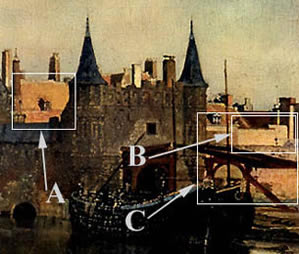
Ever since Proust, there has been much argument over the whereabouts of that 'little patch of yellow wall' on Vermeer's painting. There are three contenders (see above), all in the sunlit area to the right of the picture – but none of this matters; there is more than enough to gaze – and wonder – at in the View of Delft.
Tuesday, 31 October 2017
Monday, 30 October 2017
Hobhouse's History
'A modern blight sees history through a prism (or fog) that distorts much of the past, not because of often obvious absurdities, but because of anachronisms. Contemporary political correctness can only exist after certain conditions have been fulfilled. These conditions did not exist before current technology made them possible. So, to consider the past when these factors could not have been present under the assumption that they were, is naive of students. For teachers it is at best ignorant and, at its worst, close to intellectual fraud.'
Wise words from Henry Hobhouse in a prefatory note to his Seeds of Wealth (published in 2003, and things have got worse since then). This is a follow-up to Hobhouse's Seeds of Change: Five Plants that Transformed Mankind, a book full of unexpected connections and startling insights that, once pointed out, seem obvious – and yet change everything. The footnotes alone contain more interest than a shelf full of more pedestrian histories.
The five plants whose roles in history are examined in Seeds of Change are sugar, tea, cotton, the potato and the cinchoa (the source of quinine). The chapter on sugar alone upturns all the conventional wisdom about the triangular slave trade (though of course that false wisdom still thrives, partly for reasons hinted at in the quotation above). Hobhouse's chapter on the potato does a similar mythbusting job for the Irish potato famine. The second edition of Seeds of Change added the coca plant to the original five, with similarly eye-opening results.
Seeds of Wealth takes a similar approach to the earlier work, but focuses on plant products that have made men – and nations – rich, and in doing so have changed the course of history: timber, wine, rubber and tobacco. So far I have read only the chapter on timber, and it's packed with fascinating facts and figures that convincingly demonstrate how British shortage of timber and American superabundance of it dictated the course of both countries' histories over four centuries, bringing about Britain's very early industrial revolution and fuelling the westward march of the States, among many other things...
Henry Hobhouse was not only a historian but a broadcaster, journalist, farmer and politician. When he died last year, the eulogy at his funeral was spoken by his godson – Jacob Rees-Mogg.
Wise words from Henry Hobhouse in a prefatory note to his Seeds of Wealth (published in 2003, and things have got worse since then). This is a follow-up to Hobhouse's Seeds of Change: Five Plants that Transformed Mankind, a book full of unexpected connections and startling insights that, once pointed out, seem obvious – and yet change everything. The footnotes alone contain more interest than a shelf full of more pedestrian histories.
The five plants whose roles in history are examined in Seeds of Change are sugar, tea, cotton, the potato and the cinchoa (the source of quinine). The chapter on sugar alone upturns all the conventional wisdom about the triangular slave trade (though of course that false wisdom still thrives, partly for reasons hinted at in the quotation above). Hobhouse's chapter on the potato does a similar mythbusting job for the Irish potato famine. The second edition of Seeds of Change added the coca plant to the original five, with similarly eye-opening results.
Seeds of Wealth takes a similar approach to the earlier work, but focuses on plant products that have made men – and nations – rich, and in doing so have changed the course of history: timber, wine, rubber and tobacco. So far I have read only the chapter on timber, and it's packed with fascinating facts and figures that convincingly demonstrate how British shortage of timber and American superabundance of it dictated the course of both countries' histories over four centuries, bringing about Britain's very early industrial revolution and fuelling the westward march of the States, among many other things...
Henry Hobhouse was not only a historian but a broadcaster, journalist, farmer and politician. When he died last year, the eulogy at his funeral was spoken by his godson – Jacob Rees-Mogg.
Sunday, 29 October 2017
The Hardy Tree and 'human jam'
The other day I visited, for the first time, Old St Pancras' Church and its graveyard, hard by the great Victorian railway terminus named for the same Roman saint. The church is a Victorian rebuild in that ugliest of revivalist styles, Neo-Norman (the original's bad enough, Neo is ten times worse). However, its wide, uncluttered interior is very pleasing, with a few interesting monuments (including one to the great miniature painter Samuel Cooper) and a faint smell of Anglo-Catholic incense in the air. A numinous space, and wonderfully quiet amid the busyness of North London.
That quiet is due in large part to the insulating effect of the graveyard that lies all around the church, dotted with grand old plane trees. Among those buried here are Johann Christian Bach, the sculptor John Flaxman and John Polidori, author of The Vampyre. Sir John Soane and his wife lie beneath a gloriously Soanean mausoluem, whose handkerchief-domed roof inspired the design of the red telephone box. William Godwin and Mary Wollstonecraft share a memorial (though their remains were removed to Bournemouth in 1851). When this was the grave of her mother alone, the young Mary was brought to it daily by her father to pay her respects, and it was there, later, that she and Percy Shelley planned their elopement.
But one of the most striking features of Old St Pancras' churchyard is not a grave but the tree pictured above – the Hardy Tree. In the mid-1860s, young Thomas Hardy, who was training to be an architect under the eminent Arthur Blomfield, had to supervise the excavation and clearing of a large part of the churchyard to make room for the expansion of the railway and its terminus. This grisly job involved dealing with a jumbled mass of coffins and human remains and removing hundreds of headstones. Hardy, it is said, had the bright idea of arranging many of these redundant stones in circles resting against the bole of a young ash tree. Now, in an effect Hardy would surely have relished, the tree's gnarled roots, growing out year after year, have begun to engulf and absorb the stones – an image of life and death inextricably intertwined.
Some years later, when he was back in Dorset and an established writer, Hardy noticed that the graveyard of Wimborne Minster had been levelled and its headstones rearranged. Around the same time, he met Arthur Blomfield again, who reminded him how the two of them had worked on clearing Old St Pancras' churchyard, on one occasion finding a coffin that contained a skeleton with an extra skull. This train of associations inspired Hardy's first poem in several years, one full of macabre humour – The Levelled Churchyard
"O passenger, pray list and catch
Our sighs and piteous groans,
Half stifled in this jumbled patch
Of wrenched memorial stones!
"We late-lamented, resting here,
Are mixed to human jam,
And each to each exclaims in fear,
'I know not which I am!'
"The wicked people have annexed
The verses on the good;
A roaring drunkard sports the text
Teetotal Tommy should!
"Where we are huddled none can trace,
And if our names remain,
They pave some path or p-ing place
Where we have never lain!
"There's not a modest maiden elf
But dreads the final Trumpet,
Lest half of her should rise herself,
And half some local strumpet!
"From restorations of Thy fane,
From smoothings of Thy sward,
From zealous Churchmen's pick and plane
Deliver us O Lord! Amen!"
The railway runs just the other side of the high wall in the background of the photograph.
That quiet is due in large part to the insulating effect of the graveyard that lies all around the church, dotted with grand old plane trees. Among those buried here are Johann Christian Bach, the sculptor John Flaxman and John Polidori, author of The Vampyre. Sir John Soane and his wife lie beneath a gloriously Soanean mausoluem, whose handkerchief-domed roof inspired the design of the red telephone box. William Godwin and Mary Wollstonecraft share a memorial (though their remains were removed to Bournemouth in 1851). When this was the grave of her mother alone, the young Mary was brought to it daily by her father to pay her respects, and it was there, later, that she and Percy Shelley planned their elopement.
But one of the most striking features of Old St Pancras' churchyard is not a grave but the tree pictured above – the Hardy Tree. In the mid-1860s, young Thomas Hardy, who was training to be an architect under the eminent Arthur Blomfield, had to supervise the excavation and clearing of a large part of the churchyard to make room for the expansion of the railway and its terminus. This grisly job involved dealing with a jumbled mass of coffins and human remains and removing hundreds of headstones. Hardy, it is said, had the bright idea of arranging many of these redundant stones in circles resting against the bole of a young ash tree. Now, in an effect Hardy would surely have relished, the tree's gnarled roots, growing out year after year, have begun to engulf and absorb the stones – an image of life and death inextricably intertwined.
Some years later, when he was back in Dorset and an established writer, Hardy noticed that the graveyard of Wimborne Minster had been levelled and its headstones rearranged. Around the same time, he met Arthur Blomfield again, who reminded him how the two of them had worked on clearing Old St Pancras' churchyard, on one occasion finding a coffin that contained a skeleton with an extra skull. This train of associations inspired Hardy's first poem in several years, one full of macabre humour – The Levelled Churchyard
"O passenger, pray list and catch
Our sighs and piteous groans,
Half stifled in this jumbled patch
Of wrenched memorial stones!
"We late-lamented, resting here,
Are mixed to human jam,
And each to each exclaims in fear,
'I know not which I am!'
"The wicked people have annexed
The verses on the good;
A roaring drunkard sports the text
Teetotal Tommy should!
"Where we are huddled none can trace,
And if our names remain,
They pave some path or p-ing place
Where we have never lain!
"There's not a modest maiden elf
But dreads the final Trumpet,
Lest half of her should rise herself,
And half some local strumpet!
"From restorations of Thy fane,
From smoothings of Thy sward,
From zealous Churchmen's pick and plane
Deliver us O Lord! Amen!"
The railway runs just the other side of the high wall in the background of the photograph.
Friday, 27 October 2017
Thought for the Day
'If a chap can't compose an epic poem while he's weaving a tapestry, he had better shut up, he'll never do any good at all.'
William Morris
William Morris
Wednesday, 25 October 2017
Drawn in Colour
Today I dropped in on the National Gallery to have a look at Drawn in Colour, a lovely exhibition of the twenty-odd Degas pastel drawings and paintings that were collected by the Glasgow ship owner Sir William Burrell and are normally on display in the Burrell Collection in that fair city. This is the first time they have left Scotland together, and happily they will be at the National until next May. You'd be mad to miss them.
The pastels are of course sensationally good, especially the later ones that show Degas's technique becoming increasingly bold (as in Dancers on a Bench, above). The brilliant Jockeys in the Rain (below), with its slashing diagonals, is one of the stars of the show, and there are several of those extraordinary nude studies of women washing themselves that some people find disturbingly voyeuristic. To me, they seem no more than a life-drawing extension of Degas's predilection for painting people utterly absorbed in their own worlds, as if the painter is an unnoticed presence who has just happened upon them, and has no interest but to draw them as best he can – which is quite preternaturally well.
More than anything, I loved the pictures of the life – mostly the backstage life – of ballet dancers and would-be ballet dancers. The painting at the top of this post, The Rehearsal, one Degas's earliest ballet pictures, is in oils, and it's quite ravishing, a tour de force of composition, lighting and colour, with a crop that's bold even for Degas. Looking at these pictures, which manage to convey at once the beauty of ballet and the painful, exhausting physical slog of it, put me in mind – inevitably, in the month of his death – of Richard Wilbur's great ekphrastic poem, L'Etoile. The picture that inspired it is not in this exhibition (it's in the Musée d'Orsay), but here it is...
A rushing music, seizing on her dance,
The pastels are of course sensationally good, especially the later ones that show Degas's technique becoming increasingly bold (as in Dancers on a Bench, above). The brilliant Jockeys in the Rain (below), with its slashing diagonals, is one of the stars of the show, and there are several of those extraordinary nude studies of women washing themselves that some people find disturbingly voyeuristic. To me, they seem no more than a life-drawing extension of Degas's predilection for painting people utterly absorbed in their own worlds, as if the painter is an unnoticed presence who has just happened upon them, and has no interest but to draw them as best he can – which is quite preternaturally well.
More than anything, I loved the pictures of the life – mostly the backstage life – of ballet dancers and would-be ballet dancers. The painting at the top of this post, The Rehearsal, one Degas's earliest ballet pictures, is in oils, and it's quite ravishing, a tour de force of composition, lighting and colour, with a crop that's bold even for Degas. Looking at these pictures, which manage to convey at once the beauty of ballet and the painful, exhausting physical slog of it, put me in mind – inevitably, in the month of his death – of Richard Wilbur's great ekphrastic poem, L'Etoile. The picture that inspired it is not in this exhibition (it's in the Musée d'Orsay), but here it is...
A rushing music, seizing on her dance,
Now lifts it from her, blind into the light;
And blind the dancer, tiptoe on the boards
Reaches a moment toward her dance's flight.
Even as she aspires in loudening shine
The music pales and sweetens, sinks away;
And past her arabesque in shadow show
The fixt feet of the maitre de ballet.
So she will turn and walk through metal halls
To where some ancient woman will unmesh
Her small strict shape, and yawns will turn her face
Into a little wilderness of flesh.
Tuesday, 24 October 2017
Islington and the Universe
So, it's official – the worst place in the UK to be a woman is, er, Islington. That was one of the findings of a big survey commissioned by Radio 4's Woman's Hour, which applied various criteria – housing affordability, personal wellbeing, safety, crime, education, etc – to every part of the UK and ran the figures. The two best places to be a woman were both rather nice parts of lowland Scotland – East Dumbartonshire and East Renfrewshire – with prosperous West Oxfordshire coming in third. And there, right down at the bottom, was that jewel of North London – Islington (379th of 380 in personal wellbeing and 369th in crime). As a confirmed South Londoner who could never understand why anyone in their right mind would wish to live North of the river (unless it was in the pleasanter parts of Kensington or Hampstead), I am unsurprised and, I must admit, rather gratified by this result. Heaven knows what those fine people at Woman's Hour (a continuation of the Guardian woman's page by other means) must make of it. Trendy, vibrant, diverse Islington, home to so many right-thinking PC feminists, turns out to be the worst place in the UK to be a woman. Can such things be?
To change the subject, I can't resist linking to this story, which Bryan A tweeted earlier. Yes, the universe shouldn't exist! I feel this is almost as startling – and oddly pleasing – as the Islington finding.
Monday, 23 October 2017
Bridges v Hopkins
Born on this day in 1844 was the poet Robert Bridges, whose greatest contribution to English literature was his collecting and eventual publication of the poems of Gerard Manley Hopkins. The two men met at Oxford and were lifelong friends thereafter. However, they were a very odd couple, in most respects as different from each other as chalk and cheese – Bridges firmly anti-Catholic and conservative in all things, including poetry, and Hopkins devoutly Catholic and open to currents of thought and ways of writing verse that were quite repugnant to Bridges. The relationship between the two friends, who undoubtedly had a deep affection for each other, would be better understood if Bridges hadn't, after Hopkins' death, had all his (Bridges') letters to him returned and destroyed (though one survived).
Bridges clearly did not understand or appreciate his friend's poetry, and was reluctant to publish it (a reluctance endorsed by his fellow poet Coventry Patmore). He might have been right to hesitate, as Hopkins' verse, if published in quantity in the 1880s or 1890s, could well have been dismissed as the most outlandish experimentation. When eight of his poems were published in an anthology in 1893 (five years after Hopkins' death), Bridges included a note on the poet, which ended uninvitingly:
'Poems as far removed as his come to be from the ordinary simplicity of grammar and meter, had they no other drawback, could never be popular, for they have this plain fault, that, aiming at an unattainable perfection of language, they not only sacrifice simplicity, but very often, among verses of the rarest beauty, show a neglect of those canons of taste which seem common to all poetry.'
Even when Bridges finally brought out a proper edition of Hopkins's poems in 1918, he attached a minatory preface that could scarcely have been more negative:
'Apart from faults of taste, which, few as they numerically are, yet affect my liking and more repel my sympathy than do all the rude shocks of his purely artistic wantonness – apart from these, there are definite faults of style which a reader must have courage to face, and must in some measure condone before he can discover the great beauties.'
Well, cheers, Bob – thanks for that ringing endorsement...
Since then, of course, the whirligig of time has brought in its revenges: Robert Bridges, one-time Poet Laureate, survives only in a few anthology pieces (like this one), while Hopkins is regarded as one of the great (or, at the very least, 'major minor') English poets.
Bridges clearly did not understand or appreciate his friend's poetry, and was reluctant to publish it (a reluctance endorsed by his fellow poet Coventry Patmore). He might have been right to hesitate, as Hopkins' verse, if published in quantity in the 1880s or 1890s, could well have been dismissed as the most outlandish experimentation. When eight of his poems were published in an anthology in 1893 (five years after Hopkins' death), Bridges included a note on the poet, which ended uninvitingly:
'Poems as far removed as his come to be from the ordinary simplicity of grammar and meter, had they no other drawback, could never be popular, for they have this plain fault, that, aiming at an unattainable perfection of language, they not only sacrifice simplicity, but very often, among verses of the rarest beauty, show a neglect of those canons of taste which seem common to all poetry.'
Even when Bridges finally brought out a proper edition of Hopkins's poems in 1918, he attached a minatory preface that could scarcely have been more negative:
'Apart from faults of taste, which, few as they numerically are, yet affect my liking and more repel my sympathy than do all the rude shocks of his purely artistic wantonness – apart from these, there are definite faults of style which a reader must have courage to face, and must in some measure condone before he can discover the great beauties.'
Well, cheers, Bob – thanks for that ringing endorsement...
Since then, of course, the whirligig of time has brought in its revenges: Robert Bridges, one-time Poet Laureate, survives only in a few anthology pieces (like this one), while Hopkins is regarded as one of the great (or, at the very least, 'major minor') English poets.
Subscribe to:
Posts (Atom)


