Sunday, 31 October 2021

Hotel Poems

 Lately, for various reasons, I've been spending quite a lot of time in hotels. This has led me to conclude that bland, low-price chain hotels are best for sleeping in, while older, more upmarket hotels are best for everything else, e.g. sitting around observing the passing scene. Here is Peter Porter doing just that, in the opening poem of his 1975 collection, Living in a Calm Country – 

At the Castle Hotel, Taunton

Today it's not scones but tea-cakes
   (And the sound of ambulances
   in the reconstructed streets) –

Rich voices are discussing the new Warden
   (The Show is the best for years,
   the Architects' watercolours outstanding) – 

Pearls and brogues survive, cashmere clings 
   (Is this the Ark of Adultery
   or two old friends killing time?) –

Interlopers must wait for their tea
   (There's only one waitress on today,
   her footsteps are masked on the stairs) – 

Hands want something to do, eyes won't idle
   (Country Life in a rexine folder:
   who buys, who sells all these houses?) – 

O impossible England under the modern stars
   (Mr Edward du Cann* thanks the voters
   of Taunton for their generous support) –

So much beauty, so unexpectedly preserved
   (And we two strangers have today
   honoured gentle Eliot at East Coker) –

Not only the pleasant eating by the road
   (And the cider factory, the industrial
   archaeology with the rural) – 

But the pattern of beauty changing in the air
   (Fields painted by history, a steam
   of seasons softening what lives) – 

Somerset for survivors and a good things too 
   (Seventeenth-century farmhouse,
   part-converted, owner abroad
) – 

Seen from Ilminster spire, everything is safe
   (It is being kept for posterity
   but where do the people of England live?)

*Edward du Cann was a rather louche Tory politician who was MP for Taunton. He was an Oxford friend of Kingsley Amis.
  In this miniature portrait of 'impossible England' at a particular time and in a very particular place, two distinct poems run in parallel, in a kind of antiphon, before they converge at the end – typically clever stuff, and in places beautiful (the last-but-two stanza, 'But the pattern of beauty changing in the air...'). 

Philip Larkin is also specific about place and time in his sonnet, 'Friday Night in the Royal Station Hotel', a scene of dimly lit ('darkly' lit indeed) desolation. I am old enough to remember when provincial hotels at quiet times were like this – but this is not just a well made descriptive poem: the five lines after the break, and especially the enigmatic closing sentences, take it into another dimension. 

Light spreads darkly downwards from the high
Clusters of lights over empty chairs
That face each other, coloured differently.
Through open doors, the dining-room declares
A larger loneliness of knives and glass
And silence laid like carpet. A porter reads
An unsold evening paper. Hours pass,
And all the salesmen have gone back to Leeds,
Leaving full ashtrays in the Conference Room.

In shoeless corridors, the lights burn. How
Isolated, like a fort, it is –
The headed paper, made for writing home
(If home existed) letters of exile: Now
Night comes on. Waves fold behind villages.

The Royal Station Hotel survived to become the 'iconic' Mercure Hull Royal Hotel. 

  Here's another hotel poem – or one that begins in a hotel: Anthony Hecht's 'Lagoon', his 'version' of a Joseph Brodsky poem. The hotel is the Pensione Accademia, where Ruskin stayed when he was working on The Stones of Venice, and I know it because I stayed there a few years ago. In the poem it's Christmas time, and the place seems as desolate as Larkin's Royal Station Hotel...

I
Down in the lobby three elderly women, bored, 
Take up, with their knitting, the Passion of Our Lord
        As the universe and the tiny realm
Of the pension 'Accademia', side by side, 
With TV blaring, sail into Christmastide,
        A look out desk-clerk at the helm.

II
And a nameless lodger, a nobody, boards the boat, 
A bottle of grappa concealed in his raincoat
        As he gains his shadowy room, bereaved
Of memory, homeland, son, with only the noise
Of distant forests to grieve for his former joys,
        If anyone is grieved.

III
Venetian churchbells, tea cups, mantel clocks,
Chime and confound themselves in this stale box
        Of assorted lives. The brazen, coiled
Octopus-chandelier appears to be licking,
In a triptych mirror, bedsheet and mattress ticking,
       Sodden with tears and passion-soiled.

IV
Blown by nightwinds, an Adriatic tide
Floods the canals, boats rock from side to side,
      Moored cradles, and the humble bream,
Not ass and oxen, guards the rented bed
Where the windowblind above your sleeping head 
      Moves to the sea-star's guiding beam.....

After which, something cheering is called for. Here is Frank O'Hara, as usual skipping merrily through whatever's bobbing about on the surface of his mind. 'Hotel Particulier' hardly seems to be about any particular hotel, but it's fun – and I've always liked the last sentence, which invariably springs to mind when I enter a new hotel, though I've yet to try it on the desk-clerk...

How exciting it is
                              not to be at Port Lligat
or learning Portuguese in Bilbao so you can go to Brazil

Erik Satie made a great mistake learning Latin
the Brise Marine* wasn't written in Sanskrit, baby

I had a teacher one whole summer who never told my anything
                                                           and it was wonderful

and then there is the Bibliotheque Nationale, cuspidors,
glasses, anxiety 
                          you don't get crabs that way,
and what you don't know will hurt somebody else

how clear the air is, how low the moon, how flat the sun,
et cetera,
               just so you don't coin a phrase that changes
can be 'rung' on
                          like les neiges d'antan
and that sort of thing (oops!), (roll me over)!

is this the hostel where the lazy and fun-loving
                                       start up the mountain?

* The Brise Marine is a poem by Mallarmé – and, as it happens, the name of a hotel at Cap-Ferrat. 


Saturday, 30 October 2021

Walking Again

 Yesterday, for the first time in a year and more, I was out walking with that little band of walkers who, from time to time, muster for a day's walk, usually with some architectural/historical interest thrown in. I've been walking with them for nearly 40 years now, and the group is dwindling in numbers and becoming less active, for obvious age-related reasons – but yesterday five of us still ambulant survivors assembled in the Wiltshire countryside for a nine-mile walk, punctuated by the traditional long lunch.
  We met at the out-of-the-way village of Ogbourne St Andrew, close to Marlborough but feeling much like the middle of nowhere. The church there, built of flint and ashlar with some brick infill, is a nice example of the kind of small, unostentatious village church that has evolved over the centuries, incorporating something of each architectural period along the way. It even has an Anglo-Saxon burial mound standing conspicuously in the churchyard – something you don't often see. 
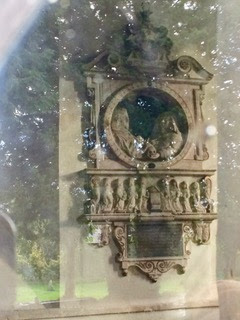
  Sadly, but not surprisingly, the church was locked, but, peering in through a clear window, I was able to make out a rather fine monument, which I photographed through the glass, creating this ghostly image of a monument floating amid reflected trees and sky –

The couple in the circular niche recall some of the 17th-century monuments of conjugal affection that feature in my book (in the chapter 'What Will Survive of Us'), but this husband and wife are holding between them a skull; their thoughts are less on each other than on mortality – as well they might be: six of the eight children kneeling below them are holding skulls, showing that they were already gone into the world of light (as Henry Vaughan puts it). It's a slightly old-fashioned monument for its date – and the date is interesting: 1655, therefore under the Commonwealth, when very few memorials of any degree of elaboration were being made. 
  The other notable church was St John the Baptists, Mildenhall (pronounced Minal, and not to be confused with Mildenhall in Suffolk). This has a similarly unshowy and mixed exterior, but inside is a revelation – a rare, perfectly preserved late Georgian interior, complete with box pews, panelling, gallery,  reredos, pulpit and (identical) reader's desk. And it was open.
  We ate lunch in a little town pub in Marlborough, where the menu consisted almost entirely of pies – but they were good pies. As we ate – in company with another of the walkers and his wife, who had dropped in to meet us  – we watched the rain siling down outside. By the time we had finished, it had passed over, replaced by blue skies and mellow autumn sunshine. Most of the rest of the walk was along an abandoned railway track, lined with small trees and shrubs – dogwood, guelder rose beautiful in its autumn colouring and hung with berries, hawthorn jewelled with bright red haws, blackthorn studded with plump sloes (abundant this year, as are most tree fruits).
  It was so good to be out walking amid all this beauty, and in company again. Let's hope it is a harbinger of better, more normal, more humanly convivial times ahead.


Thursday, 28 October 2021

'All things which sustain'

 In times like these, when it is fashionable in some quarters to describe yourself as an 'activist' (and, like as not, a 'stand-up comedian'), it's good to hear a quiet voice celebrating the importance of doing nothing. In this elegant, musical poem on a musical subject – the 'fermata' is what we Brits usually call a 'pause', the undefined rest denoted by a Mr Chad* eye (arch over dot) – the American poet Turner Cassity gives form to... well, to nothing, to that charged pause. He's a poet who is light on his feet, fluent, agile, and often – that rare thing among modern poets – funny. His work is hard to find over here, but worth seeking out. The collection from which this poem is taken, Between the Chains, has an epigraph from Ivy Compton-Burnett – a sure sign of something interesting in store...

Against Activism

The arch of the fermata holds the note,
If only on the paper. Wrist or breath
Or the depressed piano keys draw out
The sound itself. Inertia audible,
Vibrating string, vibrating air postpone.
That which they so delay, the beat held back,
Is abstract also; yet the mind conditioned
Waits for the certain thunderclap
Hard on the flash. The lightning, nothing if
Not active principle, creates the wave
Which it anticipates. The lifted felts
In the piano, up-bow, down-bow, tongue
Not touching on the reed, prolong the bars
Each passively, by what they do not do.
Horsehair on catgut take the active voice?
Of course. The thing the players do not do
Is let the change from down to up-bow sound. 
'Free bowing' is the operative phrase.
Assuring linkages by letting be,
Most concertmasters write it in the parts.
Among the brasses faces turn to red;
Arms independent bow one seamless note.
Soon, on the sostenuto, cramp sets in.
The right-hand pedal, all things which sustain,
Do so at least in part by doing nothing.

* Mr Chad was a popular graffito character, usually portrayed poking his nose over a wall and complaining about the absence of something: 'Wot! No.....?' He was born, it seems, in 1941, at a secret training centre in Gainsborough, Lincolnshire, where 'radio location' (Radar) was being taught. A wag adapted a circuit diagram into the features of Mr Chad and added the words 'WOT! No electrons?' The rest is history: Mr Chad lasted well into the Sixties, maybe longer.  

Wednesday, 27 October 2021

Darwin and Johnson: 'Mutual and strong dislike subsisted between them'

 From the start, it is clear that Anna Seward's biography of Erasmus Darwin is a wonderfully eccentric production, organised on principles entirely her own. It is also clear that she is not hugely enamoured of Dr Darwin as a man, though she reveres him as a poet and respects his intellect (even if she has very little to say about his scientific inquiries and his many inventions). It seems she nursed some animus towards him because he used lines of hers in his Botanic Garden without permission or acknowledgment.
   The first chapter begins with a short, hardly flattering sketch of the corpulent, stuttering, overbearing Darwin, before diverting into something of more interest to Anna Seward – the intellectual life of Lichfield and the luminaries who gave it, in her day, its particular lustre. Most of the first chapter, indeed, is taken up with a lengthy biographical profile of one of them, Thomas Day, an interesting figure in himself – one of many intellectuals led astray by the ideas of the fashionable Jean-Jacques Rousseau – but of no great relevance to the life of Dr Darwin. Seward makes a show of getting back on track at the start of the second chapter. but is soon talking of Sir Brooke Boothby, with a diversion on Mr Munday of Marketon, author of Needwood Forest ('one of the most beautiful local poems that has ever been written'). She returns to her subject with an account of Dr Darwin being thrown from his carriage and breaking the patella of his right knee. 'It is remarkable,' writes Seward, 'that this uncommon accident happened to three of the inhabitants of Lichfield in the course of one year; first, to the author of these memoirs in the prime of her youth; next, to Dr Darwin; and, lastly, to the late Mr Levett, a gentleman of wealth and consequence in the town. No such misfortune was previously remembered in that city, nor has it once recurred through all the years which has since elapsed.' Well, fancy that. 
  After a little more of Dr Darwin, Seward introduces , among others, the Rev. Thomas Seward (no relation), whose poetry she quotes, and the Rev. Archdeacon Vyse, whose verse she quotes at greater length. Any reader hoping that Seward's admiration for the 'choice spirits' of Lichfield would extend to its most famous son, Samuel Johnson, will be disappointed. He and Dr Darwin 'had one or two interviews, but never afterwards sought each other. Mutual and strong dislike subsisted between them' – and Anna Seward cannot forgive Johnson his 'many hints of Lichfield's intellectual barrenness'. The 'arrogant' Johnson, she says, 'liked only worshippers'. Though several of Lichfield's finest paid court to Johnson when he visited his home town, 'they were not in the herd that "paged his heels" and sunk, in servile silence, under the force of his dogmas, when their hearts and their judgments bore contrary testimony'. All of this sounds rather as if Anna Seward could not forgive Johnson for neglecting Lichfield, with its galaxy of starry intellects (in her estimate), in favour of London. It is a shame, though, that the two greatest men Lichfield produced – Erasmus Darwin and Samuel Johnson – did not get on. 


Tuesday, 26 October 2021

Sloane

 Strolling down the King's Road this morning, en route to an old friend's 70th birthday lunch, I was pleased to see that the statue of Sir Hans Sloane is still standing proudly in full view. In a book I read recently (for review), Sloane is described as a 'naturalist, slave owner and founder of the British Museum' – in that order. He is clearly in the crosshairs of the woke brigade, so it would be no surprise if that statue were to become 'problematic'.
Wikipedia describes Sir Hans, more usefully and accurately, as a 'physician, naturalist and collector'. 

Sunday, 24 October 2021

'This stoney register'

 Oddly, in researching my book on monuments, I never visited the Collegiate Church of St Bartholomew, Tong, one of the most monument-packed churches in the Midlands (it's just over the Staffordshire border in Shropshire). Yesterday, on my Mercian travels with my cousin, I made good the omission, and was relieved to find that it contained no particularly interesting monuments of 'my' period (the early 17th century). But it does indeed contain a lot of monuments, to members of the Vernon and Stanley families – a collection whose general effect is, it has to be said, more than a little oppressive. 
  One of the monuments – a grand, well carved double-decker – has some literary interest. It commemorates three of the Stanley family, various members of which illustrious clan patronised William Shakespeare. Because of this connection, it is widely believed that the two epitaphs on this monument were written by the man himself. If so, they are not among his best efforts, but they have their moments. One reads
'Ask who lyes here but do not weep
He is not dead he doth but sleep
This stoney register is for his bones
His fame is more perpetual than these stones
And his own goodness with himself being gone
Shall live when earthlie monument is none'
[Note the unfortunate per-echo of that ever popular funeral verse 'Do no stand at my grave and weep']
And the other reads
'Not monumental stone preserve our Fame
Nor skye aspiring pyramids our name
The memory of Him for whom this stands
Shall outlive marble and defacers Hands
When all to Time's consumption shall be geaven
Standley for whom this stands shall stand in Heaven'

  Tong church has another literary association too. It was in Tong that Dickens set his great tearjerker, the death of Little Nell (he knew Tong because his grandmother was housekeeper at Tong Castle). This death scene (of which Oscar Wilde wrote 'One must have a heart of stone to read the death of Little Nell without laughing') caused such a sensation, on both sides of the Atlantic, that Dickensian pilgrims soon began descending on Tong in search of Little Nell's grave. At some point an enterprising verger created a suitably inscribed tombstone and even faked an entry in the church's burial register, so Tong churchyard became the site of 'Little Nell's Grave'. Visitors were quite prepared to overlook the fact that in The Old Curiosity Shop she is buried inside the church.


Thursday, 21 October 2021

'The masculine loco-descriptive tradition'

 I recently bought a modern edition (2010) of the Life of Erasmus Darwin written by the 'Swan of Lichfield', Anna Seward (pronounced, I was surprised to learn, 'See-ward'). Seward has recently attracted the attention of academics, for her sometimes innovative proto-Romantic verse and other writings, for her unconventional (and in modern terms unclassifiable) love life, and for being a respected woman writer in a then very male-dominated literary world. Whether her biography of Darwin is any good I have yet to discover, having only just got through the lengthy Introduction, which, while full of interest, reads rather like a reheated thesis or dissertation. I laughed out loud at a quotation from one Sharon Seltzer, who declares that Seward's poems on the famous early industrial site Coalbrookdale are 'a significant intervention in the masculine loco-descriptive tradition'. A little later, the author of the Introduction describes Seward's literary criticism as 'worthy of our attention because it evokes a deeply relational mode of analytic thought and creative work not always associated with late 18th-century literature'. Deeply relational, eh?
  As for Erasmus Darwin, he remains very present in Lichfield. Yesterday I spotted the most unlikely tribute to the great man and the Lunar Society of which he was a leading light: the Brewhouse and Kitchen pub, which brews its own beers, has a red rye ale (dry, amber aromatic) called Lunartick [sic]. I must try it some time...