Tuesday, 31 May 2022

Sickert, Tonks

 Born on this day in 1860 (in Munich, to a German-Danish father and English mother) was the painter Walter Sickert, who has appeared quite often on this blog, most recently  sporting his retired tug-boat captain look. He is in the same gear in the picture above, in which he is seen dozing companionably with his friend and coeval Philip Wilson Steer. Titled Sodales: Mr Steer and Mr Wilson, it was painted by Henry Tonks, 'the most renowned and formidable teacher of his generation', who, curiously, was a successful surgeon before switching to art. With his famously withering manner, hooded eyes and grim features, he seemed entirely cold and humourless, but some of his pictures, like the affectionate portrait above, belie that impression. As does this caricature of John Singer Sargent as a war artist (which Tonks also was) painting en plein air at the front...

Sunday, 29 May 2022

Yours for a Bawbee, and All in a Good Cause...

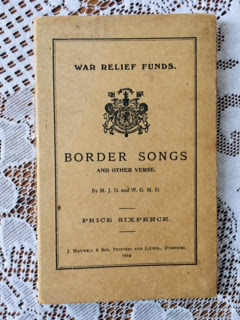
 Here's something I spotted in a charity shop this morning – Border Songs and Other Verse by M.J.D. and W.G.M.D, published in 1914 by J. Maxwell & Son, printers and lithographers, of Dumfries. The price was sixpence, and it was being sold in aid of the War Relief Funds, part of a huge charity fundraising endeavour that continued throughout the Kaiser War. I had never seen a publication like this before, so naturally I bought it (for £1 – less than half the present value of that sixpence). It's a slim volume of just 24 pages, and many of the poems it contains are in the Walter Scott tradition, celebrating the history, lore and landscape of the Scottish Borders. However, there are also verses on more general subjects: 'September', 'Swallows', 'Breakers', 'The Song of the Heart', 'The Song of Life' – and a stirring celebration of Albanian freedom, 'Albania (Written During the Balkan War)'. These are all competently written, if very much of their time; some indeed had already appeared in various magazines. 
  This sonnet, with nothing of the Scottish Borders (or indeed Albania) about it, caught my eye. Its epigraph is taken from Dr Johnson's famous letter to Lord Chesterfield: 'The notice which you have been pleased to take of my labours, had it been early, it had been kind; but it has been delayed till I am indifferent and cannot enjoy it, till I am solitary and cannot impart it, till I am known and do not want it.' The poem has little to add, but it translates Johnson's sentiments neatly, if rather strenuously, into (Petrarchan) sonnet form – 

And this is Fame! and this is what I sought
And longed for with a yearning and a pain
That made my youthful years a weary strain!
And now the victory's won, the battle fought;
But I would gladly give what years have brought
To hear the long-hushed voices once again
In my old home, where only peace did reign,
And love and tenderness and kindly thought.
Too late has come the world's praise to me,
The hearts are still that would have throbbed with pride;
And now my tired heart only says "too late";
For Death has changed the nights and days to me.
Save hope of meeting there is nought beside,
And Name and Fame have come to me too late. 


Friday, 27 May 2022

'No end of the cars'

 Back in the suburban demiparadise (maybe the hemidemiparadise now?) I'm constantly appalled, and all but deafened and choked, by the ever growing volume of traffic on the roads. A sweet and distant memory now are the car-free roads of lockdown, the quietness, the clean air... It seems that one of the many regrettable effects of the Covid panic was to scare people off public transport and back into their cars. 
 Traffic-choked roads, however, have been a feature of this country for a surprisingly long time. Rereading Philip Larkin's A Girl in Winter, I came across this passage, describing the countryside near London shortly before the Hitler War: 
'The main roads were full of cars and cyclists, the garages were all open, and every so often they would pass a tea garden with a sign, or a chalked board saying that fruit was on sale, plums or pears. There was no end of the cars. They streamed in both directions, pulled up by the roadside so that occupants could spread a meal, formed long ranks outside swimming pools...'
  The roads were every bit as congested in my Fifties childhood, and I remember sitting, bored and fretful, in many an endless traffic jam. I remember the tea gardens too (not many of those left now), and the roadside picnics. We had many such picnics en famille, brewing tea on a spirit burner  – a long job – in a small square kettle that was fitted into a cleverly designed leather canteen, with compartments for cutlery and blue plastic cups and plates. You would have to be mad, or addicted to petrol fumes – and, ideally, deaf – to hazard a roadside picnic now. As for the 'swimming pools', these would be the outdoor pools known as 'lidos' (pronounced 'lydo') that were very popular between the wars – of which, happily, a few remain. I remember one in particular: Ruislip Lido, which was (and is) a 60-acre lake with lido facilities (and a miniature railway). After a dip, we would often walk in the adjoining woods and, if we were lucky, have the magical experience of watching White Admirals flying. Maybe I should revisit those woods, before I leave the South. Or maybe not. 

Wednesday, 25 May 2022

Petit

 This morning, wandering in the churchyard of St Michael's, Lichfield (where Dr Johnson's parents are buried, as well as some of Philip Larkin's forebears), I came across the grave of the Rev. John Louis Petit – a name that somewhere rang the faintest of bells. An informative board standing near the grave, and subsequent online delving, revealed that Petit, who was for a while curate of St Michael's, was a prolific and original topographical watercolorist, and a leading player in what might be called the architectural style wars of the early and pre-Victorian period. While Pugin and the Camden Society carried all before them, Petit argued strongly against the excesses of Gothicism, and in favour of minimal restoration of buildings (rather than wholesale Gothicising) and drawing on earlier styles – and on the architecture of other countries – to develop an original approach that did not ape the 'one true style', i.e.Gothic. In this he was, while the battle raged, on the losing side, with the big guns of the Gothic Revival (including, at the time, George Gilbert Scott) ranged against him. Developments later in the 19th century, with the work of the Society for the Protection of Ancient Buildings and the growth of more relaxed and eclectic building styles, vindicated Petit's general ideas, but he was still destined to be largely forgotten by all but architectural historians. 
  As a watercolorist, Petit developed a style that combined accuracy with an attempt to convey the emotional impact of buildings. Many of his pictures look, by Victorian standards, unfinished, harking back to an earlier Romantic style. He used some of these paintings in his books and educational activities, and left vast numbers, often mixed in with work by his almost equally prolific sisters, at his death. They were soon widely dispersed, some were damaged and some lost, others sold off in batches at auction. Only in recent years have research and conservation efforts rescued some portion of his huge output and focused attention on the all but forgotten Petit. Above is his painting of Crowland Abbey in Lincolnshire.   

Sunday, 22 May 2022

'Eagerly waiting for the five o'clock tea'

 I love this bit of crazy Portuguese artwork (by one Andre da Loba). It adorns a box containing a jar of delicious rosemary honey, bought for us (in London) by our daughter before she returned to New Zealand last month. The honey is lyrically described in four languages, one on each side of the box, and the English version reads 'SWEET GARNERED IN TRADITION, EAGERLY WAITING FOR THE FIVE O'CLOCK TEA'. Every bit as wacky as the picture... 

Thursday, 19 May 2022

'The sound of failure'

I've always tended to prefer blurry and grainy photographs (black and white or early colour) to glossy, full-colour high-definition images, to prefer obsolescent tech to the latest thing, lo-fi to hi-fi, the rough-around-the-edges to the smooth and highly finished. It's something I never really thought about, regarding it as a simple matter of taste, perhaps related to a general preference for things of the past over things of the present. But someone who has thought about it is the musician Brian Eno, and I was delighted to come across this quotation today. These are, I think, wise words, identifying something real and generally unacknowledged: 

 'Whatever you now find weird, ugly, uncomfortable and nasty about a new medium will surely become its signature. CD distortion, the jitteriness of digital video, the crap sound of 8-bit – all of these will be cherished and emulated as soon as they can be avoided. It’s the sound of failure: so much modern art is the sound of things going out of control, of a medium pushing to its limits and breaking apart. The distorted guitar sound is the sound of something too loud for the medium supposed to carry it. The blues singer with the cracked voice is the sound of an emotional cry too powerful for the throat that releases it. The excitement of grainy film, of bleached-out black and white, is the excitement of witnessing events too momentous for the medium assigned to record them.'

Wednesday, 18 May 2022

Johnson as Kangaroo

 One of the most endearing things about that endlessly complex man, Samuel Johnson, was his capacity for childlike exuberance, even downright silliness (something he shared with Keats). Perhaps, in Johnson's case, it was a counterweight to the depression that always threatened to drag him down to the depths. Boswell more than once notes the Doctor's fondness for rolling down hills, with every evidence of enjoyment, and there's another delightful instance of his exuberance that was not recorded at the time by Boswell, but finds its place in the Life. It happened at an inn in Inverness when he and Boswell were on their way to the Hebrides. The Rev. Alexander Grant, who was there, reported that Johnson 'was in high spirits. In the course of conversation he mentioned that Mr Banks [the famous botanist Joseph Banks, who travelled on Cook's first voyage] had, in his travels in New South Wales, discovered an extraordinary animal called the Kangaroo. The appearance, conformation and habits of this quadruped were of the most singular kind: and in order to render his description more vivid and graphic, Johnson rose from his chair and volunteered an imitation of the animal. The company stared; and Mr Grant said nothing could be more ludicrous than the appearance of a tall, heavy, grave-looking man like Dr Johnson standing up to mimic the shape and motions of a kangaroo. He stood erect, put out his hands like feelers, and, gathering up the tail of his huge brown coat so as to resemble the pouch of the animal, made two or three vigorous bounds across the room!'