Saturday, 31 December 2011

The Year


It was the year of the Wedding - not that Kate and Wills affair (to which, owing to an unaccountable oversight, I wasn't invited) but this one. Technically it was not a wedding but a Blessing - and it certainly worked; first grandchild due in July! It was on the wedding morn that I saw my first swift of the year, the start of an unusually long swift summer, which lasted nearly to the end of August.
A poor butterfly summer though. After a glorious spring, the weather turned mostly dismal and inimical to my flying friends. But it began and ended well - and, thanks to one magical encounter, this year will live in my memory as the Year of the Emperor.
Patrick Barkham's The Butterfly Isles was among the pleasures of another good reading year, in the course of which I journeyed through Richard Holmes's The Age of Wonder, read one of the funniest books I've ever come across, marvelled again at John Williams, plunged into Richard Wilbur's poetry, read a strangely wonderful one-off, and- oh - much else...
Other highlights of the Nigeness year were the discovery of this wonder of the blogscape, the birth of a new prose form, and my long delayed discovery of the glories of Purcell. I look forward to hearing more and more Purcell in the new year - and I look forward to another year of blogging about this and that. To all who browse here I wish a very happy 2012 - or I would if that date hadn't been annexed by the London Olympiad junta. Happy New Year!

Friday, 30 December 2011

The Fate of a Humorist

'A half truth, like half a brick, is always more forcible as an argument than a whole one. It carries better.'
The wise words above - whose truth is daily demonstrated in the blogosphere - were written by Stephen Leacock, economist and humorous writer, born on this day in 1869. In his heyday, the 1910s and Twenties, Leacock was probably the most famous humorist in the world, and one of the most famous writers - indeed it was said that more people had heard of Leacock than had heard of Canada (the country of his birth). But who now has heard of him? It seems Leacock's humour - like most humour - was of the kind that doesn't long outlast its time.
Oddly, I discovered a relic of Leacock's fame while looking through the books left behind by my old English teacher (and friend and mentor) when he died. There was a copy of Leacock's Nonsense Novels, in an edition from the 1920s, already in its umpteenth printing. It was a notably handsome volume, with jolly illustrations (by John Kettelwell), so I took it, but I must confess I haven't even attempted to read it. As Groucho Marx (a Leacock admirer) once wrote to a man who had sent him an unsolicited volume: 'I laughed from the moment I picked it up to the moment I put it down. One day I'll read it.'

Thursday, 29 December 2011

'One large stage set...'

Among my most prized presents this Christmas were a bottle of 12-year-old Craigellachie (dangerously drinkable at 46%) and a book that I didn't even know existed - Edward Bawden's London (V&A Publishing, 2011). This handsome volume explores Bawden's life and work through his many depictions of London life and London locations. The life story throws up a few surprises - I didn't know, for example, that Bawden was on board the Laconia when it was torpedoed. Saved from drowning, he was adrift on an open boat for five days before being picked up by the Vichy cruiser La Gloire and interned in Morocco. The biggest surprise, though, was to learn that - far from being the genial, carefree, cheery character that his works suggest - Bawden (the product of a severely Methodistical upbringing) was a shy, socially awkward man who shunned company and preferred to shut himself away and work. His close friend Eric Ravilious - they met on their first day at the Royal College of Art and 'clicked' instantly - was the outgoing, gregarious one. It was as if Bawden somehow 'caught' Ravilious's good cheer and, unable to express it personally, expressed it in his art. He found his style early, and 'was to spend the next 66 years expanding and refining his technique, but never wavering in his belief that the world was one large stage set populated by slightly mad people whose antics continued to surprise not only himself but also the innocent birds, cats, ants and bees who had to share it with them'. So his very detachment from the world was also the source of his comic vision.
Beautifully produced and packed with good reproductions of linocuts, lithographs, engravings, drawings and much else, this is a book that every Bawden lover should seek out. It is also one of those volumes that you simply have to have in your hands (it even has pictorial boards, showing the Tower of London, under the dust jacket) - any electronic version would be a feeble simulacrum. Perhaps this is how the book (as codex) will survive in the age of the ebook - as a thing of beauty. Perhaps the coming of the electronic book will trigger a new golden age of book design... A pity the great Edward Bawden isn't still around to contribute to it.

Wednesday, 28 December 2011

An Odd Winter

After the rigours of the pre-Christmas workstorm, it's really rather pleasant to return to the office after the festivities and enjoy the short lull between Christmas and the New Year. Part of the pleasure is in the relative quietness of London at this time - and especially the all but deserted commuter trains. I was enjoying the comfort of a quiet, roomy carriage as my train drew into Victoria this morning when, gazing out of the window as we neared the station, I saw - of all things - a row of sunflowers rising above a boundary wall in front of one of the less upmarket of the apartment blocks to the west of the line. And the sunflowers were in full bloom! I know the weather's been mild - but surely not that mild. And why hadn't I noticed them before? It is an odd winter, this one. A bumblebee flew past me on Boxing Day... Oh and yes, it was a very good Christmas - as I hope was yours.

Friday, 23 December 2011

Happy Christmas

This year's Nigeness Christmas card is this Adoration of the Shepherds - a very beautiful, very Venetian treatment of the subject, probably by Giorgione but quite possibly by Titian. It comes with very best wishes to all who browse here for a Happy Christmas. For myself, I've already had one very special present - the news that our first grandchild is due to come into the world next July...
There should be a Christmas thought from me on tomorrow's Dabbler.
Meanwhile, Merry Christmas, everyone!

Wednesday, 21 December 2011

The Wired Bookworld

Over on The Dabbler, the redoubtable Jon Hotten asks, in a comment, if I deliberately held off from buying Muriel Spark's Memento Mori online when I could easily have done so for 1p. In that particular case, I did indeed hold off. After so many years of finding the charity shop bookshelves groaning with every other Spark title (if I had a penny for every Girls of Slender Means or Far Cry From Kensington I'd seen, I would be on my way to being a rich man), I was becoming mildly obsessed with the curiously absent Memento Mori and determined to track it down in what is surely its natural habitat. Eventually I did. But would I bother denying myself the instant gratification of online purchase for any other titles, or is that the last? My quest, after all, began way back in the pre-Amazon, pre-AbeBooks dark ages...
This question feeds into my mixed - conflicted even - feelings about online book buying. I love the ease and convenience - and, usually, cheapness - of it, and yet I hate that it's taken all the excitement out of book searching. I know with a deadening certainty that there are very few titles indeed that I couldn't find and purchase online, sometimes with a little patience, but usually with no more than a few keystrokes. Where's the fun in that? Where's the pleasure of deferred gratification? The only game left in this wired bookworld is finding the book I want at a lower price than I could get it for online - and this can be done, even with the famous 1p books on Amazon, 1p usually translating as £2.76. However, saving the odd 77p is hardly a thrill worth pursuing with much enthusiasm. Another downer in all this is that charity shops now have expert valuers, so the chances of finding a real bargain are very slim. In the past I've picked up, for example, a mint-condition first of Dead Babies (in wraps) for 25p, and a first of Mervyn Peake's Hunting of the Snark for the same price, both from branches of Oxfam - those days will never come again. To find a real bargain nowadays, you can only hope for a bookseller - or a charity shop valuer - getting a price spectacularly wrong, or you can rummage at jumble sales, fairs, car boot sales and such places. But I seem to have changed the subject... So - would I ever again defer buying a book online for the sake of finding it in physical from? Probably not. But do I continue to scan the shelves and rummage for books wherever they are to be found? Of course I do. The thing about books is that you don't know what you want - what you need, what you must read - until you see it, and hear its call.

Tuesday, 20 December 2011

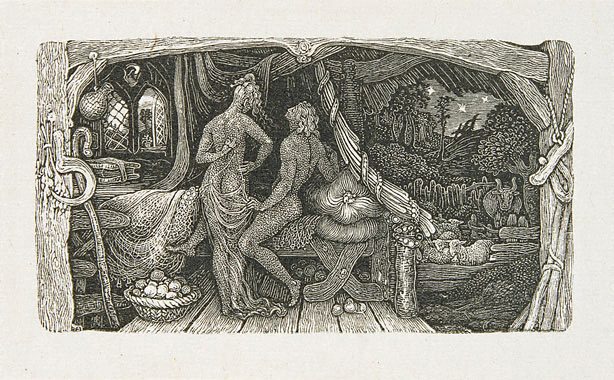
The Chamber Idyll

And then I got to thinking about wood engraving, and in particular about this little beauty - little indeed; the original image is barely three inches by one and a half. It's The Chamber Idyll by Edward Calvert, and it's in Tate Britain, though I don't think it's on display at the moment. An exquisitely beautiful - and erotically charged - work, it's beautifully composed, atmospheric, packed with meaning and amazingly delicately engraved. And yet Calvert only had a few years' experience of wood engraving when he made it, in 1831, and it was apparently the last work he produced in this medium. Calvert was one of the Ancients, the disciples of William Blake who for a few magical years gathered around Samuel Palmer in Shoreham. Later, like Palmer himself, Calvert went into an artistic decline (though Palmer's imagination flared up again in his late etchings and watercolours). Calvert spent the rest of his long life painting competently in a kind of vapid classical style, and the engravings of his golden period remained unseen by the world. Then, ten years after his death, an edition of his wood and copper engravings was published by his son, who later donated The Chamber Idyll to the Tate. The British Museum also has some Calvert prints, but The Chamber Idyll is surely his masterpiece.