Wednesday, 4 November 2009

Grimaldi 2: The Blues


What drew me to the Memoirs of Grimaldi was the discovery that he was at one time in his life passionately keen on butterflies - specifically, Dartford Blues. These are the most beautiful of all the blues, the ones we now call Adonis blues. Here's Grimaldi - a man who seems to have had the same phenomenal physical energy as Dickens himself - in June 1794:

'Being engaged nightly at Sadler's Wells, he was obliged to wait till he had finished his business upon the stage: then he returned home, had supper, and shortly after midnight started off to walk to Dartford, 15 miles from town. Here he arrived about five o'clock in the morning, and calling upon a friend of the name of Brooks, who lived in the neighbourhood, and who was already stirring, he rested, breakfasted, and sallied forth into the fields. His search was not very profitable, however, for after some hours he had only succeeded in bagging , or bottling, one Dartford Blue, with which he returned to his friend perfectly satisfied. At one o'clock he bade his friend good by, walked back to town, reached London by five, washed, took tea, and hurried to Sadler's Wells... On the same night, directly the pantomime was over, and supper over too, off he walked down to Dartford again, found the friend up again, took a hasty breakfast again, and resumed his search again. Meeting with better sport, and capturing no fewer than four dozen Dartford Blues, he hurried back to his friend's; set them... started off with the Dartford Blues in his pocket for London once more, reached home by four o'clock in the afternoon, washed, and took a hasty meal, then went to the theatre for the evening's performance.'

Incredibly, he was off to Dartford again that same night, and again on Sunday, when he had a whole day chasing the Dartford Blues, and was back in London in time for a 12 o'clock Monday morning rehearsal at Drury Lane.

It's sad, reading these exploits, to realise how many of the creatures he loved he must have killed - his collection was said to number some 4,000 butterflies - but such wholesale slaughter was commonplace, even into the 20th century. Victorian collectors thought nothing of taking out entire colonies, even of such rarities as the Large Blue and Large Copper - careless alike of the single life and of the type, it seems. On the other hand, there's no mistaking Grimaldi's consuming passion for the Dartford Blue, and it seems not to have been purely a hunter's passion; he appreciated their beauty enough to try to recapture it in watercolour. In old age, he took a particular pleasure in recalling the places where he had chased them, and the summer days devoted to the pursuit. The active side of it all ended, though, when his house in Pentonville was burgled by a gang who, smashing into the closet that housed his collection and seeing no value in it, destroyed everything but one small box and some items of collecting kit - which Grimaldi gave away the next day to an acquaintance. He never again took up his net.

Tuesday, 3 November 2009

A Scene from the Early Life of Grimaldi

One of the books my old English master gave me in the course of our 40-year friendship was a copy of the Memoirs of Grimaldi, edited by Boz - an early project of the indefatigable Dickens, who seems to have been called in by the publishers to prune and polish the work of the famous clown and of another editor. The early chapters are, as so often with memoirs, full of interest, with cheerful descriptions of young Joey's barely believable sufferings at the hands of his father - the dancer Joseph 'Iron Legs' Grimaldi - both on and off stage (Grimaldi senior was an enthusiastic flogger). Then there's the extraordinary tale of how the older Joseph, having overheard his young children innocently relishing the prospect of one day inheriting all the plate in the dining room, had himself laid out in the parlour and his two sons informed of his death.

'When Joe was brought into the dark room on so short a notice, his sensations were rather complicated, but they speedily resolved themselves into a firm persuasion that his father was not dead. A variety of causes led him to this conclusion, among which the most prominent were, his having recently seen his father in the best health; and... his observing, by looking closely at the sheet, that his deceased parent still breathed. With very little hesitation the boy perceived what line of conduct he ought to adopt, and at once bursting into a roar of the most distracted grief, flung himself upon the floor, and rolled about in a seeming transport of anguish.
John [Joey's brother], not having seen so much of public life as his brother, was not so cunning, and perceiving in his father's death nothing but a relief from flogging and books (for both of which he had a great dislike), and the immediate possession of all the plate in the dining room, indulging in various snatches of song and snapping his fingers, declared that he was very glad to hear it.
'O! you cruel boy,' said Joe, in a passion of tears, 'hadn't you any love for your dear father? Oh! what would I give to see him alive again!'
'Oh! never mind,' replied the brother; 'don't be such a fool as to cry; we can have the cuckoo-clock all to ourselves now.'
This was more than the deceased could bear. He jumped from the bier, opened the shutters, threw off the sheet, and attacked his younger son most unmercifully...'

So, fathers, if you wish to test the devotion of your children (and you're a sadistic psycho), you know what to do...

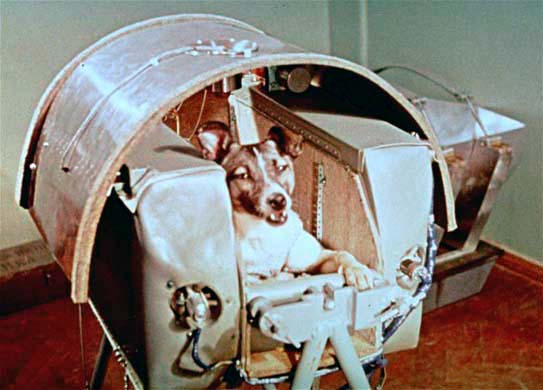
For Laika


Last night I read this poem by Zbigniew Herbert, commemorating the unfortunate Laika, the first living creature to be launched into space. This morning I woke to discover that it was on this day in 1957 that the poor mutt was sent to a certain, and almost certainly agonising, death (about which, of course, the Soviets lied). Laika has an honourable place in the tacky iconography of Soviet space exploration, and several grandiose sculpted monuments - but Herbert's sad bleak poem is her true memorial.

Monday, 2 November 2009

Ain't Nothing Like the Real Thing

Last weekend I inadvertently caught on TV a performance by what was left of the BeeGees (a couple of weird old men doing bad karaoke) and a dreary, massively self-important documentary promoting (god help us) a Fleetwood Mac reunion, and I thought to myself, as usual, Why do they do it? Or rather, why do people flock to see acts who long ago lost their mojos, pay a small fortune to sit somewhere in the same huge arena as their idols? Perhaps they're somehow unable to move on musically, locked into the once exciting music of their youth and therefore loyal to the performers who made it, regardless of their decline into inept self-parody. Equating the performers with the music is the problem, I think. If you want to relive the excitement of a great band in its heyday, remind yourself of what it was all about, you'd be better off with a good tribute band, rather than the survivors themselves, as like as not merely going through the motions for the sake of their pension pots. Ah but a tribute band is not the 'real thing'. Isn't it? In the sense that it gives a more authentic idea of what a band could do at its best, I'd say it is closer to the 'real thing' than the dismal spectacle presented by the 'dead but don't known it' originators of the music. Or of course you could just stay at home with your vinyl...

'A Beautiful but Silent View'

I'm rereading, after many years, W.G. Hoskins' The Making of the English Landscape, first published in 1955, in many ways overtaken by later studies, but still the classic of its subject - and undoubtedly the best written. Hoskins is animated by a love and deep, intimate knowledge of certain local lanscapes - especially those of Devon and Cornwall, the Midlands and north Oxfordshire - and by nostalgia for the things he saw as being lost to 'the lunacy of the 20th century', with its 'foul and joyless towns' and its new roads, 'treeless and stinking of deisel oil, murderous with lorries'. In the Midland countryside, he hears 'the dull roar of a fast main-line train taking people from a dismal illiberal life in Birmingham to a dismal illiberal life in London'. A thoroughgoing reactionary (he was against, among other things, 'income-tax, hydrogen bombs and the relentless onward march of science'), Hoskins clearly believed that England lived through a kind of golden age, between about 1570 and 1770, when the long battle to clear and colonise the land was won, parliamentary enclosure and factory industrialisation were yet to come, and 'men lived in a place that had meaning and significance for them'. Well, maybe - and surely this is still true of some men in some places (I certainly feel it's true of me, rooted for half a century in this suburban demiparadise)...

Hoskins's great insight is that landscape can only be understood when viewed in four dimensions. Time is what gives it depth and brings it fully to life, and Hoskins sees that, in the end, 'Everything is older than we think' - a truth that all who look back on earlier ages, especially the more remote ones, would do well to bear in mind. Here is a passage, not from The Making of the English Landscape, but from a later essay, that sums up the rich rewards - the necessity even - of looking closely at a landscape and reading it, knowing it in all its historical depth:

'It is satisfying to sit upon a Saxon boundary bank that commands a view of perhaps three or four miles, no more, near enough for everything to be seen clearly, and to be able to give a name to every farm dotted about the fields, to every wood and lane, to know which of these farms is recorded in Domesday Book, and which came later in the great colonisation movement of the 13th century; to see on the opposite slopes, Georgian stucco shining in the afternoon sun, the house of some impoverished squire whose ancestors settled on that hillside in the time of king John and took their name from it; to know that behind one there lies the ancient estate of a long-vanished abbey where St Boniface had his earliest schooling, and that in front stretches the demesne farm of Anglo-Saxon and Norman kings; to be aware, if you like, that one is part of an immense unbroken stream that has flowed over this scene for more than a thousand years; but at any rate to look at every feature with exact knowledge, able to give a name to it and knowing how it got there, and not just to gaze uncomprehendingly at it as a beautiful but silent view.'

To read Hoskins is truly to have your eyes opened, and I'd urge anyone who hasn't got round to it to put him on your 'to read' list - or maybe your Christmas list(the Folio Society publishes a handsome edition, slipcase and all).

Sunday, 1 November 2009

But...

There's only story that really matters today - this earth-shaking - nay cosmos-shaking - saga from the wonderful world of the Twitterati. Do we laugh or cry? We certainly - in my case - resolve never to go anywhere near Twitter. Meanwhile, I've had it with this blog - we're through - and it's all your fault, Dearieme (and Anonymous). I hereby retire from the blogscape.
No I don't. Only joshing ;-)

Nutt, Strictly and Crooked Timber

The gloriously named Professor David Nutt is still stomping around in a big huff, having been rather amusingly sacked (it can't have been Brown - it's too witty). Grumbling on the radio yesterday, he gave a clear impression that he seriously believed the country (and no doubt the entire known universe) should be ruled by 'good science', i.e. the latest thinking of the scientists, based on the latest research, of whatever quality. This was not questioned, nor was it pointed out that the 'best scientific advice' tends to swing about like a weathercock in a banging gale. Apply 'good science' and nothing else to Professor Nutt's field of expertise and you'd end up with booze and fags classed as controlled drugs, the pubs closed and ciggies on prescription (at best). Perhaps this is what he wants - I rather suspect it is - but it is not what any government with any kind of democratic mandate could or would ever dream of enacting. Policy can never be dictated by scientific advice, and there is such a thing as democracy - as the distinguished judges on Strictly Come Dancing are dismayed to learn afresh with each new series. As the results of last night's 'viewers' vote' came in, forcing two of the best contestants into a dance-off, the judges' jaws hung, their heads were in their hands, they could not believe what they were seeing. Well, that's democracy for you - and meanwhile, as Bryan reminds us, 15 million humanoid lifeforms were choosing to watch The X Factor instead. As Kant remarked, 'Out of the crooked timber of humanity no straight thing was ever made.'