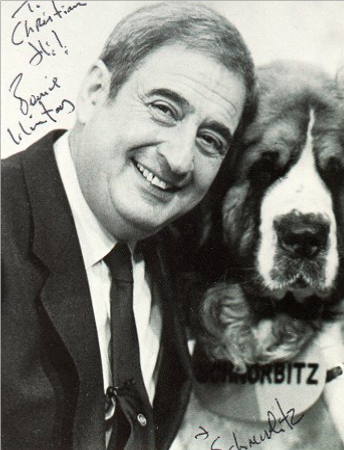
A red-letter day in the annals of showbiz, for it was on this date in 1932 that Bernie Winters (Weinstein) was born. Bernie joined his brother Mike in what was arguably (out of a crowded field) the unfunniest double act ever to have been described as 'comedy'. Once, when Morecambe and Wise were asked what they would have done if they'd flopped in showbusiness, they replied 'We'd have been Mike and Bernie Winters.' And yet Mike and Bernie were, from the late 50s through to the early 70s, huge. They were even, mystifyingly, rated 'top comics for Britain's teenage audience' in 1957.
The brothers began as a musical comedy act, with Bernie interrupting Mike's solos with hilarious impressions of Jimmy Cagney and Charles Laughton, while Mike 'did' Cary Grant. Many years later, Grant dropped in on Mike backstage at the Bristol Hippodrome and remarked 'You know, Mike, that was the worst Cary Grant impression I ever heard.'
The evolved (if that's the word) Winters double act consisted of Mike looking serious and smoking a pipe while Bernie looked like an imbecile and talked like an imbecile with a speech impediment. Backstage at a Royal Variety Performance, the Queen was introduced to the brothers and asked 'Do you speak French?' She must have thought that their being French was the only possible explanation for their comedy being that bad.
After the brothers broke up - with much acrimony, apparently - Bernie replaced Mike with a 14-stone St Bernard, Schnorbitz, who was considerably funnier and became a bigger star than either of them. Schnorbitz once fell into Terry Scott's swimming pool and was rescued by Barbara Windsor. You had to be there.
Friday, 6 September 2013
Thursday, 5 September 2013
Mast Year
In many parts of the country, 2013 is turning out to be a 'mast year' - a year in which the woodland trees are heavy with fruit, nuts and acorns. There's also talk of a bumper harvest of orchard fruits - and no wonder, after all this warm sunshine (and early rainfall). Yesterday, checking up on my own little plum tree - a miniature, with a weeping habit - I was pleased to find ten or a dozen plums, ripe and ready, hanging under the branches. I decided to leave them to get another day's sun, then pick them this morning. But this morning the branches were bare - all but one plum had gone, leaving not a trace behind. No discarded stones, no pulpy messes, nothing - a clean job, neatly executed. I suspect foxes.
It was a disappointment - they are usually very tasty and sweet (as was the one survivor) - but that's plums for you: here today, gone tomorrow (Eheu fugaces labuntur pruni...). I hope whatever - or whoever? - took them had much pleasure from them. They are a tempting fruit. As William Carlos Williams puts it in This Is Just to Say -
'I have eaten
the plums
that were in
the icebox
and which
you were probably
saving
for breakfast
Forgive me
they were delicious
so sweet
and so cold'
It was a disappointment - they are usually very tasty and sweet (as was the one survivor) - but that's plums for you: here today, gone tomorrow (Eheu fugaces labuntur pruni...). I hope whatever - or whoever? - took them had much pleasure from them. They are a tempting fruit. As William Carlos Williams puts it in This Is Just to Say -
'I have eaten
the plums
that were in
the icebox
and which
you were probably
saving
for breakfast
Forgive me
they were delicious
so sweet
and so cold'
Wednesday, 4 September 2013
Heroes of the 1896 Olympics, continued
I can't let the day go by without marking the anniversary of Dimitrios Loundras, born on this day in 1885. That's him in the picture, between the two hulking fellows. Dimitrios, aged just ten, was a hero of the great 1896 Athens Olympiad. His achievement did not match the triumph (and lifetime of free shaves) of marathon winner Spiridon Louis, but he lived to be the oldest survivor of the 1896 games. And his name remains in the record books as the youngest competitor and medallist in Olympic history. Competing in the team parallel bars event, his team, Ethnikos Gymnastikos Syllogos, came third and took the bronze. Third out of three teams, but never mind - well done, Dimitrios Loundras.
Who's the Boss?
The name 'Hugo Boss' first swam into my ken some 20 or more years ago, when a woman I was working with told me she had taken her boyfriend shopping and kitted him out from top to toe in 'Hugo Boss'. Poor chap, I thought - and what a repellent name for a gentleman's outfitters. I didn't like the look of their products either, as I began to notice them over the years, and have never been tempted, even at knockdown eBay prices.
I assumed from the start that 'Hugo Boss' was an invented brand name, craftily conflating the blunt assertiveness of 'Boss' and the softening touch of class provided by 'Hugo'. But no - I now discover that the firm was founded by a charming character called Hugo Ferdinand Boss (born Metzingen, 1885), who set up in business in 1923, joined the Nazi party in 1931, and made his fortune manufacturing those oh so chic black uniforms for the SS, the elegantly understated brown outfits of the SA, and the fun black-and-brown ensembles of the Hitler Youth. The forced labour of French and Polish prisoners helped speed the expansion of his empire - a fact for which belated apologies were issued. Hugo Boss himself survived the war, was fined for his support of the Nazis and disenfranchised. He died in 1948, of a tooth abscess.
Somehow I now like Hugo Boss clothes even less.
I assumed from the start that 'Hugo Boss' was an invented brand name, craftily conflating the blunt assertiveness of 'Boss' and the softening touch of class provided by 'Hugo'. But no - I now discover that the firm was founded by a charming character called Hugo Ferdinand Boss (born Metzingen, 1885), who set up in business in 1923, joined the Nazi party in 1931, and made his fortune manufacturing those oh so chic black uniforms for the SS, the elegantly understated brown outfits of the SA, and the fun black-and-brown ensembles of the Hitler Youth. The forced labour of French and Polish prisoners helped speed the expansion of his empire - a fact for which belated apologies were issued. Hugo Boss himself survived the war, was fined for his support of the Nazis and disenfranchised. He died in 1948, of a tooth abscess.
Somehow I now like Hugo Boss clothes even less.
Tuesday, 3 September 2013
What Denmark Watches
Denmark is a country with a great image - a land of happiness, harmony and social cohesion where all is civilised, ordered and in perfect balance, and all good things flourish. Surely, we might muse idly, it would be good to live in Denmark... Well maybe - but ponder this: the Danes' idea of cracking good television is that mystifying New Year's Eve institution Dinner for One (which suggests that the Danish sense of humour is, like the Germans', no laughing matter) - and, for the rest of the year, liberal helpings of Midsomer Murders. Known in Denmark as Barnaby, MM has bestrode the Danish primetime schedules like a colossus for 12 years, drawing a huge and loyal following and a 40 percent audience share.
Yes, the land that gave us The Killing and Borgen considers the gift amply repaid by an endless succession of wildly improbable murders in achingly picturesque village settings. And now, in a mind-boggling development, Midsomer Murders is to celebrate its 100th episode by filming part of it in... Copenhagen. The plodding Barnaby and his sidekick will travel to Copenhagen when a body is found there that somehow has links with a Midsomer family (what are the chances?). The episode will even involve actors from The Killing and Borgen - but this is no time for naming and shaming. They know who they are.
Heaven knows where and in what bizarre circumstances the body is found, but I'm guessing one of the rides in the Tivoli gardens might be involved (if only because the Little Mermaid is too small to feature as a crime scene) - or it could be the Carlsberg brewery, drowned in a vat of lager? Barnaby, we can be sure, will be as mystified by the food - raw herring? - as by the case. While he bumbles about and scratches his head, the body count will rise inexorably - but by then we'll be safely back in Badger's Drift, and all Denmark will be sitting back in its beautifully designed armchairs and enjoying the picture-postcard landscapes of Midsomer.
Yes, the land that gave us The Killing and Borgen considers the gift amply repaid by an endless succession of wildly improbable murders in achingly picturesque village settings. And now, in a mind-boggling development, Midsomer Murders is to celebrate its 100th episode by filming part of it in... Copenhagen. The plodding Barnaby and his sidekick will travel to Copenhagen when a body is found there that somehow has links with a Midsomer family (what are the chances?). The episode will even involve actors from The Killing and Borgen - but this is no time for naming and shaming. They know who they are.
Heaven knows where and in what bizarre circumstances the body is found, but I'm guessing one of the rides in the Tivoli gardens might be involved (if only because the Little Mermaid is too small to feature as a crime scene) - or it could be the Carlsberg brewery, drowned in a vat of lager? Barnaby, we can be sure, will be as mystified by the food - raw herring? - as by the case. While he bumbles about and scratches his head, the body count will rise inexorably - but by then we'll be safely back in Badger's Drift, and all Denmark will be sitting back in its beautifully designed armchairs and enjoying the picture-postcard landscapes of Midsomer.
Monday, 2 September 2013
The David Frost I Knew
As tributes pour in to the Grand Inquisitor, TV mogul, serial entrepreneur and unsurpassed Through the Keyhole presenter, my mind wanders back through the mists of memory to the David Frost I knew...
An intensely private man, sensitive almost to a fault, David loved nothing more than to turn his back on the busy world and pursue his twin passions - ecclesiastical embroidery and his lifelong study of Thomas Aquinas's Summa Theologica. He shunned company, but a few trusted friends - myself happily included - were allowed over the threshold of his austere Farm Street rooms. I recall many a precious evening discussing the finer points of the Summa over tea and a pipe of tobacco (his one indulgence!), while his nimble fingers plied the needle to such dazzling effect. His set of hassocks for Ss Cosmas and Damian, Tite St, are the stuff of ecclesiastical legend. He was also - as none but his closest friends knew - an accomplished writer of occasional lyric verse, and could successfully have published a slim volume or two - but such was his nature that the thought of making such a vulgar entree into the public arena appalled him...
Hang on - maybe I'm thinking of another David Frost?
Coming Soon: The Michael Parkinson I knew.
An intensely private man, sensitive almost to a fault, David loved nothing more than to turn his back on the busy world and pursue his twin passions - ecclesiastical embroidery and his lifelong study of Thomas Aquinas's Summa Theologica. He shunned company, but a few trusted friends - myself happily included - were allowed over the threshold of his austere Farm Street rooms. I recall many a precious evening discussing the finer points of the Summa over tea and a pipe of tobacco (his one indulgence!), while his nimble fingers plied the needle to such dazzling effect. His set of hassocks for Ss Cosmas and Damian, Tite St, are the stuff of ecclesiastical legend. He was also - as none but his closest friends knew - an accomplished writer of occasional lyric verse, and could successfully have published a slim volume or two - but such was his nature that the thought of making such a vulgar entree into the public arena appalled him...
Hang on - maybe I'm thinking of another David Frost?
Coming Soon: The Michael Parkinson I knew.
Sunday, 1 September 2013
Summer
September already. Summer - the season - is nearing an end, while for Summer - the small person - life is just beginning. Yes, the granddaughter - a creature of quite breathtaking loveliness - has a name. Summer. It is perfect for her.
Unlike Frankly Adorable Sam, Summer has no namesakes I can think of in literature. However, Summer is one of the great themes of poetry - indeed it would be possible to make a good historical anthology of English verse by following the theme, all the way from
'Sumer is icumen in'...
Unlike Frankly Adorable Sam, Summer has no namesakes I can think of in literature. However, Summer is one of the great themes of poetry - indeed it would be possible to make a good historical anthology of English verse by following the theme, all the way from
'Sumer is icumen in'...
Subscribe to:
Posts (Atom)