There was a discussion on Radio 4's Today programme this morning about the curious fact that Margaret Thatcher, Angela Merkel and Frauke Petry, leader of the German 'right wing' 'populist' party AfD, all graduated in Chemistry. Perhaps (the general drift of the discussion seemed to be) this gave them a logical, analytical, scientific approach to problem-solving that improved their understanding of political questions...
Not mentioned was recent research demonstrating that Engineering graduates - presumably with the same logical, analytical, scientific approach to problem-solving - are massively over-represented among, er, Islamic terrorists. Funny old world.
Tuesday, 15 March 2016


Monday, 14 March 2016
First Butterfly - Just!

The painting is A Study in March, or Early Spring (1855) by John William Inchbold.
Just a note...
... to remind readers that The Dabbler is thriving in its new Facebook incarnation. Lots of good stuff, some from this very blog.
Saturday, 12 March 2016
First Bat!
I was walking all day yesterday in deepest Surrey, mostly in sunshine - and yet I didn't see a single butterfly, not so much as a Brimstone or a Red Admiral. However, what I did see, to my amazement, was a bat, flitting about at treetop level in broad daylight, flying in rapid circles, with little darting diversions to snatch some flying morsel (of which there can't have been many at this time of year). It was too large to be a Pipistrelle, but what species it was I couldn't say. After a couple of minutes of circling, it flew off into the woods and was lost from sight. I'm pretty sure this is the first time ever that I have seen my first bat before my first butterfly. The times are out of joint...
Talking of 'flitting' - surely le mot juste for bat flight - here's George Meredith, opening the last 'sonnet' of Modern Love:
'Thus piteously Love closed what he begat:
Talking of 'flitting' - surely le mot juste for bat flight - here's George Meredith, opening the last 'sonnet' of Modern Love:
'Thus piteously Love closed what he begat:
The union of this ever-diverse pair!
These two were rapid falcons in a snare,
Condemned to do the flitting of the bat...'
Thursday, 10 March 2016
Economics: A Reminder from Ruskin
What passes for political discourse in this country is nowadays largely limited to questions of economics (with the odd laudable exception). During the last general election campaign, the dreary 'debate' was almost entirely about questions of economics, and the EU referendum campaign is shaping up to be much the same - everything reduced to competing projections of our economic future outside/inside the Union, and all other issues (such little matters as sovereignty, identity, unprecedented mass immigration, Islamic terrorism, even the state of health of the EU) swept into the margins of the debate. This might be comprehensible if economics were a proven science, but its track record has been dismal and, in particular, its accuracy as a predictive tool has been shown time and again to be close to zero. I suppose we accord the 'dismal science' so much (unearned) respect because it looks like the kind of thing that makes sense, that really ought to work - and because we don't have anything much else, having marginalised so many other ways of looking at questions of polity and governance.
When economics first began to exert its influence - in the form of 'political economy' - the more imaginative thinkers saw through its pretensions and attacked it vigorously, though ultimately to little or no effect. Here, from the opening of Unto This Last (1860), is John Ruskin's analysis of what's essentially wrong with the new 'science'. Reading it today, in a world so thoroughly engulfed in economics and its consequences, is a bracing experience (as Ruskin so often is)...
'Among the delusions which at different periods have possessed themselves of the minds of large masses of the human race, perhaps the most curious — certainly the least creditable — is the modern soi-disant science of political economy, based on the idea that an advantageous code of social action may be determined irrespectively of the influence of social affection. Of course, as in the instances of alchemy, astrology, witchcraft, and other such popular creeds, political economy has a plausible idea at the root of it. “The social affections,” says the economist, “are accidental and disturbing elements in human nature; but avarice and the desire of progress are constant elements. Let us eliminate the inconstants, and, considering the human being merely as a covetous machine, examine by what laws of labour, purchase, and sale, the greatest accumulative result in wealth is obtainable. Those laws once determined, it will be for each individual afterwards to introduce as much of the disturbing affectionate element as he chooses, and to determine for himself the result on the new conditions supposed."
This would be a perfectly logical and successful method of analysis, if the accidentals afterwards to be introduced were of the same nature as the powers first examined. Supposing a body in motion to be influenced by constant and inconstant forces, it is usually the simplest way of examining its course to trace it first under the persistent conditions, and afterwards introduce the causes of variation. But the disturbing elements in the social problem are not of the same nature as the constant ones: they alter the essence of the creature under examination the moment they are added; they operate, not mathematically, but chemically, introducing conditions which render all our previous knowledge unavailable. We made learned experiments upon pure nitrogen, and have convinced ourselves that it is a very manageable gas: but, behold! the thing which we have practically to deal with is its chloride; and this, the moment we touch it on our established principles, sends us and our apparatus through the ceiling.
Observe, I neither impugn nor doubt the conclusion of the science if its terms are accepted. I am simply uninterested in them, as I should be in those of a science of gymnastics which assumed that men had no skeletons. It might be shown, on that supposition, that it would be advantageous to roll the students up into pellets, flatten them into cakes, or stretch them into cables; and that when these results were effected, the re-insertion of the skeleton would be attended with various inconveniences to their constitution. The reasoning might be admirable, the conclusions true, and the science deficient only in applicability. Modern political economy stands on a precisely similar basis. Assuming, not that the human being has no skeleton, but that it is all skeleton, it founds an ossifiant theory of progress on this negation of a soul; and having shown the utmost that may be made of bones, and constructed a number of interesting geometrical figures with death’s-head and humeri, successfully proves the inconvenience of the reappearance of a soul among these corpuscular structures. I do not deny the truth of this theory: I simply deny its applicability to the present phase of the world.'
When economics first began to exert its influence - in the form of 'political economy' - the more imaginative thinkers saw through its pretensions and attacked it vigorously, though ultimately to little or no effect. Here, from the opening of Unto This Last (1860), is John Ruskin's analysis of what's essentially wrong with the new 'science'. Reading it today, in a world so thoroughly engulfed in economics and its consequences, is a bracing experience (as Ruskin so often is)...
'Among the delusions which at different periods have possessed themselves of the minds of large masses of the human race, perhaps the most curious — certainly the least creditable — is the modern soi-disant science of political economy, based on the idea that an advantageous code of social action may be determined irrespectively of the influence of social affection. Of course, as in the instances of alchemy, astrology, witchcraft, and other such popular creeds, political economy has a plausible idea at the root of it. “The social affections,” says the economist, “are accidental and disturbing elements in human nature; but avarice and the desire of progress are constant elements. Let us eliminate the inconstants, and, considering the human being merely as a covetous machine, examine by what laws of labour, purchase, and sale, the greatest accumulative result in wealth is obtainable. Those laws once determined, it will be for each individual afterwards to introduce as much of the disturbing affectionate element as he chooses, and to determine for himself the result on the new conditions supposed."
This would be a perfectly logical and successful method of analysis, if the accidentals afterwards to be introduced were of the same nature as the powers first examined. Supposing a body in motion to be influenced by constant and inconstant forces, it is usually the simplest way of examining its course to trace it first under the persistent conditions, and afterwards introduce the causes of variation. But the disturbing elements in the social problem are not of the same nature as the constant ones: they alter the essence of the creature under examination the moment they are added; they operate, not mathematically, but chemically, introducing conditions which render all our previous knowledge unavailable. We made learned experiments upon pure nitrogen, and have convinced ourselves that it is a very manageable gas: but, behold! the thing which we have practically to deal with is its chloride; and this, the moment we touch it on our established principles, sends us and our apparatus through the ceiling.
Observe, I neither impugn nor doubt the conclusion of the science if its terms are accepted. I am simply uninterested in them, as I should be in those of a science of gymnastics which assumed that men had no skeletons. It might be shown, on that supposition, that it would be advantageous to roll the students up into pellets, flatten them into cakes, or stretch them into cables; and that when these results were effected, the re-insertion of the skeleton would be attended with various inconveniences to their constitution. The reasoning might be admirable, the conclusions true, and the science deficient only in applicability. Modern political economy stands on a precisely similar basis. Assuming, not that the human being has no skeleton, but that it is all skeleton, it founds an ossifiant theory of progress on this negation of a soul; and having shown the utmost that may be made of bones, and constructed a number of interesting geometrical figures with death’s-head and humeri, successfully proves the inconvenience of the reappearance of a soul among these corpuscular structures. I do not deny the truth of this theory: I simply deny its applicability to the present phase of the world.'
Wednesday, 9 March 2016
Before the Fire
This animated 3-D tour of parts of London before the Great Fire is rather wonderful, I think. But was the city really that murky and gloomy, was its tonal palette that limited? It is always represented as such, in dramas and elsewhere, but surely London could be a bright and sunny place at times. The absence of people in the animation is understandable, given its technical limitations, but it does enhance the doomy, pre-apocalyptic feel of the animation. Nice music, though - by Hans Zimmer.
Tuesday, 8 March 2016
Pigpen: Forever One of the Grateful Dead
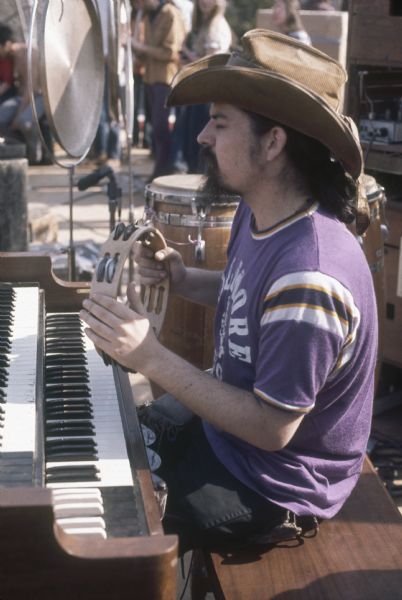
'Pigpen was and is now forever one of the Grateful Dead,' reads the inscription on his gravestone in Alta Mesa Memorial Park. Here he is in his one and only vocal appearance on that classic album American Beauty - the country blues Operator...
Subscribe to:
Posts (Atom)
