Here's a coincidence and a half. When I was in the V&A the other day, making my way to the Opus Anglicanum exhibition [see below], I spotted a couple of small-scale models for church monuments by Roubiliac. They looked interesting, and I made a mental note of the monuments' whereabouts, in a place called Warkton in Northamptonshire. The next day, my Derbyshire cousin (who knew nothing of this brief encounter in the V&A) forwarded to me an account of a restoration project that had been sent to her by a friend with an interest in such things. It was the restoration of the Roubiliac monuments and two others, all to members of the Montagu family, in the church of St Edmund, Warkton.
Clearly this was a sign, so on Saturday the cousin and I duly set off across three county boundaries to see for ourselves these remarkable monuments in their newly restored condition. They occupy the custom-built chancel of the parish church of a small, pretty (and publess) village northeast of Kettering, where they look entirely out of place, fabulously grandiose - and utterly stunning. There is no other word for the concussing impact of all that sparkling white marble, flooded in clear light from the huge east window. Involuntary 'Wow!'s are unavoidable. In art-historical terms, this is a collection of monuments of international importance, and there is nothing else like it in any English church.
The two Roubiliac monuments whose models I had seen are to John, 2nd Duke of Montagu (d.1749), and Lady Mary Churchill, Duchess of Montagu (d.1751). Lady Mary is figured in the first monument as the grieving widow, her anguished face upturned to a medallion portrait of the Duke.
The pose is, of course, mannered, but the carving of the dress, the right hand and the Duke's various honours laid out for all to see is quite exquisite.
To the right of the monument, the figure of Charity holds up the medallion portrait of the great man, while one of three children/putti (possibly representing the Montagus' three lost children) sheds a tear. Spilling out of the body of the monument are cannon and shot and other martial items emblematic of Montagu's role as the 18th-century equivalent of Minister of Defence.
The other Roubiliac monument is every bit as much a bravura display of the sculptor's art, but is made to a rather more artificial scheme. The muse Clotho spins out the thread of life, only for it to be cut by the shears of Atropos (her left hand resting on a skull, along with Clotho's right foot), to the horror of an onlooking Lachesis. Meanwhile two putti are busy adorning Mary's memorial urn.
As if these two stunning monuments were not enough, there's a third, equally brilliant but in a different manner, by another expatriate foreigner, the Dutchman Peter Mathias Van Gelder. He worked with Robert Adam, and it shows in the design of the niche in which the monument stands, and in the neoclassical style of the sculpture. It commemorates Lady Mary Montagu, Duchess of Montagu, and represents her care for distressed women, widows and orphans. The figures are quite beautifully realised, especially the angel who bends over the grieving woman and points heavenward.
The fourth and latest memorial of the quartet, sculpted by the Scotsman Thomas Campbell, is the simplest in design and the least impressive in effect - an anticlimax after the others, but it hardly matters. The Montagu monuments are a national treasure, a wonder of England. If you find yourself anywhere nearby, make your way to Warkton and be amazed (but telephone the churchwarden first, as the church is often closed in the winter months).
What the Montagu monuments lack - apart from Christian content (only present in the last) - is true emotional impact, a real sense of grief. The 18th century was not too strong on this aspect of monumental art, but the Victorian period certainly was, and a monument from the 1850s that we came across in the little Derbyshire church of St Katherine, Rowsley (neo-Norman, by Salvin junior) was genuinely moving as well as being beautifully sculpted. It commemorates Lady John Manners and her daughter, who died soon after birth, followed within a fortnight by her mother. The work of a Scottish sculptor, William Calder Marshall, it deserves to be better known.
Monday, 24 October 2016
Friday, 21 October 2016
Sitrep
I am up in Derbyshire just now (what, again? Yes, again). But meanwhile a piece by me about Sir John Soane's Museum is up on the website of Pooky, interiors and lighting mavens extraordinaire.
Wednesday, 19 October 2016
Words
Your starter for ten. What do all these words have in common?
ambidextrous, antediluvian, analogous, approximate, ascetic, anomalous,
carnivorous, coexistence, coma, compensate, computer, cryptography, cylindrical,
disruption, electricity, exhaustion, ferocious, follicle, generator, gymnastic,
hallucination, herbaceous, holocaust, insecurity, indigenous, jocularity,
literary, locomotion, medical, migrant, mucous, prairie, prostate, polarity,
precocious, pubescent, suicide, therapeutic, ulterior, ultimate, veterinarian.
Rather amazingly, every one of them was coined by Sir Thomas Browne, who was born on this day in 1605 and died, with exemplary symmetry, on the same day in 1682. Browne has, indeed, a total of 775 entries in the OED for first use of a word - not all of them as useful, or as lasting, as those above. Even if he had not written his great works - Hydriotaphia (Urn Burial), Religio Medici and the vast and strange Pseudodoxia Epidemica (Vulgar Errors) - he would have earned some fame in the world of words.
Sir Thomas was also, very probably, the first man to say 'I am the happiest man alive.' And, from what we know of his life and character and can adduce from his portrait, it seems likely to have been true.
Monday, 17 October 2016
English Beauty
Today I thought I'd drop in on the V&A to take a look at the Opus Anglicanum exhibition.
Opus Anglicanum - English work - is the name given to the extraordinarily high-quality embroidery that was produced in this country from the 12th to the 15th century and was in demand all over Europe and beyond. I wasn't expecting this exhibition to detain me long, but I thought I'd go along as there's not likely to be another on such a scale for many years - these pieces are extremely delicate and rare and seldom allowed to travel. As things turned out, I spent the best part of an hour and half exploring Opus Anglicanum.
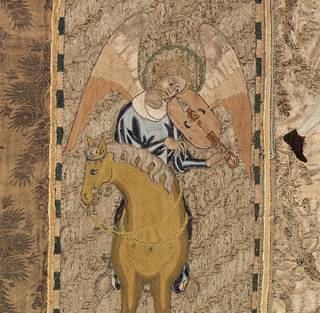
The thing is, these pieces - especially the church vestments - are just so beautiful. In design, drawing, colour and composition they are way beyond anything being done in painting, at least in this country - and it is all achieved with fantastically delicate and intricate stitching of coloured silks and gold and silver thread. The first exhibit you see, the Bologna Cope, is an absolute stunner, and in a wonderful state of preservation, considering it's 700 years old. Each panel is a little masterpiece, every detail is full of life (that's an incidental angel below) - it's altogether astonishing. And there is more to come, of comparable quality - copes, chasubles, orphreys, dalmatics (it pays to increase your word power...). There's a cope from the Vatican, no less, another from Toledo, there's an extraordinarily beautiful Tree of Jesse from Lyon, there's even English work from as far afield as Iceland.
However closely I examined these glorious pieces I could hardly believe that such effects had been created with nothing more that stitches in cloth. The explanatory labels, with their talk of underside couching, split stitch and stem stitch, did little to enlighten me, and even a video installation showing the stitches being made was not much help. The whole thing seems all but miraculous. It's a wonderful exhibition.
When I eventually tottered out - through the gift shop, inevitably - I was immediately hit by a blast of Whiter Shade of Pale, a symptom of the V&A's concurrent Sixties exhibition, You Say You Want a Revolution? Not me, thanks.
Saturday, 15 October 2016
From the Stacks to the Stage
Jean Alexander, the great character actress who played Hilda Ogden in Coronation Street for many years, has died, just three days after her 90th birthday. I was delighted to learn that, before she took up acting, Jean Alexander was a librarian, and she continued to be an active supporter of public libraries all her life. A librarian going into showbiz! That doesn't often happen, though I did once meet Caron Wheeler (later of Soul II Soul) when she was a Saturday library assistant. She didn't look like a career librarian to me...
Plenty of writers were also librarians, of course - Philip Larkin, Anne Tyler, Angus Wilson, etc - but have there been any actors, other than Jean Alexander, who began as librarians? Don't say Elizabeth Taylor - it was the other one, the writer. Over to you, Dave Lull?
Friday, 14 October 2016
A Bit More Bobness
Since the Dylan Nobel brouhaha is still going on, even on this blog, let me add this suggestion of another way of looking at Dylan's lyrics. Those who claim him as a bona fide poet always seem to support their case by quoting his most obviously, showily 'poetical' songs, such wordy, image-packed epics as Desolation Row, Sad Eyed Lady of the Lowlands or Stuck Inside of Mobile (all damned fine, indeed wonderful songs). I would suggest that Dylan actually comes closest to writing words that can stand on their own when he stays closest to ballad form. In particular I'd opine that the album John Wesley Harding contains not only some of his most perfect songs but some of his finest words - all the best of them in simple, concentrated ballad form. I Dreamed I Saw Saint Augustine, I Pity the Poor Immigrant... Of course they're better when they're sung, but those words on their own pack quite a punch, don't they?
All but forgotten: Elizabeth Jenkins
Does the name Elizabeth Jenkins ring any bells? It didn't with me when it came up on my last visit to my favourite bookshop (The Bookshop in Wirksworth). The proprietor had just sold an Elizabeth Jenkins and was pleasantly surprised to find that she was still being read. Elizabeth who? I asked, and he gave me the basics - distinguished writer, up there with the other Elizabeths, Bowen and Taylor, in her day, widely read and highly regarded. And now all but forgotten.
She had in fallen out of fashion long before she died, at the extraordinary age of 104, in 2010 (she published a memoir in her 100th year). She was a prolific writer - of biographies and historical studies as well as novels - but, held back by her diffident nature, she did little to sustain her career, shunning all publicity and self-promotion (she would have sunk like a stone in today's literary world). Happily, though, one novel of hers - The Tortoise and the Hare - was rediscovered by Carmen Callil and republished as a Virago Modern Classic. This remains the only Elizabeth Jenkins novel that is easily available. Naturally I bought it, and have now read it. It is startlingly good.
The Tortoise and the Hare, published in 1954, relates the break-up of a marriage - a common enough subject, but handled with rare imaginative flair and originality. Imogen is the beautiful, sensitive young wife of Evelyn Gresham, a handsome, brilliant and successful barrister with a high opinion of himself and a strong sense of entitlement, neither of which his compliant wife has done anything to dent. The Greshams have plenty of money, a big house in Berkshire and a place in town, a loyal cook, and a standard of living that might make today's readers blink in disbelief. But are they happy? Of course they are not.
The opening paragraph sets the tone - indeed it tells you almost all you need to know about these two and their relationship:
'The sunlight of late September filled the pale, formal streets between Portland Place and Manchester Square. The sky was a burning blue yet the still air was chill. A gold chestnut fan sailed down from some unseen tree and tinkled on the pavement. In the small antique-dealer's a strong shaft of sunlight, cloudy with whirling gold-dust, penetrated the collection of red lacquer and tortoiseshell, ormolu and morocco. Imogen Gresham held a mug in her bare hands; it was a pure sky blue, decorated with a pattern of raised wheat ears, of the kind known in country districts as a 'harvester'. Her eye absorbed the colour and her fingers the moulding of the wheat. Her husband however saw that there was a chip at the base of the mug, from which cracks meandered up the inside like rivers on a map.
'You don't want that, surely, ' he exclaimed. 'It would come apart in no time.' He turned abruptly to the window through which he could see his car standing at the kerb. Imogen with bent head slowly put down the mug...'
Imogen has not told Evelyn that she wanted to buy something as a favour to the antique-shop's elderly proprietor, who is on his uppers. It wouldn't have cut any ice with him if she had.
What that opening also demonstrates is Elizabeth Jenkins' ability as a descriptive writer. There are some arrestingly beautiful passages in the book, especially describing effects of light on water - the Greshams' Berkshire home is on the river, with water all around (and a key scene towards the end takes place on the Thames by Tower Bridge, after a riverboat trip). Jenkins is a writer highly attentive to surroundings, both outdoors and in. She is also highly attentive to the movements of Imogen's mind and emotions as the story unfolds and she begins to realise - but not before it is too late - what is going on between Evelyn and the wildly improbable, therefore easily dismissed, 'other woman'.
This is Blanche Silcox, tweedy, frumpy, older than Evelyn, pillar of village society, spinster, wearer of ludicrous hats, but wealthy, capable, knowledgable in practical affairs and strong-minded. It is in those last attributes - all of which Imogen lacks - that Blanche's fatal attraction lies. With Imogen we have to watch in horror as Blanche gradually engulfs Evelyn's life, leaving no room for his wife. Imogen's passivity, her failure to force a crisis and 'have it out' with Evelyn before it is too late, is at once deeply frustrating and entirely believable. Blanche Silcox has outflanked her, defeating her on her own ground. When it becomes clear that Evelyn 'adores' Blanche and even finds her more sexually satisfying than Imogen, it is all over. Imogen cannot fight back. As a male friend remarks, bluntly summing up the debacle, 'Women who are attractive in that sort of way, it's their thing. They never think about anything else, practically. That's why they're such good value, up to a point. But an affront to that side of them, and they're beaten to the floor. It wouldn't occur to them to try to patch the thing up...'
As it happens, there is an element of autobiography in The Tortoise and the Hare. Elizabeth Jenkins, a beautiful, sensitive woman herself, was dumped by a married lover (a man quite as distinguished and self-important as Evelyn Gresham) in favour of a rival every bit as improbable as Blanche Silcox. The novel was written in a burst of creative frenzy in the immediate aftermath, though you'd never guess that it was written at speed. Jenkins is an elegant stylist, very much in the Jane Austen mould (she wrote a well-thought-of biography of Austen and was a founder of the Jane Austen Society) - and her perception is similarly sharp and often merciless. The novel includes some extremely caustic descriptions of 'progressive' and 'arty' types, and there is a thoroughly Austenesque skewering of a featherbrained babbler along the way.
There is a decent range of well drawn, sympathetic secondary characters, providing some necessary shifts of viewpoint away from the unhappy Imogen. She, however, remains the centre of our fascinated, sometimes appalled interest, and it is her desperate situation that draws us in. The Tortoise and the Hare is a remarkable novel, and I have no argument with those who rate it as one of the classics of postwar English fiction. I'm certainly going to keep my eyes peeled for more Elizabeth Jenkins - she is a writer far too good to be forgotten.
Subscribe to:
Posts (Atom)