Wandering around in Birmingham's botanical gardens yesterday, I came across a board carrying a little background information about the plant hunter David Douglas, after whom the Douglas Fir is named. The intrepid Douglas, who introduced some 240 plants to Britain, travelled widely in the wilds of North America, and met his end, at the age of 35, in Hawaii. Climbing in the mountains, he became snow blind and fell into a pit trap, where he was gored to death by a wild bull. (At least, that's the version of his death given on the Birmingham board. Wikipedia offers a more nuanced account of Douglas's mysterious end.)
Then, this morning, I discovered that King Zog of Albania (born on this day in 1895) was probably, at his peak, the world's heaviest smoker, getting through more than 200 a day. He also survived something like 55 assassination attempts, on one occasion defending himself with his own pistol, making him the only head of state to have personally exchanged fire with a would-be assassin.
Sunday, 8 October 2017


Friday, 6 October 2017
The Lost Words?
This looks like a fine book – which, as the review says, should be made available in a cheaper edition if it is to reach the intended audience. But in what sense are these words – words like blackberry, buttercup, kingfisher, acorn, bluebell, conker, wren – 'lost'? They have been dropped from a children's dictionary whose very limited remit is simply to reflect current usage. By that criterion, their omission was probably justified, though I'm always suspicious of the publicity-seeking stunts of dictionary publishers these days. 'Lost words', though? The words will only be lost if the things described are (if then – words can have long afterlives), and there is no sign of any of these common natural phenomena disappearing.
The problem is that children today typically have less everyday contact with the natural world than they did in the days when they – we – were free to roam at large. But even in the city, nature is everywhere, even on the pavement (the asphalt can indeed be botanised), let alone in parks and gardens and along streets, many of which are still tree-lined, even in the very centre of town. Indeed the suburbs are now richer, in terms of natural diversity, than much of the intensively-farmed countryside. All that is needed is for children's attention to be drawn to this ever-present nature, and if the parents aren't doing that (especially when children are very young and eager to soak up all the knowledge they can get), then the schools should be – it's one of the most useful things they could do.
Happily my (adorable) granddaughter, who has just started school, has already been out on at least one organised nature walk in a nearby park. Not that she needed it, as she's grown up well aware of what blackberries, buttercups, acorns, bluebells, conkers and the rest are – these are certainly not 'lost words' for her, and I'm sure she's not the only one. But schools should certainly be doing more of this sort of thing – right through to secondary level (as was standard when I was at school). It would be good for the children's health and wellbeing, expand their knowledge of the world, and make them more aware of what is around them. If there's no room on the timetable, why not drop 'physical education' in favour of nature walks? Far more beneficial than running around on a muddy field or jumping over a vaulting horse. Horse? Another 'lost word'?
Thursday, 5 October 2017
The Whirligig of Time
I was half-listening to Radio 4 just now – David Cannadine talking about Prime Ministers' Props – when I caught a familiar sound pumping away under the words. Blow me down if it wasn't the Velvet Underground's White Light / White Heat! My mind looped back half a century...
When I was first at university, I would occasionally inflict my presence on the 'college disco'. Of the stack of singles that made up the playlist, only one was deemed cool and transgressive enough for us poseurs to request – White Light / White Heat. Not that we intended to dance – dear me, no. The thing was to take a seat, assume a languid pose and make no response whatever – not so much as a tapping finger – to the juddering, amphetamine-fuelled beat of the music. This was not easy, but as a demonstration of the art of cool it seemed well worth the effort. The pose could be broken only to ask the DJ to turn up the volume (if it was possible by this stage to make yourself heard). Yes indeed – like the young Sam Johnson, I spent my university years in a condition best characterised as one of 'stark insensibility'.
Why was White Light / White Heat being played under Prime Ministers' Props? It was triggered, alas, by Harold Wilson's talk of the 'white heat of the technological revolution' – what radio producer could resist such a cue? The principal subject of the programme, however, was Sir Alec Douglas-Home, who once said that if he wanted to work out an economic problem, he would do it with matchsticks. Guess which early Status Quo single was chosen to accompany every mention of matchsticks...?
Wednesday, 4 October 2017
Sargent at Dulwich

The pictures, painted in Venice, around the Med, in the Alps and various parts of France, Italy and Spain, the Middle East, North Africa and elsewhere, show a continuing preoccupation with painting effects of light on water and stone, of reflected light from water onto stone, of strong sun and complex shadow, and the particular problems of rendering light and shade on white material against white paper (as in the dress of the poster girl, Lady with Umbrella, above left).
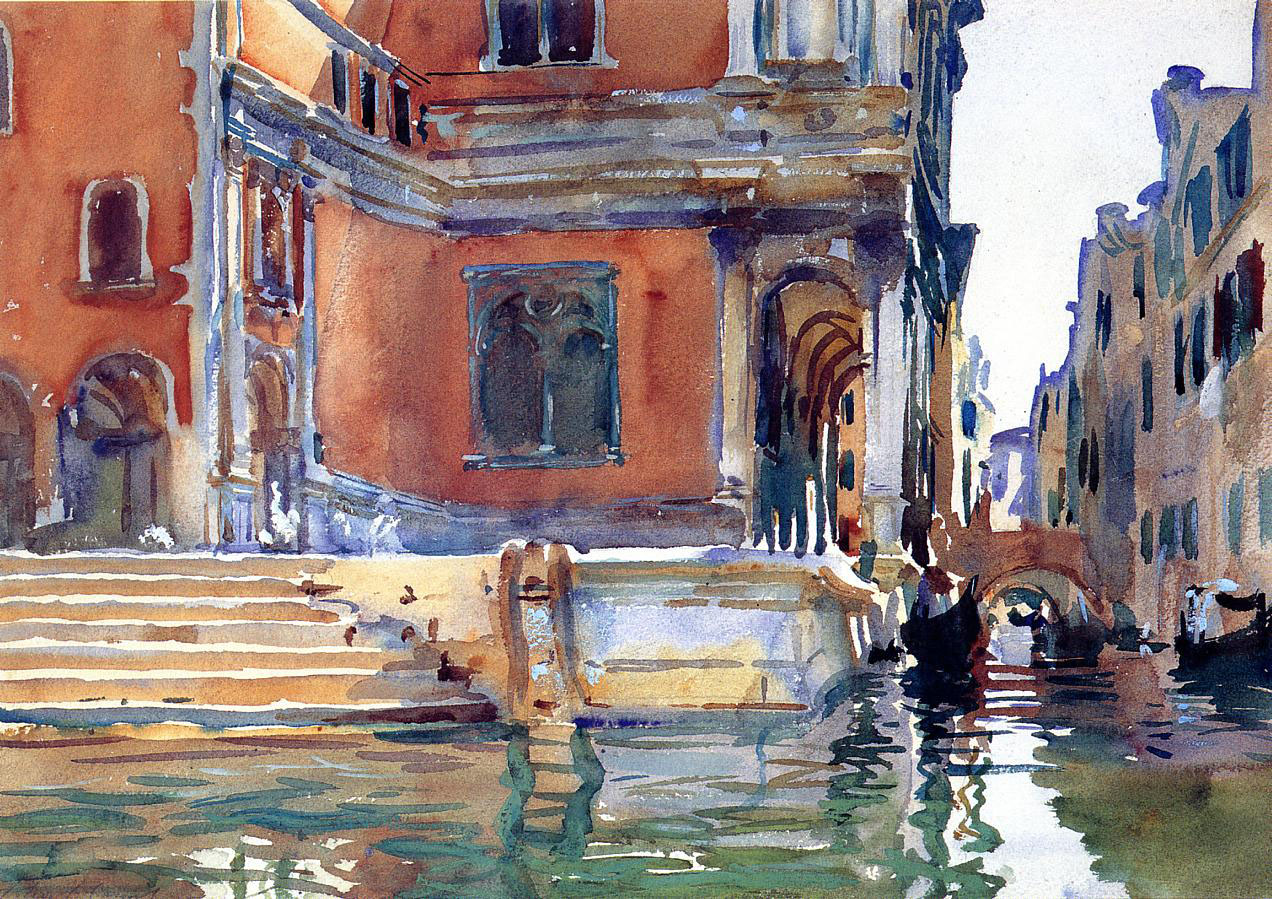
In Venice, Sargent paints at water level, from a gondola, fascinated by the effects of light where stone and water meet, by the play of light on the underside of bridges and the hulls of boats. There are no grand panoramas or conventional postcard views of the city; Sargent's engagement is intimate and detailed, the rapt attention of an artist rather than a tourist. He doesn't paint a palazzo – he paints one corner of it, from water level – and when, elsewhere in Italy, he paints a grand Baroque fountain he ignores the statue at the centre in favour of studying the meeting of stone and water at the edge of its pool. Most of these paintings could be classed as studies rather than finished works – but when studies are of this quality, the distinction hardly matters. Sargent himself lined his walls not with oils but with these watercolours, which no doubt also served as happy reminders of his travels and leisure time (others on show in the exhibition – rather less successful – are from Sargent's time as a war artist, and there are a few portrait studies of male nudes).

Walking around the exhibition – which is of manageable size, around 90 works – I realised I'd seen some of these pictures before, at the Royal Academy's Sargent and the Sea exhibition back in 2010 (including The One I'd Have Stolen). This time, the one I'd have stolen (theoretically, Your Honour) was the Spanish Fountain (above right), as perfect a study of sunlight on water and stone as anyone ever painted in watercolour. This is a thoroughly enjoyable exhibition, and I'm glad I made it – just.

Tuesday, 3 October 2017
Tom Petty
Sad news that Tom Petty has died, and at only 66. He did some great work, especially in creative collaboration with other musicians. A couple of touching details struck me in his obits...
At the age of 11, Petty (who had had a difficult childhood) met Elvis Presley and shook his hand - and 'That was the end of doing anything other than music in my life.'
Last year, after playing a set of 40th anniversary gigs with the Heartbreakers, he told Rolling Stone, 'I have a granddaughter now I'd like to see as much as I can. I don't want to spend my life on the road.' One of the good guys. RIP.
Monday, 2 October 2017
'A pip of life amid a mort of tails'
Today is the birthday of that great poet and successful insurance executive Wallace Stevens – 138 today. How to mark the day? With a poem, of course – but which? I got my inspiration when I was taking a stroll early this evening, looked up and saw a squadron of parakeets flying over, on the way to their roosting grounds...
The Bird with the Coppery Keen Claws
Above the forest of the parakeets,
A parakeet of parakeets prevails,
A pip of life amid a mort of tails.
(The rudiments of tropics are around,
Aloe of ivory, pear of rusty rind.)
His lids are white because his eyes are blind.
He is not paradise of parakeets,
Of his gold ether, golden alguazil,
Except because he broods there and is still.
Panache upon panache, his tails deploy
Upward and outward, in green-vented forms,
His tip a drop of water full of storms.
But though the turbulent tinges undulate
As his pure intellect applies its laws,
He moves not on his coppery, keen claws.
He munches a dry shell while he exerts
His will, yet never ceases, perfect cock,
To flare, in the sun-pallor of his rock.
Next time I see the parakeets I shall relish the image of a 'parakeet of parakeets' brooding over them, exerting his will as he munches a dry shell...
Sunday, 1 October 2017
Last Night I Saw W.H. Auden...
He was the subject of a BBC2 documentary, Stop All the Clocks: W.H. Auden in an Age of Anxiety, an attempt to – guess what – 'explore the contemporary relevance' of Auden's poetry. Ah well - that's the kind of pitch you'd have to make to get a programme on a dead white poet onto a mainstream BBC channel. And it wasn't at all bad.
Predictably, there was a lot of dubious stuff linking Auden's September 1, 1939 ('I sit in one of the dives/ On Fifty-Second Street/ Uncertain and afraid/ As the clever hopes expire/ Of a low, dishonest decade...') with the terrorist atrocity of 9/11. Equally predictably, much was made of Funeral Blues and its famous appearance in that terrible film Four Weddings and a Funeral (where John Hannah managed to turn what always struck me a serio-comic five-finger exercise into a heartbroken expression of grief).
Funeral Blues gave Auden's now posthumous fame a new lease of life – surely a good thing. But one of the interesting features of the documentary was its frequent reminders of just how famous the poet was, internationally, in his later life. He even appeared on Parkinson, for heaven's sake – smoking like a chimney and discoursing about poetry. Would any poet make it on to a popular chat show today? Hardly...
And there was extraordinary footage of Auden and Chester Kalman at their quaint little cottage at Kirchstetten in Austria (where Auden was buried). We see the poet suavely, almost ingratiatingly, giving interviews in German, and – more alarmingly – driving a VW Beetle, not a good idea for a man who lived on benzedrine and alcohol (indeed he had to give it up shortly after the footage was taken). At one point, Igor Stravinsky came on to declare that 'Auden has been in Austria too long now. After all, we can't afford to give our best poet to the Germans.' Quite.
The programme ended, fittingly, with another poem Auden wrote in 1939 - the great elegy In Memory of W.B. Yeats... 'In the deserts of the heart/ Let the healing fountain start,/ In the prison of his days/ Teach the free man how to praise.'
Subscribe to:
Posts (Atom)
