Friday, 28 June 2013

Back from Dieppe

Well, that was thoroughly restorative. Dieppe retains its unique, slightly faded charm, and its particular beauties of setting - the wide bay, the subtle, ever changing tones of sea and sky, and that extraordinary light, at once milky and sparkling. There was sunshine too this time, plenty of it - and, on the last evening, one of the best meals I have ever had, anywhere. If you find yourself eating in Dieppe, waste no time - head straight for the Bistrot des Barrieres, right by the fish market, where the former chef at La Melie is now doing his own superb thing with the freshest and finest ingredients, simply and perfectly cooked...
  But enough of food. Our visit also coincided with an exhibition at the castle of paintings by Jacques Emile Blanche, the gifted Anglophile who dominated Dieppe's artistic society for decades. The above piece of bravura portraiture - which is massive in scale and entirely uncharacteristic - was a highlight (of a kind) of the exhibition. A monumental work with the feel of a Baroque altarpiece, but drawing on the English tradition of open-air family portraiture, it depicts the Norwegian painter Frits Thaulow, his somewhat Amazonian wife, his son and his adoring daughter, in her turn adored by the family dog. In these unlikely circumstances, Thaulow, cigarette in mouth, attempts to paint a landscape.
  Thaulow specialised in painting rivers and flowing water - one of his river scenes was in the exhibition (and caught Mrs N's eye, who suggested I secrete it under my coat on the way out - but in fact the painting I most coveted was a quite beautifully accomplished late still life by Blanche, of white hellebores in a dark blue vase beside a yellow bowl. I could live with that...).
 When they set up house in Dieppe, Thaulow and his wife were notably friendly, generous and hospitable to all, and were among the few in the cliquey and fissiparous world of 'Dieppe society' who were without enemies. Thaulow was also one of those who did not shun - as Sickert and, against his better instincts, Blanche did - Oscar Wilde when he arrived in Dieppe after serving his prison sentence. On one occasion when Wilde was being publicly humiliated in a cafe, Thaulow rose from his table, strode over and boomed at him, 'Mr Wilde, my wife and I would feel honoured to have you dine with us en famille this evening.' Wilde gratefully accepted and became a frequent visitor at the Thaulows'.
 Sadly the Cafe Suisse, outside which Wilde would sit in his Dieppe days, holding court and being summarily 'cut', has had a recent garish makeover that has erased every last trace of its illustrious fin de siecle past. Such a shame it wasn't, rather, restored to its red plush and gilt glory. On the other hand, one of the remaining traces of the great days of the English community in Dieppe - the fading remnant of an 'English Grocers' sign near the Cafe des Tribunaux - has been repainted and now looks as good as new, though of course the building it was painted on no longer houses an English grocer's shop.
 Sadly too, butterflies were few and far between this year on the clifftops where they used to be abundant, around the castle and above the harbour. However, yesterday morning I had a happy moment when, beside the road under the cliffs near the ferry port, I spotted, on a patch of scrubby land yellow with birdsfoot trefoil, stonecrop and kidney vetch, a Small Blue flying - and then another, and another and another, a thriving little colony of this tiniest and daintiest of our British blues, now scarce and very local on our side of the Channel. This could well turn out to be the highlight of my butterfly year - and it happened in Dieppe.

Saturday, 22 June 2013

Botanising on the Asphalt again

I've been taking Walter Benjamin's phrase literally on walks to and from the station lately, keeping my eyes to the ground and making a rough inventory of the plants breaking through and thriving - at least until the next visit from the weedkiller sprayers - in the gutters and on the edges of kerbs and pavements. It's not until you start counting that you realise how many species there are, happily living in these apparently inhospitable corners. I've identified three or four different grasses (don't ask me their names), various bittercresses and other crucifers, groundsel, sow thistle, chickweed and hawkweeds, willow herb, ivy-leaved toadflax, lesser bindweed, herb bennet, storksbills, green alkanet, mallow, lambstail plantain, redshank, spurge, the inevitable buddleia, and garden escapes including yellow fumitory (Corydalis), Oxalis and various poppies, including the 'Caiforrnia poppy', Escholzia. I'm sure there are many more that an expert botanist, working systematically, would identify - upward of 50 species perhaps, in 100 yards or so of pavement and gutter. All this abundance, all this persistence, the indestructible plant kingdom reminding us of the frailty of our tenure... As Horace would have it, 'Naturam expellas furca, tamen usque recurret' (you may drive out nature with a pitchfork but she hurries right back).
  But tomorrow I am heading for Dieppe to spend a few days as a summer flaneur, botanising the asphalt in the sense that Benjamin meant. Au revoir, amis...

Friday, 21 June 2013

Now the Juniper

Hard on the heels of Ash Dieback Disease comes news of a fungal threat to our native Juniper trees - and we can't afford to lose any native conifer species: Juniper is one of just three, and most of our juniper trees are old and ailing. The fungus, Phytophthora Austrocedrae, has been found in trees in Scotland and Northern England, and the news has predictably been reported as a threat to our precious gin and tonic - though it is no such thing, as we import nearly all our juniper berries from eastern Europe. As usual with these tree scares, it's hard to know how seriously to take it - and hard not to suspect that imported plants might be involved (though it's illegal to import junipers from beyond the EU).  The good news is that there's no sign of trouble around Box Hill, where the numerous junipers gave their name to Juniper Hall, now a field centre, in the 1790s a haunt of French emigres [does anyone know how to do accents on Blogger?] escaping the worst excesses of the French Revolution. It was in the Templeton Room at Juniper Hall that Fanny Burney met General Alexandre d'Arblay and fell in love. They married soon after in Mickleham church and settled down happily in Camilla Cottage (built on the royalties of the novel) in nearby Westhumble, just along the road from the Burford Bridge hotel, where in 1817 John Keats stayed while he was writing Endymion: 'I like this place very much. There is Hill & Dale and a little River--I went up Box hill this Evening after the Moon--you a' seen the Moon--came down--and wrote some lines. Whenever I am separated from you, and not engaged in a continued Poem--every Letter shall bring you a lyric--but I am too anxious for you to enjoy the whole, to send you a particle...'

Thursday, 20 June 2013

Gandolfini: 'These people are nuts; this is kind of interesting...'

The death of James Gandolfini is sad news. His portrayal of Tony Soprano deserves all the praise it's had and more. For my money The Sopranos was the greatest TV drama ever made, and its greatness owed a great deal to Gandolfini. The actor's sudden death lends an extra dimension to that extraordinary final scene of The Sopranos... RIP.

Wednesday, 19 June 2013

'This thin uncomprehended song...'

Yesterday I heard a report on the radio about the spectacular mass hatching of Periodical Cicadas in the eastern seaboard states of the US. It put me in mind of Richard Wilbur's poem, Cicadas:

'You know those windless summer evenings, swollen to stasis
by too-substantial melodies, rich as a

running-down record, ground round

to full quiet. Even the leaves
have thick tongues.


And if the first crickets quicken then,
other inhabitants, at window or door
or rising from table, feel in the lungs
a slim false-freshness, by this
trick of the ear.

Chanters of miracles took for a simple sign
the Latin cicada, because of his long waiting
and sweet change in daylight, and his singing
all his life, pinched on the ash leaf,
heedless of ants.

Others made morals; all were puzzled and joyed
by this gratuitous song. Such a plain thing
morals could not surround, nor listening:
not `chirr’ nor `cri-cri.’ There is no straight
way of approaching it.

This thin uncomprehended song it is
springs healing questions into binding air.
Fabre, by firing all the municipal cannon
under a piping tree, found out
cicadas cannot hear.'


The last lines refer to an experiment by the great naturalist and nature writer Jean-Henri Fabre - a man distrustful of theories and systems, whom Darwin called 'an inimitable observer'.
Here is his own account of the cicada experiment:
'For fifteen years the Common Cicada has thrust his society upon me. Every summer for two months I have these insects before my eyes, and their song in my ears. I see them ranged in rows on the smooth bark of the plane trees, the maker of music and his mate sitting side-by-side …. Whether drinking or moving they never cease singing.
It seems unlikely therefore that they are calling their mates. You do not spend months on end calling to someone who is at your elbow. Indeed I am inclined to think that the Cicada himself cannot even hear the song he sings with so much apparent delight ….
On one occasion I borrowed the local artillery, that is to say the guns that are fired on feast days in the village. There were two of them, and they were crammed with powder as though for the most important rejoicings. They were placed at the foot of the plane trees in front of my door. We were careful to leave the windows open, to prevent the panes from breaking. The Cicadas in the branches overhead could not see what was happening.
Six of us waited below, eager to hear what would be the effect on the orchestra above.
Bang! The gun went off with a noise like a thunderclap.
Quite unconcerned, the Cicada continued to sing. Not one appeared in the least disturbed …
I think, after this experiment, we must admit that the Cicada is hard of hearing, and like a very deaf man, is quite unconscious that he is making a noise.'

Perhaps not the most scrupulously scientific experiment - but fun, and beautifully narrated.

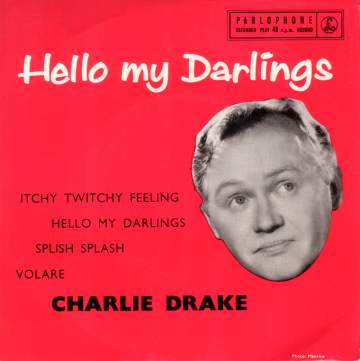
Heroes Of Prog Rock: Charlie Drake

Born on this day in 1925 was the diminutive comic Charlie Drake, who was, incredibly, a considerable star in the Fifties and Sixties. Even in an era that abounded in deeply unfunny comedians, he stood out as quite singularly tiresome - though he was very popular with children, including, I blush to recall, my boyhood self. I'm pretty sure I even watched (and presumably enjoyed) at least one of his feature films - Sands of the Desert? Drake's catchphrase 'Hello my darlings!' was originally addressed to the breasts of any of the tall, big-busted starlets with whose poitrine he found himself eye to eye, as it were, in the course of duty. Later, he adapted it to all situations, to unfailingly irksome effect.
  Apart from the catchphrase, Drake's stock in trade was slapstick - and it was nearly the end of him when a live TV sketch went wrong in 1961. The little chap was to be hauled through a bookcase that had been specially set up to fall apart as he emerged - but an over-diligent workman (or friend of British comedy) had mended it, with the result that it put up a considerable resistance. Unaware of what had happened, Drake's fellow actors proceeded with the rest of the sketch, which involved picking him up and throwing him through a window. Drake was unconscious for three days, with a fractured skull, and didn't return to the screen for two years.
  Like many a comedian in those days, Drake made several records (mostly produced by George Martin, who has had to live with the shame ever since) - but his most startling contribution to music history was a 1975 single titled You Never Know, the first post-Genesis solo project of prog rock / world music legend Peter Gabriel (who had himself recorded the song as a demo). The performing line-up for Drake's recording of You Never Know is surely one of the most bizarre ever: lead vocal Charlie Drake, backing vocal Sandy Denny, Robert Fripp on guitar, Percy Jones on bass, Keith Tippett on keyboards and Phil Collins on drums.You can, if you must, listen to it here - though  I must warn you, it's pretty terrifying...
 Drake - whose last stage role was as Baron Hardon in Jim Davidson's 'adult' pantomime Sinderella - was a notorious womaniser. However, there is no truth in the rumour that flame-haired Simply Red frontman Mick Hucknall was his love child.
  To his credit, Drake did put in a fine performance as Smallweed in the BBC's 1985 Bleak House. This too was pretty terrifying, but in a better way.

Tuesday, 18 June 2013

Beau Dabbler

I pay tribute to Beau Brummell on The Dabbler today...