My father ( d. 1991) has been in my dreams rather a lot lately. Just being there, not packing any particular charge or significance. Often my mother too (d.2013), both of them usually in some stage of middle age, never old. It seems quite unremarkable. We meet without surprise, as in Richard Wilbur's poem (the title poem of his last collection)...
Anterooms
Out of the snowdrift
Which covered it, this pillared
Sundial starts to lift,
Able now at last
To let its frozen hours
Melt into the past
In bright, ticking drops.
Time so often hastens by,
Time so often stops—
Still, it strains belief
How an instant can dilate,
Or long years be brief.
Dreams, which interweave
All our times and tenses, are
What we can believe:
Dark they are, yet plain,
Coming to us now as if
Through a cobwebbed pane
Where, before our eyes,
All the living and the dead
Meet without surprise.
Thursday, 30 November 2017


Wednesday, 29 November 2017
Yet More Retroprogressive News
Good to hear that the government has plans to reopen several railway lines axed in the notorious 'Beeching cuts'. And this is being done largely to ease the overcrowding on existing routes. The railways, those archaic survivals from the Victorian era, were supposed to wither away in a the whizzy go-ahead age of the motor car – but no, they are busier than ever (at least since the demobilisation after the last war). As that BBC favourite Jimmy Savile (whatever became of him?) used to say, 'This is the age of the train.'
Time for a replay of Flanders and Swann's classic elegy to the old branch lines lost to the Beeching axe...
Time for a replay of Flanders and Swann's classic elegy to the old branch lines lost to the Beeching axe...
Monday, 27 November 2017
In a Nutshell

It's a book that exactly fits its title, and the outlining is done con brio by one Edmund Vale, a writer with a lively style and a nice turn of phrase. Here he is on the fall of the hard-line antiquarian Camden Society following their restoration of St Sepulchre's in Cambridge:
'They began by pulling down the clerestory, a 15th-century restoration of the Norman original but in contemporary Perpendicular. The little windows were replaced in 19th-century Norman. When it came to putting the clock back in the chancel, they could not resist replacing the Communion table with a supposed near replica of what must have served the pious founders – a fixed stone altar. But parishioners returning to their revived place of worship mistook this touch of architectural virtu for a doctrinal outrage. The Society was sued at law for Popery, convicted, and ordered to remove the rock of offence.
The Camden Society never recovered from this blow to their prestige. But they had succeeded in lifting a vogue which had begun as a genteel folly – a sort of whimsical counterblast to the awful solemnity of neo-classicism – into an even more flourishing solemnity which, in turn, infused its stylistic influence into buildings of every description.'
The running titles are pretty good too – Surprising Discovery (of Ancient Greek architecture), New Post-Roman Speedways, Vogue of the Queen Anne-ites, Dissolution of the Servant Class, But the Romans Got There First... Reading this little volume is rather like reading Osbert Lancaster or John Betjeman. But who was Edmund Vale?
He was, I discover, a prolific author of books on the English countryside and English buildings, among other things – the kind of writer who had a ready market between the wars and in the immediate postwar years. There's a Facebook page devoted to him, curated by his grandson – here's the link. I'll be looking out for more of his books.
An Outline of English Architecture is illustrated with a few photographs and small line drawings. Nowadays a book like this would consist mostly of photographic illustrations, with the words limited to little more than captions. It might, I suppose, be more practically useful, but it wouldn't be a tenth as enjoyable as Edmund Vale's little Nutshell Book.
Sunday, 26 November 2017
A Matter of Manners
In today's Sunday Times, Niall Ferguson refers to the current pushback against sexual harassment as a 'revolution in manners' (he has well-founded reservations about its potential to 'overshoot', as revolutions do). Ferguson is surely right to identify the whole business as a matter of manners – manners in need of reform – and he's the third person I've noticed so far making this identification (the others were an unlikely pair – Jacob Rees Mogg and Petronella Wyatt).
These days the word 'manners' tends to be narrowly defined in terms of such things as table manners and the fatuous rules of etiquette, but it represents something far bigger and more important than any of that. Manners are the basic lubricant of society, the conventions of behaviour that enable us to live together with minimal friction. The aim of manners, properly understood, is to avoid causing discomfort to other people – discomfort ranging all the way from awkwardness and embarrassment to real pain and distress. It is indeed a matter of convention, and therefore liable to evolve over time, but that doesn't mean it is any less real, important or 'authentic'.
Instead of taking a forensic view of the whole sexual harassment brouhaha as a matter of infringed rights and criminal (or proto-criminal) offences, it might be more illuminating to consider it as being, at least in part, the product of an evolution of manners, of the ways men and women interact with each other. There is clearly criminality in cases where underaged children are involved (though this doesn't seem to apply to the rock stars who thrived in the Seventies) and in the activities of the more thuggish sexual predators (one of whom once occupied the White House). But much of the rest is down to a movement in the barriers of offence. It is no doubt regrettable, but it is a fact that, back in the Seventies, women and girls took a degree of what we would now call sexual harassment as an everyday nuisance, one that most of them were perfectly capable of dealing with. Now we tend to find such behaviour unacceptable – quite right too – but then it was, just, within the boundaries of the acceptable. It was, however, outside the bounds of mannerly behaviour. Such behaviour was, among other things, bad manners – inconsiderate, crude and likely to cause distress.
The English were once famed for their manners – not elaborate displays of fake courtesy but a basic decent concern not to discomfit or pain the other person, to rub along (rubbing along being one of the great English talents, along with muddling through). These manners were closely related to English self-effacement and respect for fair play. Of course they were by no means universal, but they were enough in evidence for the stereotype to gain traction and persist. It is in decline now, in an age of coarsening manners and strident self-assertion, but it does survive (especially away from the urban scrum). We should cherish and encourage it; manners, in this broad humane sense, really matter. They make us what we are. As William of Wykeham put it centuries ago, 'Manners makyth man'.
Friday, 24 November 2017
'A splendid person and a most arrogant spirit...'
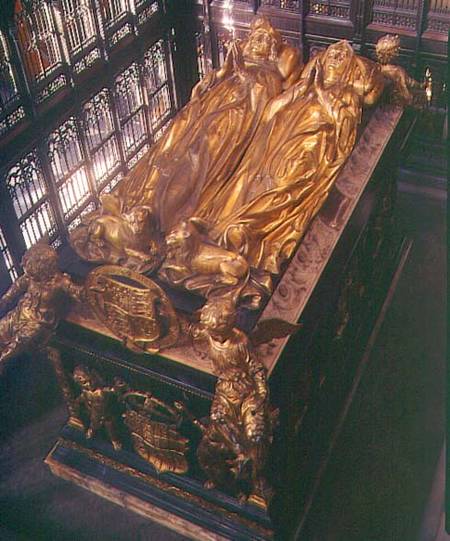
As a young man, Torrigiani, while copying Masaccio's frescoes in the Carmine church with various other learners, got into a row with Michelangelo and punched him so hard that he broke his nose. After this he seems to have fled Florence, turned up again in Rome, then spent some years as a hired soldier – the perfect job for him – before catching the eye of Henry VIII, who wanted a suitably splendid tomb for his parents . He certainly got it, along with various other pieces of work by Torrigiano, most of which were later destroyed by the Puritans.
Cellini, according to himself, refused to come to England from Florence to work with Torrigiano.
'This man,' he recalls, 'had a splendid person and a most arrogant spirit, with the air of a great soldier more than a sculptor, especially in regard to his vehement gestures and his resonant voice, together with a habit he had of knitting his brows, enough to frighten any man of courage. He kept talking every day about his gallant feats among those beasts of Englishmen.'
Beasts, indeed! Still, he left us with one of our greatest works of funerary art.

Thursday, 23 November 2017
'Thou shouldst be living at this hour'
'And what doe they tell us vainly of new opinions, when this very opinion of theirs, that none must be heard but whom they like, is the worst and newest opinion of all others, and is the chief cause why sects and schisms doe so much abound and true knowledge is kept at distance from us...'
Wise and prophetic words from Milton's pamphlet on press freedom, Areopagitica, published on this day in 1644. They could hardly be more pertinent in these ever more censorious times when, for so many, 'none must be heard but whom they like'.
(At school I was given a copy of Areopagitica by the head of the French department. I think this was a shot fired in the fierce trench warfare between him and the head of the English department. I remained loyal to English Literature.)
Wednesday, 22 November 2017
The Doctor Gives a Heavy Stroke
'I myself am of opinion,' declares Samuel Johnson to the assembled company, 'that more influence has been ascribed to "The Beggar's Opera" than it in reality ever had; for I do not believe that any man was ever made a rogue by being present at its representation. At the same time I do not deny that it may have some influence, by making the character of a rogue familiar, and in some degree pleasing.' Then collecting himself, as it were, to give a heavy stroke: 'There is in it such a labefectation of all principles, as may be injurious to morality.'
While he pronounced this response, we sat in a comical sort of restraint, smothering a laugh, which we were afraid might burst out...'
A heavy stroke indeed, 'labefactation'. Johnson seems to have coined it for the occasion, taking the already obscure word 'labefaction' and making of it something still more crushingly impressive. The meaning is straightforward enough: a weakening or loosening, tending to downfall (from labare, to fall or totter, with facere, to make). There's a verb, equally obscure – to 'labefy'.
Boswell himself believed there was real moral danger in The Beggar's Opera, with its highly attractive picture of the gaiety and heroism of an amoral rogue – but the young Scotsman was no doubt rather more prone to moral labefaction than the good Doctor.
Subscribe to:
Posts (Atom)
