Wednesday, 14 August 2013
Crows and Herons
Yesterday evening, looking out of the train window as I travelled home, I saw a sight I'd never seen before. Two herons were perched high up in a tree among a couple of dozen crows who were taking up positions to roost - and who seemed quite unperturbed by the presence of herons among them. Whenever in the past I've seen crows and herons in any kind of proximity, the former have been relentlessly mobbing the latter and driving them away. Are the crows changing their ways - and if so, why? There must be something in it for them, as they're extremely smart birds who in the past few decades have developed from solitary country dwellers to gregarious, streetwise urban scavengers. Now they are so numerous wherever there's a bit of water, herons too have changed their ways, becoming almost fearless in the presence of humans (now we're not shooting at them) and taking their place among the lesser waterfowl, even competing with the ducks for thrown bread. But if a new age of detente with the crows is dawning, we may be sure it's the crows who are controlling the situation. I wonder what is going on. Has anyone else noticed this new behaviour, or was it an aberration?


Restraint

Talking of restraint, here is a short and simple poem by Edward Thomas (buried in the Agny Military Cemetery, Row C, Grave 43) -
A Private
This ploughman dead in battle slept out of doors
Many a frozen night, and merrily
Answered staid drinkers, good bedmen, and all bores:
"At Mrs Greenland's Hawthorn Bush," said he,
"I slept." None knew which bush. Above the town,
Beyond `The Drover', a hundred spot the down
In Wiltshire. And where now at last he sleeps
More sound in France - that, too, he secret keeps.
Tuesday, 13 August 2013
This and That
The skies are quieter now - apart, that is, from the ever-growing flocks of ring-necked parakeets (40 or 50 at a time these days) making their raucous, shrieking way to wherever the food is. They, I fear, will be always with us - but the swifts have gone for the year. Or as good as gone, after a summer in which they seemed more numerous, vocal and lively than they've been for some while. I thought I might have seen my last on Friday, but no - yesterday evening, quite high up over Carshalton village, three swifts were flying quietly and purposefully into the southwest...
This was a cheering end to a somewhat grim day, which began with a visit to the dentist. As I lay there in the dental chair, with dark glasses on (he insists), while he drilled, injected and poked away and his assistant plied the suction tube, I became aware that Vaughan Williams's Tallis Fantasia was playing, pianissimo, in the background. 'Melancholic music, I'm afraid,' said the dentist. 'Rather lovely though', I ventured, speaking from the still functioning side of my mouth (he'd given me a double dose of anaesthetic). He told me he'd treated himself to a big boxed set of Vaughan Williams, which he found in a large, wonderfully well stocked record store in London. 'Whereabouts?' I asked, as you would. He seemed a little embarrassed at this and, after a little prevarication, had to admit he hadn't the faintest idea. He thought it might be somewhere near Oxford Circus, but really it could be anywhere. Definitely London though. Whenever he is in London, he told me, he loses all sense of direction and hasn't the faintest idea where he is. I think, in the circumstances, he's doing rather well to find his way to the surgery every morning (let alone find his way round so many mouths). Anyway, next time I see him, he promises, he'll be able to tell me where to find this musical goldmine.
I went on my way, for the next four hours unable to eat, barely able to drink, and feeling as if half of someone else's jaw had been crudely attached to mine in some sort of Frankensteinian experiment. All's well today, though, apart from a little residual pain.
PS: I see Blackberry is in trouble. Clearly they should merge with Apple. Easy as pie. This could be the anaesthetic talking...
This was a cheering end to a somewhat grim day, which began with a visit to the dentist. As I lay there in the dental chair, with dark glasses on (he insists), while he drilled, injected and poked away and his assistant plied the suction tube, I became aware that Vaughan Williams's Tallis Fantasia was playing, pianissimo, in the background. 'Melancholic music, I'm afraid,' said the dentist. 'Rather lovely though', I ventured, speaking from the still functioning side of my mouth (he'd given me a double dose of anaesthetic). He told me he'd treated himself to a big boxed set of Vaughan Williams, which he found in a large, wonderfully well stocked record store in London. 'Whereabouts?' I asked, as you would. He seemed a little embarrassed at this and, after a little prevarication, had to admit he hadn't the faintest idea. He thought it might be somewhere near Oxford Circus, but really it could be anywhere. Definitely London though. Whenever he is in London, he told me, he loses all sense of direction and hasn't the faintest idea where he is. I think, in the circumstances, he's doing rather well to find his way to the surgery every morning (let alone find his way round so many mouths). Anyway, next time I see him, he promises, he'll be able to tell me where to find this musical goldmine.
I went on my way, for the next four hours unable to eat, barely able to drink, and feeling as if half of someone else's jaw had been crudely attached to mine in some sort of Frankensteinian experiment. All's well today, though, apart from a little residual pain.
PS: I see Blackberry is in trouble. Clearly they should merge with Apple. Easy as pie. This could be the anaesthetic talking...
Monday, 12 August 2013
Sunday, 11 August 2013
Melon Day
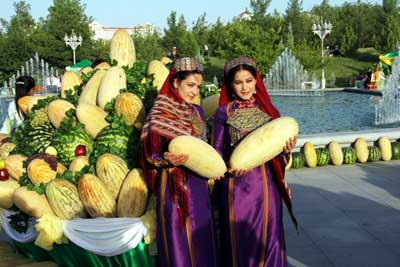
'Almighty God,' declared Turkmenbashi (the man not the melon) in 2004, 'has turned Turkmen soil into a fertile source of an abundance of the tastiest fruits. Among them are Turkmen melons, which are the result of farmers' hard work and which have a unique taste reminiscent of the fruit of Paradise.'
'The Turkmen melon,' he remarked on another occasion, 'is the source of our pride. Its taste has no equal in the world, the smell makes your head spin.' No wonder the doughty Turkmens are so keen to celebrate their melons.
They also, by the way, have an annual celebration of the wonders of water. It falls on the first Sunday of April and goes by the name Drop of Water Is a Grain of Gold Festival.
Friday, 9 August 2013
WTF?
Just in case - and it seems unlikely on recent form - you've come here looking for something in the way of serious thought, or a bit of lit crit, perhaps a poem - I can only apologise and suggest you look elsewhere. I'm afraid this warm August has thoroughly addled my pate, I seem to be permanently tired - and everywhere I look it's the Silly Season. I managed not to post yesterday on the Jimmy Savile float outrage (it's given me an idea for next year's Carshalton Carnival), but today I found myself reading the story of a lady vicar's offensive bumper sticker. This sticker (which, we are assured, went unremarked by Rowan Williams himself) bears the legend WTFWJD, i.e. WTF would Jesus do? A variant on the better-known WWJD - What would Jesus do? (a good, if often unanswerable question), the WTF version is generally employed by 'anti-fundies [fundamentalists]' and indeed anti-Xtians, as a weapon of mockery (there's even a song of the same name), so I'm not sure if the lady vicar really knows what she's doing, other than being, well... silly. But then I read on - and was astonished to learn that this lady vicar is none other than the well-known librettist Alice Goodman, who is the wife of our Greatest Living Poet, Geoffrey Hill! What on earth are we to make of this? Of all the names one might expect to turn up in a Silly Season story, that of Geoffrey Hill is surely the very last.
Thursday, 8 August 2013
Iconic!

Looking at Abbey Road's list of titles is a reminder that even this, perhaps the best Beatles album (certainly the best Side 2), contains some clunkers - the unforgivable Her Majesty, Maxwell's Silver Hammer, and of course Ringo's distinctive contribution, Octopus's Garden. Talking of Ringo, did you know about his addition to the James Bond songbook? Let Ringo himself tell the tale...
Subscribe to:
Posts (Atom)
