I guess I'd better get my twopenn'orth in on the subject du jour - the sensational news that Bob Dylan has won the Nobel Prize for Literature. This is, if nothing else, a capital joke (who said the Swedes have no sense of humour?) and I'm sure Dylan will take it in that spirit. This particular Nobel prize has long been one kind of joke, and now it is another.
Though I yield to no man (unless he is called Bryan Appleyard) in my admiration for Dylan's work, I have not for a very long time mistaken that work for literature. Dylan is a songwriter of rare, indeed unique, genius, but songs are what he writes - not poems, not literature (pace Christopher Ricks). It's great that he has won, but probably better to think that what he's won is the Nobel Prize for Bobness. It was high time.
Thursday, 13 October 2016


Wednesday, 12 October 2016
Dieppe Album

Otherwise, however, what change there has been bodes well. A good deal of discreet and sensitive refurbishment has been achieved in the old town, new businesses are opening rather than old ones closing down, and there's a general sense that Dieppe is no longer a town in decline. At the same time, it retains its faded, crumbling-round-the-edges, fin-de-siècle charm, and the streets of the old town - especially the back streets - are very much as Walter Sickert would have known them (though the less said about the now hideous, once elegant Café Suisse the better).

Among the welcome signs of renewal was the pleasant surprise of the newly restored Maison Miffant (above) on Rue d' Ecosses. For many years this historic building - the oldest house in Dieppe, one of the few that survived the unfortunate Anglo-Dutch bombardment of 1694 - stood mouldering away, becoming increasingly dilapidated, and looking ever less likely to be saved. Now, though, it has been restored and refurbished, and divided into five apartments. Admittedly it now stands surrounded by a building site (presumably a deal was cut with the property developer), but at least it's standing, and in good shape to last a few more centuries.


And this chap? He stands in an outbuilding of the castle/museum that looms over the town. We were a couple of weeks too late to catch an exhibition we'd already seen in Chichester - Sickert in Dieppe.
Back
Back from Dieppe to discover that my piece on Van Gogh's 'other' flower paintings is up on the flowerful blog of the excellent Freddie's Flowers, suppliers of fine blooms to the quality. Give your eyes a treat...
Wednesday, 5 October 2016
Off
I'm off to Dieppe (what, again? Yes, again - it's been two years now and I'm feeling withdrawal symptoms) for a few days. A bientot!
Tuesday, 4 October 2016
The Richest Artist You'd Never Heard Of
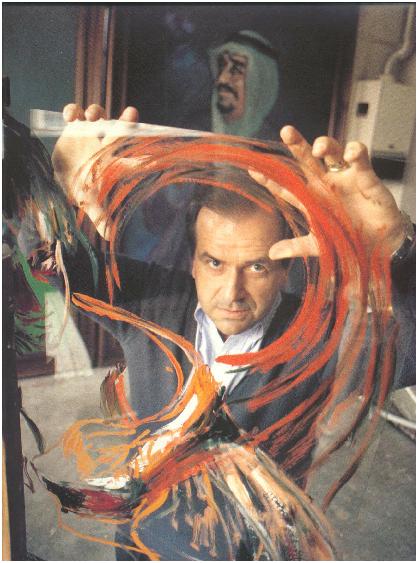
The secret of his success was his cordial professional relationship with the Saudi royal family, who were prepared in his case to overlook Islam's traditional ban on representative art, especially portrait painting. Vicari painted the Saudi royals and romantic scenes of Bedouin life and the beauties of Riyadh, and at one point sold 125 paintings of the First Gulf War to Prince Khaled for £17 million. No fewer than three galleries in Saudi Arabia are devoted to Vicari's works, which look like the kind of things Rolf Harris might have produced if let loose in Arabia. They are certainly not lacking in, er, vigour and, er, colour. (There's a good deal of Vicari to be seen on Google Images, including a press photograph of the artist giving Harry Secombe a painting lesson.)
This artist clearly had immense charm, and long before he began to exert it on the Saudis, he had become a popular London society portraitist and artist about town. He must also have had a good deal of native talent: the son of Italian restaurateurs in Port Talbot, he won the painting gold medal at the Wales National Eisteddfod at the age of 12 and was the youngest person ever to gain a scholarship to the Slade. There he studied under Lucian Freud, though it seems to have had little effect on his style. When he became rich - with a studio near Nice and apartments in Monte Carlo and Riyadh - he lived high off the hog and was lavish and generous with his money, to such an extent that, by 2014, he had, almost incredibly, managed to bankrupt himself. He died in hospital in Swansea, back in his native land.
What a life! A life worth celebrating, surely (even if the art perhaps isn't).

Monday, 3 October 2016
Time, memory, etc.
No wonder I was so startled to discover I'd been on Facebook for two years - I actually joined in February this year. But I was ready to believe it was my Facebook 'second birthday' because, when it comes to the passage of time, I'll believe pretty much anything. I'm at that stage of life when events of a few days or weeks ago can seem wrong-end-of-a-telescope remote, while things that happened last year or the year before can feel oddly fresh and recent.
Of course, time never marches at a steady pace - it's wonderfully elastic, stretching as we look back on an eventful period full of change, contracting when nothing much has happened and we've stayed in one place. However, I guess I'm now on the foothills of old age - or my memory is. So far, this is causing me no problems and is in fact rather agreeable, part of that general progress (lapse?) of my mind from pin-sharp clarity (how long ago that seems) to something more fuzzy and benign, allusive rather than expository, 'ghostlier demarcations' - from Pre-Raphaelite to Impressionist, if you like. I can't wait for Cubism...
Of course, time never marches at a steady pace - it's wonderfully elastic, stretching as we look back on an eventful period full of change, contracting when nothing much has happened and we've stayed in one place. However, I guess I'm now on the foothills of old age - or my memory is. So far, this is causing me no problems and is in fact rather agreeable, part of that general progress (lapse?) of my mind from pin-sharp clarity (how long ago that seems) to something more fuzzy and benign, allusive rather than expository, 'ghostlier demarcations' - from Pre-Raphaelite to Impressionist, if you like. I can't wait for Cubism...
Sunday, 2 October 2016
Sunday Morning
It's Wallace Stevens's birthday today (born 1879), and it's Sunday morning - so, if ever there was an occasion for revisiting his Sunday Morning, this is it. It's surely one of his greatest poems, and one of the most beautiful of the 20th century. I've been rereading it for half a century and still each reading delivers something new, some subtle shift of light or colour or 'meaning' - surely the sign of a classic. And it remains radiantly, tear-makingly beautiful...
I
Complacencies of the peignoir, and late
Coffee and oranges in a sunny chair,
And the green freedom of a cockatoo
Upon a rug mingle to dissipate
The holy hush of ancient sacrifice.
She dreams a little, and she feels the dark
Encroachment of that old catastrophe,
As a calm darkens among water-lights.
The pungent oranges and bright, green wings
Seem things in some procession of the dead,
Winding across wide water, without sound.
The day is like wide water, without sound,
Stilled for the passing of her dreaming feet
Over the seas, to silent Palestine,
Dominion of the blood and sepulchre.
II
Why should she give her bounty to the dead?
What is divinity if it can come
Only in silent shadows and in dreams?
Shall she not find in comforts of the sun,
In pungent fruit and bright, green wings, or else
In any balm or beauty of the earth,
Things to be cherished like the thought of heaven?
Divinity must live within herself:
Passions of rain, or moods in falling snow;
Grievings in loneliness, or unsubdued
Elations when the forest blooms; gusty
Emotions on wet roads on autumn nights;
All pleasures and all pains, remembering
The bough of summer and the winter branch.
These are the measures destined for her soul.
III
Jove in the clouds had his inhuman birth.
No mother suckled him, no sweet land gave
Large-mannered motions to his mythy mind.
He moved among us, as a muttering king,
Magnificent, would move among his hinds,
Until our blood, commingling, virginal,
With heaven, brought such requital to desire
The very hinds discerned it, in a star.
Shall our blood fail? Or shall it come to be
The blood of paradise? And shall the earth
Seem all of paradise that we shall know?
The sky will be much friendlier then than now,
A part of labor and a part of pain,
And next in glory to enduring love,
Not this dividing and indifferent blue.
IV
She says, “I am content when wakened birds,
Before they fly, test the reality
Of misty fields, by their sweet questionings;
But when the birds are gone, and their warm fields
Return no more, where, then, is paradise?”
There is not any haunt of prophecy,
Nor any old chimera of the grave,
Neither the golden underground, nor isle
Melodious, where spirits gat them home,
Nor visionary south, nor cloudy palm
Remote on heaven’s hill, that has endured
As April’s green endures; or will endure
Like her remembrance of awakened birds,
Or her desire for June and evening, tipped
By the consummation of the swallow’s wings.
V
She says, “But in contentment I still feel
The need of some imperishable bliss.”
Death is the mother of beauty; hence from her,
Alone, shall come fulfilment to our dreams
And our desires. Although she strews the leaves
Of sure obliteration on our paths,
The path sick sorrow took, the many paths
Where triumph rang its brassy phrase, or love
Whispered a little out of tenderness,
She makes the willow shiver in the sun
For maidens who were wont to sit and gaze
Upon the grass, relinquished to their feet.
She causes boys to pile new plums and pears
On disregarded plate. The maidens taste
And stray impassioned in the littering leaves.
VI
Is there no change of death in paradise?
Does ripe fruit never fall? Or do the boughs
Hang always heavy in that perfect sky,
Unchanging, yet so like our perishing earth,
With rivers like our own that seek for seas
They never find, the same receding shores
That never touch with inarticulate pang?
Why set the pear upon those river-banks
Or spice the shores with odors of the plum?
Alas, that they should wear our colors there,
The silken weavings of our afternoons,
And pick the strings of our insipid lutes!
Death is the mother of beauty, mystical,
Within whose burning bosom we devise
Our earthly mothers waiting, sleeplessly.
VII
Supple and turbulent, a ring of men
Shall chant in orgy on a summer morn
Their boisterous devotion to the sun,
Not as a god, but as a god might be,
Naked among them, like a savage source.
Their chant shall be a chant of paradise,
Out of their blood, returning to the sky;
And in their chant shall enter, voice by voice,
The windy lake wherein their lord delights,
The trees, like serafin, and echoing hills,
That choir among themselves long afterward.
They shall know well the heavenly fellowship
Of men that perish and of summer morn.
And whence they came and whither they shall go
The dew upon their feet shall manifest.
VIII
She hears, upon that water without sound,
A voice that cries, “The tomb in Palestine
Is not the porch of spirits lingering.
It is the grave of Jesus, where he lay.”
We live in an old chaos of the sun,
Or old dependency of day and night,
Or island solitude, unsponsored, free,
Of that wide water, inescapable.
Deer walk upon our mountains, and the quail
Whistle about us their spontaneous cries;
Sweet berries ripen in the wilderness;
And, in the isolation of the sky,
At evening, casual flocks of pigeons make
Ambiguous undulations as they sink,
Downward to darkness, on extended wings.
Subscribe to:
Posts (Atom)
