Thursday, 10 June 2021

Two Cathedrals

 There was an excellent documentary on BBC4 last night that told the story of the redesign and rebuilding of Coventry cathedral after German bombs had reduced much of the ancient structure to rubble. Several things were striking about this trip back in time to the postwar world, among them the astonishingly high quality of (most of) the commissioned artworks, and the equally high quality of Kenneth Clark's intelligent and critical response to the new cathedral. Filming his own documentary about the then new building, he asked real, searching questions of the architect, Basil Spence, and had certainly not hung his critical faculties up at the door, being clear about what he thought worked and what he thought did not. This was very refreshing, especially as we tend to caricature the postwar period as one of unquestioning deference (and Lord Clark of Civilisation as a presenter sauntering into view and asking only 'What could be more agreeable...?')
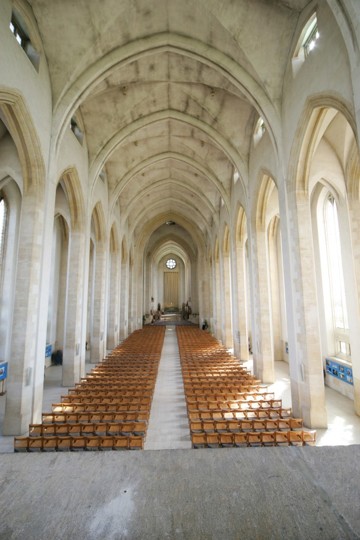
  Watching the BBC4 film put me in mind of another new cathedral, less grand and less iconic, which was consecrated a year earlier (in 1961) in my home county. Guildford cathedral had a long gestation – 25 years – and a troubled one, beset as it was by financial problems and various controversies, including a pretty basic one about the style of the building. At Coventry, Spence, in keeping with the spirit of the time, had turned his back on Gothic and created an unmistakably modern building. At Guildford, however, the Gothic style had one of its late triumphs. Edward Maule's building is in a plain, pared-down Gothic idiom, in keeping with the architect's aim to 'produce a design, definitely of our time, yet in the line of the great English cathedrals, to build anew on tradition, to rely on proportion, mass, volume and line rather than on elaboration and ornament'. A fine statement of intent, and one that Maule kept to, producing a noble building with airy, numinous interior spaces. 
  I remember the latter stages of the building of Guildford cathedral, when we would take family trips to see how it was getting on. And I remember a brilliant fund-raising scheme that was launched to raise money to finish the building – 'Buy a Brick'. For half a crown in the old money (equivalent to a fiver or so today), anyone could buy a brick and sign their name, or someone else's, on it. More than 200,000 people bought a brick, making a huge contribution to the cathedral's seriously limited building budget. 
  What I did not know at the time was that the project had been saved years before, in 1947, when a former Canadian prime minister, R.B. Bennett, the 1st Viscount Bennett, bought much of the land intended for the cathedral's site on Stag Hill and donated it to the diocese, as a memorial to the sacrifice of his fellow Canadians in the two world wars. Bennett had retired to Mickleham in Surrey after his Canadian political career, which coincided with the Great Depression, had ended in failure. The fine building that stands on Stag Hill is his best memorial, and a worthy one to the extraordinary sacrifice made by Canada in the world wars.

Wednesday, 9 June 2021

Too Darn Hot

 It's Cole Porter's 130th birthday today – and the weather here is very nearly hot (by English standards). So, what could be more fitting than this Porter song, sung to perfection in every point  – and in a voice beyond compare – by Ella Fitzgerald...


Tuesday, 8 June 2021

A True Great

 On the 89th birthday of the great Ray Illingworth, the best Test captain England ever had, it's tempting to wonder what he might be making of the present England shower. Actually I don't think we need to wonder...
The exemplar of Yorkshire grit, Illingworth forged a distinguished career in his own right as a hard-to-hit bowler and hard-to-shift batsman (upwards of 2,000 wickets and 20,000 runs in first-class cricket), but it was as a captain that he reached the heights. When he took charge of the England team, they had lost only one of their previous 14 Test matches and none of their last seven. Under Illingworth that unbeaten run was extended to 27 Tests without defeat between 1968 and 1971, and only one defeat in 40 Tests between 1966 and 1971. In Australia in 1970-71, Illingworth's team beat the Aussies 2-0 in the Test series – an unprecedented feat on Australian soil. They played tough, not stinting on mental and physical intimidation, and they played to win – defeat was not to be contemplated. How different, how very different, from today's approach, and today's players, whose lamentable performance against New Zealand over the weekend must have had Illingworth shaking his head in disbelief, along with the rest of us. 
And we may be sure that every other word uttered by Illingworth's men in their prime would have been enough to get them suspended from international cricket today. 

Sunday, 6 June 2021

Jon Redmond

 When this image turned up online, my first thought was something along the lines of 'Wow!' and my second was, Who painted this? An intense, boldly worked still life of everyday objects, it's clearly in a tradition that stretches back from the present to Manet, to the great Dutch still-life painters and to Velazquez. Could it be a contemporary painting? Well, yes, it could: it's called 'Silver', and it's by one Jon Redmond, a Pennsylvania-based painter of whom I had never heard. 
  I immediately sought out more, and found a good many online, also an interview with the artist, who has been exhibiting for 20 years or so, and seems uncommonly sensible for a contemporary artist (which may be why he isn't better known). Redmond paints landscapes and buildings as well as still lifes and interiors, all drawn from his immediate surrounding in Chester County. His paintings are very much about the play of light on surfaces, and his technique is vigorous and immediate, painting alla prima (wet on wet), without preliminaries, least of all any line drawing – 'I hate line. I want to do the searching and struggling while I am painting, because that is when the painting becomes interesting ... What is important is what is happening on either side of where a line would be.' And he likes to show his workings, leaving areas unfinished.
  He has no anxiety about influence or tradition and is happy to channel, for example, Degas, as here, in this accomplished nude, which explores the play of light on convex (the model) and concave (the bath) surfaces –

Redmond also sees no need to make a fuss about being 'contemporary': 'If you try to be "contemporary" your work will suffer. We are contemporary by being alive today, so why work hard at it?' He is attracted by 'ordinary', simple subjects rather than by big and obviously picturesque ones. 'The most important thing,' he says, 'is that I am excited about what I see.' Well, you can sense the excitement in a painting like this one, with its singing, zinging colours – 
And, talking of colour, how about this one, titled 'Eclipse', which reminds me of the work of our own Robert Dukes...
Redmond is refreshingly honest about the painter's life: 'Painting for me is really just a legal excuse to sit down and look at something for hours on end. What other profession allows you to go out, find something really cool, and stare at it as long as you want?' Well, quite. And that 'something really cool' might include, as here, washing hanging out to dry on a clothesline. This one is called 'Pink Pants' – 

And here, finally, is one of Redmond's haunting interiors – 

This, it seems to me, is a fine painter. I'll be looking out for his work from now on...

Saturday, 5 June 2021

Amis's Camberwell Beauty

 Ageing has its pleasures. One is that, as my memory becomes lightly perforated, I find myself 'discovering' something – a poem, even a book – that I subsequently discover I had read before. It reads as if for the first time, but, no, I've been here before... Case in point: the other day I heard someone on the radio mention that Kingsley Amis had written a poem about seeing a Camberwell Beauty butterfly when he was a boy – in Camberwell. I soon found it – not exactly a poem about seeing a Camberwell Beauty but the first stanza of a poem of regret, 'To H.', addressed to Amis's first wife, Hilary 'Hilly' Bardwell, whom he had treated appallingly when they were married. Nevertheless, Hilly and her third husband ended up living in Kingsley's big house as a kind of upmarket housekeepers. By then, Amis's sex drive (the lunatic to whom he'd been handcuffed for fifty years, to use his own image) had finally waned, so life was that bit simpler. Looking back in this poignant poem, Kingsley clearly regrets the way he undervalued and mistreated Hilly when he had her – but I think what we're looking at here is wistful regret rather than repentance. Or is that uncharitable?

To H.

I.
In 1932 when I was ten
In my grandmother’s garden in Camberwell
I saw a Camberwell Beauty butterfly
Sitting on a clump of Michaelmas daisies.
I recognised it because I’d seen a picture
Showing its brownish wings with creamy edges
In a boy’s paper or on a cigarette-card
Earlier that week. And I remember thinking,
What else would you expect? Everyone knows
Camberwell Beauties come from Camberwell;
That’s why they’re called that. Yes, I was ten.

II.
In 1940 when I was eighteen
In Marlborough, going out one winter’s morning
To walk to school, I saw that every twig,
Every leaf in the vicar’s privet hedge
And every stalk and stem was covered in
A thin layer of ice as clear as glass
Because the rain had frozen as it landed.
The sun shone and the trees and shrubs shone back
Like pale flames with orange and green sparkles.
Freak weather conditions, people said,
And one was always hearing about them.

III.
In ’46 when I was twenty-four
I met someone harmless, someone defenceless,
But till then whole, unadapted within;
Awkward, gentle, healthy, straight-backed,
Who spoke to say something, laughed when amused;
If things went wrong, feared she might be at fault,
Whose eye I could have met for ever then,
Oh yes, and who was also beautiful.
Well, that was much as women were meant to be,
I thought, and set about looking further.
How can we tell, with nothing to compare?


Anyway, having read 'To H' as if for the first time, I noticed an online link to Stephen Pentz's wonderful First Known When Lost blog, and discovered that, back in 2010, he had posted just this poem – and, what's more, I had commented on it. Ah well – it was good to 'discover' it again. 

Thursday, 3 June 2021

Lost Lanes, Cut Grass, a Golden Anniversary

 Yesterday, while enjoying my constitutional, I took this photograph of a path bordered by lush cow parsley (or Queen Anne's lace) and posted it on Facebook, captioned 'Lost lanes of Queen Anne's lace' – a line from Philip Larkin's 'Cut Grass'. Today I discover that this poem – surely one of the finest really short poems in English, certainly one that packs the most charge into the fewest syllables – was written (or signed off) on this date exactly 50 years ago. Surely a golden anniversary worth marking...

Cut grass lies frail:
Brief is the breath
Mown stalks exhale.
Long, long the death

It dies in the white hours
Of young-leafed June
With chestnut flowers,
With hedges snowlike strewn,

White lilac bowed,
Lost lanes of Queen Anne's lace,
And that high-builded cloud
Moving at summer's pace.

Tuesday, 1 June 2021

Monument and Butterflies

 Noting that today was the birth date (in 1563) of the great Elizabethan (and Jacobean) statesman, courtier and survivor Robert Cecil, 1st Earl of Salisbury, I was reminded of those happy days when I was out and about researching my book, The Mother of Beauty. Cecil's striking monument, in St Etheldreda's, Hatfield, was designed by the Fleming Maximilian Colt, and is one of the greatest of its period. When I visited Hatfield, with my cousin, to see it, we found the church closed and locked, but this was one of those happy occasions when (a) the rectory was next to the church, (b) the rector was at home, and (c) he was only too happy to let us in and leave us to wander at large in his magnificent church. This fortuitous combination of circumstances did not often occur in the course of my researches, but the quest for monuments – in those heady days before the lockdowns – was a joy in itself. 
   The research for my latest production, a small book on butterflies, was mostly conducted on the living-room sofa that is my 'work station' these days – though, in a sense, the real research was done in the course of many years of watching butterflies and reading about them. It was written partly to while away the winter months when there are no butterflies to be seen, and  I am hoping the book will become available, in some form, before too many months have passed. I'll let you know.
  As for this butterfly season, it is finally under way after a dismal couple of months – cold dry April, cold wet May – and, after that prelude, it is unlikely to be a bumper season. Although I have seen a respectable 19 species so far, numbers of most have been very low, and the relentless rains of May have left a legacy of lush grass and overgrown vegetation that will not be to the liking of many of our butterflies. Let's hope things improve as the season goes on. If this sun continues shining for a few more weeks, it could make all the difference..