I used to think that Nabokov's epithet for Sigmund Freud, 'the Viennese quack', was a little harsh. Having been obliged to read Freud at university (bizarrely, as part of a course on 'The English Moralists'), I found him sometimes impressive, if usually wrong-headed. Since then, having read more about Freud and his methods, particularly his early experiments on 'hysterical' women, I have inclined more to Nabokov's characterisation. Now, in the course of reading James Shapiro's Contested Will, I discover that Freud – whose Oedipal interpretation of Shakespeare I never bought – was an 'Oxfordian', convinced that the works of 'Shakespeare' were in fact written by Edward de Vere, Earl of Oxford. Oh dear. This notion, based largely on the researches of the unfortunately named John Thomas Looney, became a loudly buzzing bee in Freud's bonnet, and he never lost an opportunity of pressing Looney's 'Shakespeare' Identified on reluctant recipients. One such was Freud's most devoted disciple, Ernest Jones. In a particularly deplorable episode, Freud responded to the terrible news that Jones's beloved daughter had died, not with the consoling thoughts Jones was pleading for, but with a recommendation that he take his mind off his troubles by investigating Looney's claims about Shakespearean authorship.
This callousness silenced even Jones for more than a month, and he hinted at his disappointment when he did write back. But the hint was lost on Freud, who was more concerned to profess himself 'dissatisfied' by Jones's failure to be suitably impressed by Looney's theory, and treated him to a further lecture on why he and Looney were right. To the end of his days, Freud remained convinced that the Earl of Oxford wrote the plays attributed to Shakespeare. Here the Viennese quack becomes the Viennese crackpot.
Saturday, 5 November 2022
Sigmund Freud, Oxfordian


Thursday, 3 November 2022
Serendipitous Reads
My recent reading has been largely dictated by charity-shop serendipity, which is not a bad method (or lack of). Having never read any Rosamond Lehmann, I snapped up a copy of her The Swan in the Evening, which I found to be a fascinating mixture of a memoir of her early years – very sharply and vividly written – and an account of the sudden, shocking death of her beloved daughter, Sally. What happened after Sally's death left her firmly convinced that survival after physical death is a fact of life – but The Swan in the Evening is no spiritualist tract; Lehmann is far too intelligent, and too good a writer, for that. It is simply an account of her own experiences and what she drew from them – consolation of course, but also a new way of looking at the world and the nature of reality. It's an extraordinary book, and would be worth reading just for the recollections of Rosamond's childhood.
Next came Ariel: A Literary Life of Jan Morris by Derek Johns, which made a brief appearance on this blog (here).
Then a book that might be seen as a kind of sequel to The Swan in the Evening – The Perfect Stranger by P.J. Kavanagh, who was Sally Lehmann's husband. Once again it is partly an autobiography and partly a memorial to Sally, but the difference is that Kavanagh's autobiog occupies nearly all the book, and Sally's death occurs right at the end, with nothing about what happened after. The book is in part the story of a truly extraordinary love – one that suddenly made sense of a life that, until he met Sally, had made very little – but it is also a remarkably honest, often funny account of a life that seemed to buffet Kavanagh from one adventure, or stretch of stupefying boredom, to another without much input from him: a Butlin's holiday camp, Switzerland, Paris, war in Korea, Oxford, Barcelona, and finally Java, where Sally died.
Here's one of the funnier passages. Kavanagh is trying to get into the BBC (always good for a laugh) and has presented them with a couple of ideas –
'They seemed enthusiastic, sent me away to work the ideas over. I did so – more enthusiasm – I even met the big boss, who delivered an impromptu lecture on the Medium (there was much talk of the Medium in those days) which finished up: "I don't care what it is – Hamlet or I Love Lucy – the script is télevision" (the pros always call it télevision while the rest of the world says televísion) "the script is Tee Vee if you can see it – er – see it – er – visually! ... Isn't that so?" Four heads in the room nodded together like metronomes, four pairs of eyes fastened themselves sightlessly on toe-caps or on the ceiling, lost in wonder at the profundity of this thought."
[I don't remember there being two ways of pronouncing television – the pros' version has prevailed.]
A little later he tries radio:
'I did a feature for sound radio on the Pre-Raphaelites. Spent weeks on the British Museum on that, found some interesting stuff and fell in love with Morris. I showed the long-hand draft to a Features producer – more enthusiasm – he stuffed it in his pocket and we went off to celebrate on the strength of it, until I had to drop out through lack of cash. When I next succeeded in tracking him down he confessed that at some stage of the celebration after I'd left him he'd lost it.'
[In the end Kavanagh was given a job as an Assistant Floor Manager in Television – one for which he was spectacularly unsuited. Such is the BBC.]
And now I'm reading James Shapiro's Contested Will: Who Wrote Shakespeare? (found in charity shop this week). This is a terrific read – 'Riveting', Hilary Mantel called it, and she's not far wrong – and offers fascinating insights into the origins and development of the curious, remarkably tenacious idea that the 'man from Stratford' could not possibly have written the works of Shakespeare. Spoiler alert: he did.
Tuesday, 1 November 2022
Rave
In the latest issue of Literary Review – out today – I rave about a wonderful new book, Country Church Monuments by C.B. Newham. This is a subject that is, of course, right up my street. The review goes something like this (but do buy the magazine – it's the best of its kind and deserves more readers)...
This big, hefty book – two inches thick and weighing something over two kilograms – fills a big gap. It fills it handsomely, authoritatively, and on a grander scale than I would have thought possible in today’s publishing climate. Its subject is one of this country’s greatest, but least appreciated and most widely dispersed, treasures: the wealth of fine monumental sculpture that has survived in our parish churches, often in remote and out-of-the-way locations where none but the dedicated church crawler is likely to come across it.
Until now, this treasure has, for the most part, been rather sketchily documented, in Pevsner’s Buildings of England and in a few historical and thematic surveys, notably Mrs Esdaile’s pioneering English Church Monuments, 1510 to 1840 and Brian Kemp’s more recent English Church Monuments, neither of which focuses specifically on the monuments in our country churches. But now we have this compendious, lavishly illustrated volume devoted entirely to just those monuments. I have seldom felt such a thrill of pleasure at the arrival of a review copy.
C.B. Newham was just the man to write this book. He has a prodigious wealth of knowledge about English and Welsh parish churches, is Director of the Parish Church Photographic Survey, and has an archive of more than half a million photographs to draw on, the product of visits to nearly nine thousand churches. More than 365 of these photographs – all full-page and in full colour, each a master class in how to photograph a monument – are included in this volume. They illustrate monuments in 365 churches, all of them in rural parishes or small towns (under 10,000 in population) and outside the orbit of the M25. The choice is, as Newham candidly acknowledges, ‘completely subjective’, though many of these monuments – for example the Montagu memorials at Warkdon, Nollekens’ monument to Maria Howard at Wetheral, Stone’s masterpiece (the monument to Elizabeth, Lady Carey) at Stowe-Nine-Churches – would be on anyone’s list. For myself, I’d have included, among others, the haunting monument to Sir Adrian Scrope at South Cockerington, Epiphanius Evesham’s Hawkins monument at Boughton-under-Blean, and the moving memorial to the Bray children at Great Barrington. But then, what would I have dropped? Beyond a certain point, these things are indeed subjective, and there is such a wealth to choose from.
Happily, Newham writes fluently and readably, so his book is as enjoyable to read as it is to handle and look at. It begins with an introduction that includes a short history of the development of church monuments from medieval times to the modern era (a period sadly lacking in good monuments). On the current wave of iconoclasm – seeking to remove monuments to people who have offended against present-day norms – Newham writes: ‘We should not expect all monuments to have been set up to entirely morally admirable people, even if they stand in a place of Christian worship. If, on the basis of contemporary moral judgments, we deface monuments or cause them to be taken down, then the debate is stifled and the opportunity to learn from past mistakes is lost. Our future is nothing without our past.’ Indeed. He is not hopeful – who could be? – when he considers the future of our parish churches, but he is heartened by the fact that, in general, our monuments are in good condition, thanks to grants, money-raising campaigns and the efforts of special-interest groups, and some village churches are finding a new lease of life as venues for community activities or local services such as post offices or part-time shops.
The body of the book is essentially a gazetteer, divided into eight English regions plus Wales, with a short description of each monument and biographical information on the person memorialised (something rarely supplied in Pevsner). The arrangement within each region is chronological, and each monument is numbered, rather pleasingly, in red. At the end of each regional section come the photographs illustrating its monuments, with those red numbers again. This arrangement, once you’ve got the hang of it, makes the book easy to navigate. After the photograph of monument number 365 – an interesting 20th-century ceramic memorial from St Mary, Tenby – comes a section containing short biographies of each sculptor whose work has won a place in the 365. Then the churches featured are listed by county – historical county, that is: hence Great Mitton, home to some remarkable Sherburne monuments, is listed under Yorkshire West Riding, not Lancashire.
After a list of ‘Monument Storehouses’, churches with especially large numbers of monuments, Newham addresses an issue of pressing interest to all church crawlers and monument seekers: church access. We are all familiar with the frustration of finding churches locked, sometimes with a list of contacts or the name of a key holder, sometimes with no information at all. ‘When it comes to locking churches,’ Newham writes, ‘in most cases there is very little reason for doing so.’ As he points out, the company that insures most of the churches of England and Wales actually recommends that churches be left open during the day, as this makes them less, not more, vulnerable to theft and vandalism. As a way of facilitating access to churches, Newham has developed an app called Keyholder which allows users to record their visiting experiences, give tips on how to obtain access, and share photographs. This covers more than 15,000 churches and has access information for over 80 per cent of them.
But back to the book: with some notes on the care of monuments, a glossary and an index, this splendid volume ends. Or almost: there are also a couple of pages of acknowledgments, in the course of which Newham tells the encouraging story of how this book came about, after the author was contacted by a publisher at Penguin who had heard about his project of photographically recording every rural parish church in England, and wondered if there was a book in it. There certainly was, and a magnificent book it is – a tremendous achievement, a thing of beauty, and a volume that should have a place on every church lover’s shelves.
Monday, 31 October 2022
Rather Special
Here (with a hat-tip to Struan Robertson) is something rather special – a unique musical encounter between the Byrds and the Earl Scruggs Band – with the background story provided by the man who managed to film it, despite the antics of one R. McGuinn. The music-making is just wonderful. Enjoy...
The Avenue

All Hallows' Eve, and a big day for birthdays – notably John Keats (born 1795), the diarist and gardener John Evelyn (1620), and two painters of the Dutch Golden Age: Johannes Vermeer (1632) and, born in 1638, Meindert Hobbema.
A pupil of Jacob van Ruisdael, Hobbema was a fine landscape painter, with a particular gift for painting trees, an essential element in his best compositions. The most famous, and one of the greatest of all Dutch landscape paintings, is his extraordinary The Avenue at Middelharnis, one of the treasures of our own National Gallery. A strikingly geometrical composition, almost like an advanced exercise in perspective, it has long fascinated other artists, including Van Gogh. Oddly, The Avenue of Middelharnis was one of the paintings that haunted my boyhood, as it was reproduced in one of the books I browsed in endlessly (The Book of Everlasting Things? A Thousand Beautiful Things?). And another was Van Gogh's The Painter on the Road to Tarascon, a painting with something of a Middelharnis feel, which (this must have been in an encyclopaedia) I remember as being represented in yellow, cyan and magenta to illustrate three-colour printing. The original went missing in the bombing of Germany during the Hitler War – a sad loss.

Sunday, 30 October 2022
A Late Butterfly and a Surprising Resemblance
And in Lichfield this morning, walking by the remains of the medieval friary, I spotted something flying frenetically from ivy bush to old stone wall and darting around at speed in jagged circles. It was a Painted Lady! One of very few I've seen this year, and a very late one. There's nothing like a late butterfly to lift the heart (unless it's an early one as spring gets under way)...

And then, in the sweetshop where I was buying a few Halloween treats for the grandchildren, the very nice woman behind the counter looked at me in a slightly startled manner and said, 'You look just like Sir Ian McKellen.' This was a new one on me. 'People must tell you that all the time, don't they?' she asked. Well, no, I replied truthfully, though I've been told I'm the living spit of many another thespian (most pleasingly Jimmy Stewart). 'Your height, your build,' she continued, 'the way you carry yourself.' Gulp. Do I carry myself like Ian McKellen? I had better work on that...
A Do and a Window

So, after but one day of residence in Lichfield, it was off again, this time to Pangbourne on the Berkshire Thames, for a family do – not quite a wedding but a joyous celebration of a rather wonderful case of late love. We stayed overnight in what was very self-consciously a 'boutique hotel', where, to judge (perhaps unfairly) by the bedroom we were in, interior design had run riot, and the relentlessly pursued 'theme' (a wild mashup of Indian, Far Eastern and East Indian) prevailed over such old-school notions as comfort and amenity. Hotels these days mostly seem to fall into one of two camps: International Bland or Boutique Bonkers, with fewer and fewer in between these poles. By and large, I prefer the first; at least it's restful, which is rather the point of a hotel, isn't it?
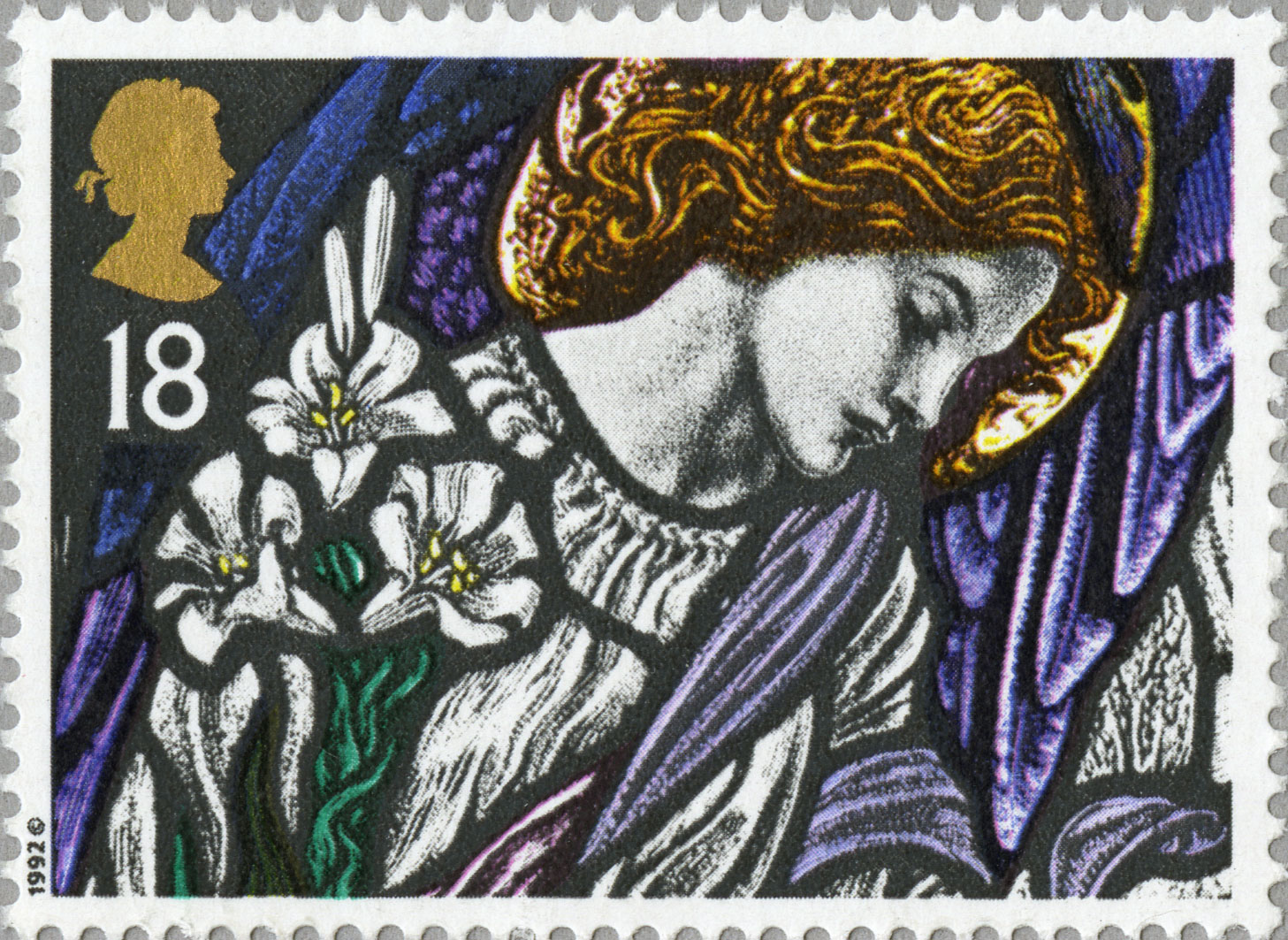
But enough of hotels. It was a gloriously sunny autumn afternoon when we arrived, and I was soon out for a look around the village – and, of course, the church, dedicated to St James the Less (as against St James the Least of All, one of the rivalrous churches in Augustus Carp, Esq, by Himself). This is Victorian, all but the tower, with a pleasant, if rather fussy, interior and some interesting tablets commemorating military men, including a young officer who died in Bengal and is remembered 'with deep love and affection' by an unrelated Major-General. But the glory of the church is the handsome East window, a blaze of light and colour, by the late Arts and Crafts stained-glass designer Karl Parsons. This too is a memorial window, to a member of the local Armstrong family and to all the men of the parish who died in the Great War. There's a detail from the central panels above, and another detail that made a rather lovely Christmas stamp in 1992, below.
And now it's Lichfield again, for rather longer this time...
