From time to time I recall some text that my class 'did' during our schooldays and either marvel at our literary capacity, or wonder what our teachers thought they were doing, or both. I was reminded of one such today – Matthew Arnold's 'Sohrab and Rustum', a Homeric narrative poem in 892 lines recounting an episode from Ferdowsi's Persian epic Shahnameh. It's a dramatic story, in which Sohrab unknowingly slays his long-lost son Rustum, but I remember it being heavy going indeed. What reminded me of Arnold today was Patrick Kurp's post, 'So Various, So Beautiful, So New', which takes its title from a phrase in Arnold's famous 'Dover Beach' (quoted by Theodore Dalrymple in an essay quoted by Patrick). This sent me back to 'Dover Beach', which I hadn't read in a while, and which now seems to me even bleaker than ever –
The sea is calm tonight.
The tide is full, the moon lies fair
Upon the straits; on the French coast the light
Gleams and is gone; the cliffs of England stand,
Glimmering and vast, out in the tranquil bay.
Come to the window, sweet is the night-air!
Only, from the long line of spray
Where the sea meets the moon-blanched land,
Listen! you hear the grating roar
Of pebbles which the waves draw back, and fling,
At their return, up the high strand,
Begin, and cease, and then again begin,
With tremulous cadence slow, and bring
The eternal note of sadness in.
Sophocles long ago
Heard it on the Ægean, and it brought
Into his mind the turbid ebb and flow
Of human misery; we
Find also in the sound a thought,
Hearing it by this distant northern sea.
The Sea of Faith
Was once, too, at the full, and round earth’s shore
Lay like the folds of a bright girdle furled.
But now I only hear
Its melancholy, long, withdrawing roar,
Retreating, to the breath
Of the night-wind, down the vast edges drear
And naked shingles of the world.
Ah, love, let us be true
To one another! for the world, which seems
To lie before us like a land of dreams,
So various, so beautiful, so new,
Hath really neither joy, nor love, nor light,
Nor certitude, nor peace, nor help for pain;
And we are here as on a darkling plain
Swept with confused alarms of struggle and flight,
Where ignorant armies clash by night.
And to think he wrote it on his honeymoon... (By the way, as has been pointed out many times, Sophocles would not have heard 'the turbid ebb and flow' of the Aegean, as that sea is not tidal.) 'Dover Beach' has been set to music more than once – most improbably by the Fugs, who perform their, ah, distinctive version of it on the album Tenderness Junction. I'll spare you that, and offer instead the beautiful setting by Samuel Barber, here sung by Dietrich Fischer-Dieskau (in a rare foray into English) with the Juilliard Quartet –
And 'Dover Beach', with its deep melancholy and oceanic imagery, brought to mind the equally bleak closing image of George Meredith's great sonnet sequence, Modern Love –
'In tragic hints here see what evermore Moves dark as yonder midnight's ocean force, Thundering like ramping hosts of warrior horse, To throw that faint thin line upon the shore!'
I'm off to Worthing again today, but before I go here's a picture to mark the 120th birthday of Edward Bawden, that great printmaker, painter and graphic designer, who has had many a mention on this blog. The picture is called March Noon and shows the kind of pleasant March morning that has yet to be seen in these parts, where snow and bitter winds have dominated the past few days' weather. We should have known it was coming, because the redwings, having been few and far between in the official winter months, started appearing in larger numbers recently, and they are a pretty sure indicator of severe weather to come. The comma butterfly also has a reputation as a weather forecaster, never (it is said) emerging from hibernation if there is more wintry weather on the way. So far, however, I haven't seen a butterfly of any breed, alas.
If I remember rightly (a big if these days), my childhood Observer's Book of Music had, in its biographical section, only one woman composer – Ethel Smyth (who in appearance could easily be mistaken for a man). Today, thanks to decades of discovery and rediscovery, women composers past and present are certainly getting their due, and those composing today face none of the past impediments to success. Radio 3 has played a large and creditable part in this process, and today, this being International Women's Day, they are pulling out all the stops with an entire day's broadcasting devoted to music written (and often performed) by women. This might seem a little like overkill, but I'm not complaining: I'm grateful to Radio 3 for having introduced me in recent times to the likes of Barbara Strozzi, Cecile Chaminard, Florence Price, Amy Beach, the Boulanger sisters, Clara Schumann, Fanny Mendelssohn, etc, etc. Meanwhile, I'm celebrating by reading an early Muriel Spark I hadn't read before: The Bachelors, in a 1950s Penguin paperback from my Chester uncle's library, price 3s 6d, cover drawing by Terence Greer – a volume of similar vintage to my Observer's Book of Music.
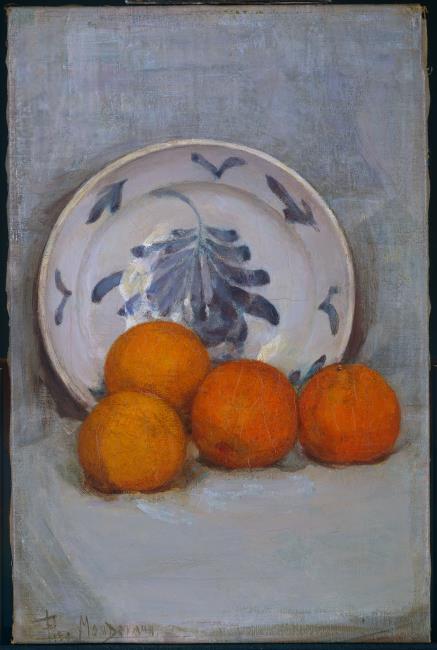
Here's a little brain teaser: Which artist painted this rather lovely still life of oranges? The answer is surprising. Further clues can be provided if required...
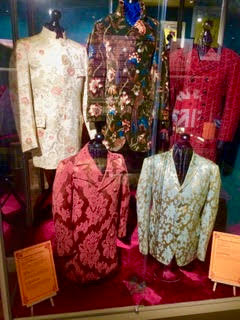
Strolling around Derby yesterday – a fine city much damaged by the motor car and the urban planner – I dropped in to a grand Georgian house that I'd never visited before: Pickford's House museum of Georgian life and costume, the former home (and professional showcase) of a successful provincial architect, Joseph Pickford. I had a look around the re-created interiors, all very nice, and a rather charming display of toy theatres, but what most caught my attention was a temporary exhibition titled The Peacock Revolution, an Exhibition of Men's Fashion from 1966-1970. The clothing on show all comes from the private collection of Peter Feely, a Derby man with a particular interest in the late Sixties – which was of course the period in which I lived out my late teens, of which the less said the better. The clothes come from such famous boutiques as Granny Takes a Trip, Hung on You, Take 6, Lord John (where I bought my wedding suit) and Apple Boutique. Wandering around, enjoying the accompanying period-appropriate music, I found myself marvelling at how utterly gorgeous these creations were, in design, in cut, in materials. They were mostly high-end products, too expensive for most pockets, but something of their decorative gusto and design flair did filter down into the wider population (myself included, I guess: I remember a black velvet jacket of rakish cut, a dangerously tight and long overcoat, some rather startling crushed-velvet trousers, an embroidered kaftan...). And now look around you at what men, even young men, are wearing – did we ever live in a most sartorially dreary, unglamorous age? A new Peacock Revolution is long overdue.
Another picture: I call this one Self-Portrait with Fab Threads –
Well, the house is now full of boxes and mysterious items, small and large, waiting to be unpacked and disposed. It's going to be a long job... Meanwhile, I'm crossing the border into Derbyshire to spend the weekend with my cousin – but before I go, I have to quickly mark a centenary: a hundred years ago today, the great guitar picker, singer and songwriter Doc Watson was born at Deep Gap, in Watauga County, North Carolina. For a fine tribute (complete with poem), see today's Anecdotal Evidence. I have nothing to add except to offer this sample of the Doc in action, here with bluegrass legend Earl Scruggs (as ever in his buttoned-up business suit) –
Well, the big day came and went – unlike the removal men, who had somehow confused the date and were convinced they were booked for today. Ah well, as Johnny Logan almost said, what's another day? Today (St David's Day) is also the birthday of the great American poet Richard Wilbur, born 1921, and, in view of the strange times we've been through with this house (which did indeed have a couple of mysterious holes in the floor), this poem of his seems oddly apposite. It's 'A Hole in the Floor' –
The carpenter's made a hole In the parlor floor, and I'm standing Staring down into it now At four o'clock in the evening, As Schliemann stood when his shovel Knocked on the crowns of Troy.
A clean-cut sawdust sparkles On the grey, shaggy laths, And here is a cluster of shavings From the time when the floor was laid. They are silvery-gold, the color Of Hesperian apple-parings.
Kneeling, I look in under Where the joists go into hiding. A pure street, faintly littered With bits and strokes of light, Enters the long darkness Where its parallels will meet.
The radiator-pipe Rises in middle distance Like a shuttered kiosk, standing Where the only news is night. Here's it's not painted green, As it is in the visible world.
For God's sake, what am I after? Some treasure, or tiny garden? Or that untrodden place, The house's very soul, Where time has stored our footbeats And the long skein of our voices?
Not these, but the buried strangeness Which nourishes the known: That spring from which the floor-lamp Drinks now a wilder bloom, Inflaming the damask love-seat And the whole dangerous room.
Nige, who, like Mr Kenneth Horne, prefers to remain anonymous, was also a founder blogger of The Dabbler and a co-blogger on the Bryan Appleyard Thought Experiments blog. He is the sole blogger on this one, and his principal aim is to share various of life's pleasures. These tend to relate to books, art, poems, butterflies, birds, churches, music, walking, weather, drink, etc, with occasional references to the passing scene. His book, The Mother of Beauty: On the Golden Age of English Church Monuments, and Other Matters of Life and Death, is available on Amazon or direct from the author.