Wednesday, 11 September 2024

'We have to be honest...'

 Just when you thought royal statuary could get no worse – see, most recently, this –  along comes another abomination. In case you're wondering – and you might well be – the couple pictured above are intended to represent Elizabeth II and her consort, the Duke of Edinburgh. The double statue was commissioned as a memorial to the late Queen and erected in Antrim Castle Gardens in County Antrim. As an Antrim councillor confessed to BBC News, 'We have to be honest, it does not resemble the Queen in any shape or form.' And talking of shape and form, the bodies attached (in a decidedly unnatural manner) to these bizarre heads seem to be articulated in some manner quite unrelated to human anatomy as commonly understood. And the statue stands not on a plinth, or even on the ground, but on a meagre stone slab set in a flower bed. As a result, the Queen and Duke look like two people of restricted growth who have somehow got lost in the flower garden and strayed off the path. The expression of complete imbecility on the Queen's face only reinforces the impression; the Duke is perhaps right to look worried. Even the corgis don't look right... You can read the full story, told in typically exhaustive style, on the BBC News website – link here: 
https://www.bbc.co.uk/news/articles/clyl0xnrynzo

Tuesday, 10 September 2024

'Bootless home and weather-beaten back.'

A blowy day today, very autumnal, threatening rain – but it could be worse...
On this date in 1402, on a wild and windswept night, Henry IV, on campaign in Wales 'to chastise the presumptuous attempts of the Welshmen', was nearly killed when his tent collapsed about him. This was just the latest in a succession of assaults on the English by the relentless Welsh weather: 'Never did a gentle air breathe on them, but throughout the whole, rain mixed with snow and hail afflicted them with cold beyond endurance.' Yes, that sounds like Welsh weather – no wonder R.S. Thomas was such a cheery chap. This expedition was Henry's third attempt to crush the rebellion led by Owain Glyndwr (anglicised in Shakespeare to Owen Glendower). As Glendower boasts in Henry IV, Part I:
'Three times hath Henry Bolingbroke made head
Against my power; thrice from the banks of Wye
And sandy-bottom'd Severn have I sent him
Bootless home and weather-beaten back.'
Indeed – but was Glendower making use of magical powers? Holinshed reports that, to escape Henry, 'Owen conveyed himself out of the way, into his known lurking places, and (as was thought) through art of magic, he caused such foul weather of winds, tempest, rain, snow and hail to be raised, for the annoyance of the king's army, that the like had not been heard of.' After this third attempt to subdue the Welsh, Henry gave up and turned for home, but not before 'having caused his people yet to spoil and burn first a great part of the country'. Owain Glyndwr, a fugitive guerrilla heading a band of 'bare-footed rascals of small reputation', was well on his way to becoming a Welsh national hero, and indeed Prince of Wales. 
Let R.S. Thomas have the last word – 

The Rising of Glyndwr

Thunder-browed and shaggy-throated
All the men were there,
And the women with the hair
That is the raven's and the rook's despair.

Winds awoke, and vixen-footed
Firelight prowled the glade;
The stars were hooded and the moon afraid
To vex the darkness with her yellow braid.

Then he spoke, and anger kindled
In each brooding eye;
Swords and spears accused the sky,
The woods resounded with a bitter cry.

Beasts gave tongue and barn-owls hooted,
Every branch grew loud
With the menace of that crowd,
That thronged the dark, huge as a thundercloud.


Sunday, 8 September 2024

Zbigniew Herbert, Feeder of Lice

 Talking of Zbigniew Herbert, I was startled to learn that, during the Nazi occupation of Poland, he worked as a 'feeder of lice' at the Rudolf Weigl Institute in Lvov. This was not a line of work I had ever heard of, so I decided to find out a bit more...
It seems that, at this time, the only way to develop a typhus vaccine was to feed typhus-infected lice with human blood, and the sated lice would then be used in the manufacture of vaccines. As the Nazis were desperate to have a mass vaccine to protect their army from typhus, they practised louse-feeding on a grand scale. The grisly procedure involved strapping small cages containing infected lice to the feeder's thigh or calf, and leaving them to drink their fill. Each cage contained 400 to 800 lice, feeding sessions were around 30 to 45 minutes, and they were repeated over the course of 12 days. A feeder would typically accommodate between seven and 11 boxes at a time. I'm feeling itchy already...  For the feeders there was of course a risk of infection, though they would have been given some kind of vaccine (and lice transmit typhus by way of their excrement rather than their bite). For those living under Nazi occupation, there were distinct and important advantages to being feeders of lice: they were given extra food rations, were permitted to move freely around the occupied city, and were exempt from being shipped to slave labour camps and Nazi concentration camps. For those reasons, many Polish intellectuals took up louse-feeding – including our man, Zbigniew Herbert. As far as I know, this experience did not find a way into his poems, but I may well be wrong – anyone?  

Saturday, 7 September 2024

Two Poets Remember Their Fathers

 Browsing last night in my bedside poetry books, I found these two poems – very different in style but linked by a common theme – one after the other, just like that. 
First, Geoffrey Hill, in a poem (the first of his Soliloquies) dedicated to Charles Causley, a poet of a very different stamp...

The Stone Man

Recall, now, the omens of childhood:
The nettle-clump and rank elder-tree;
The stones waiting in the mason's yard:

Half-recognised kingdom of the dead:
A deeper landscape lit by distant
Flashings from their journey. At nightfall

My father scuffed clay into the house.
He set his boots on the bleak iron
Of the hearth; ate, drank, unbuckled, slept.

I leaned to the lamp; the pallid moths 
Clipped its glass, made an autumnal sound.
Words clawed my mind as though they had smelt

Revelation's flesh... So, with an ease
That is dreadful, I summon all back.
The sun bellows over its parched swarms.

Hill's father was the policeman in his Worcestershire village (Fairfield. By the way, I wonder if anyone is working on a biography of Hill?).
The second poem is by the great Polish poet Zbigniew Herbert, whose father was a lawyer who worked as a bank manager, and had fought in the Polish Legions in the First World War. 

Remembering My Father

His face severe in clouds above the waters of childhood
so rarely did he hold my warm head in his hands
given to belief not forgiving faults
because he cleared our woods and straightened paths
he carried the lantern high when we entered the night

I thought I would sit at his right hand
and we would separate light from darkness
and judge those of us who live
—it happened otherwise

A junk dealer carried his throne on a hand-cart
and the deed of ownership the map of our kingdom

he was born a second time slight very fragile
with transparent skin hardly perceptible cartilage
he diminished his body so I might receive it

in an unimportant place there is shadow under a stone 

he himself grows in me we eat our defeats
we burst out laughing
when they say how little is needed
to be reconciled


Wednesday, 4 September 2024

Miss Pym's Day Out

 Last night BBC4 showed an old edition of Bookmark, Miss Pym's Day Out, a 1992 film by James Runcie which dramatised Barbara Pym's visit to London to attend the Booker Prize dinner in 1977. Her late masterpiece Quartet in Autumn had been shortlisted – a sign of how thoroughly her literary reputation had been restored following her 14 years in the unpublished wilderness and her 1977 'rediscovery' triggered by Philip Larkin and Lord David Cecil (who both named her as the most underrated writer of the century). The film follows her as she makes her way from her home in the Oxfordshire village of Finstock to London, where she gamely endures an interview, meets various dignitaries and fans, sits through the dinner, and discovers that, of course, she hasn't won. Miss Pym's Day Out is so rich in quotations from, allusions to and glimpsed scenes from the novels that the Barbara Pym Society helpfully detailed them all in a scene by scene synopsis. The film is made in something close to documentary or cinema verité style, and various people appear as themselves – Jilly Cooper, publisher Tom Maschler, A.N. Wilson, Penelope Lively, and indeed Barbara's sister Hilary. Also present, but played by an actor, is Philip Larkin, who was chairman of the Booker judges that year – but was he rooting for Barbara to win? No, he was not: indeed, he declared he would jump out of a window if Paul Scott's Staying On didn't win. And the winner was... Staying On
  Introduced by its star, Patricia Routledge, Miss Pym's Day Out should be available on the BBC iPlayer.

Tuesday, 3 September 2024

Not So Fab

 There are many memorials on the quayside at Liverpool's Albert Docks, mostly, as is only fitting, memorial plaques to the dead of both world wars who perished at sea serving the Allied cause. There are also statues, some of them commemorating notable Liverpudlians, and the worst of them is surely that depicting the four Beatles. From a distance you'd be hard put to recognise them, and close up it doesn't get much better. Lifeless, lumpish and ugly, this piece of public sculpture, like so many others, illustrates the sad decline of the art (see, for example, the Diana statue in Kensington Gardens, the giant Lovers at St Pancras station, or this horror). Nor does it express anything at all about the Beatles: this sad and vacant looking foursome could be anyone. 
  On the other hand, one dockside statue that did impress me was 'Waiting', a monument to the Liverpool working horse, by the equine sculptor Judy Boyt. Liverpool once had more working horses on its streets than any city but London, and their role in carrying goods from the docks to warehouses and railway depots helped to keep supply lines open during both world wars. 'Waiting' is wonderfully lifelike and has real presence and character. The humble working horse has ended up with a far more impressive monument than the Fab Four. And why not? 


Only a pipe rack!

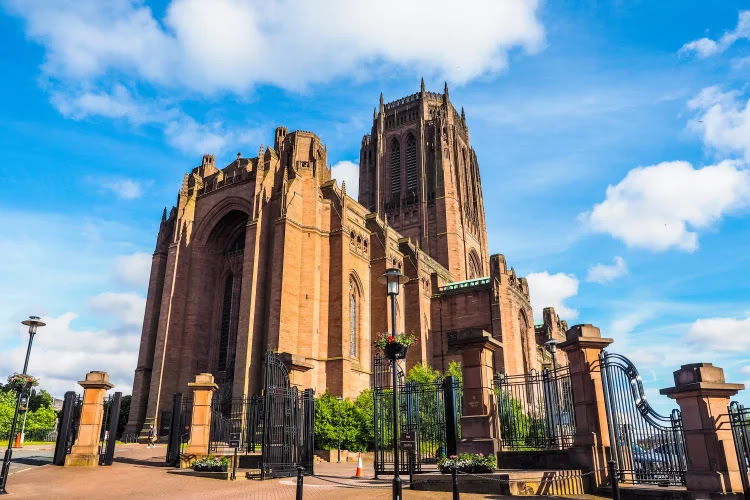
 I've been away for a few days, visiting Chester – a city I know quite well – and Liverpool, a city I had never visited before, and against which I had long nursed a quite groundless prejudice (probably caused by over-exposure to certain Scouse celebrities). In the event, I found it a fascinating, in places beautiful, city, full of fine buildings, and with a splendid waterfront, albeit one disfigured with some hideous recent crimes against architecture. And the people, such as we came across, were all pleasant and helpful. But the highlight, for me, was undoubtedly the cathedral – not the Roman Catholic one, 'Paddy's wigwam' (a wonderful interior, let down by a messy exterior that is not ageing at all well), but the Anglican cathedral on St James's Mount.
  I knew this building only from pictures and the mixed reports of visitors, and my expectations were not particularly high. Pictures certainly don't do it justice, and I feared it might turn out to be an overblown, essentially arid exercise in an outmoded style (i.e. Gothic). Nothing had prepared me for the breath-taking impact of this vast and astonishing building, the largest cathedral in Britain, and one of the largest in the world: no wonder it took so long to build – all in all from 1904 to 1978. One of the many astonishing things about it is that the architect, Giles Gilbert Scott, was just 22 years old, with no buildings to his name (only a pipe rack!), when he won the commission in open competition – and he was a Catholic, which was hardly a help. Scott's original design inevitably went through many changes over the years, but its essence remained – and that essence is true, living Gothic. Nothing about this cathedral feels like a pastiche; it all breathes the genuine spirit of Gothic (or so it seemed to me). The craftsmanship is of stunning quality, every detail works, there is beauty wherever you look, and the disposition of the vast spaces is brilliantly managed. It's not only the scale that is staggering – it's, well, it's everything. Despite its late date, and despite the competition, I would rate Liverpool Cathedral one of the great Gothic buildings of England.