Here (with a hat-tip to Struan Robertson) is something rather special – a unique musical encounter between the Byrds and the Earl Scruggs Band – with the background story provided by the man who managed to film it, despite the antics of one R. McGuinn. The music-making is just wonderful. Enjoy...
Monday, 31 October 2022


The Avenue

All Hallows' Eve, and a big day for birthdays – notably John Keats (born 1795), the diarist and gardener John Evelyn (1620), and two painters of the Dutch Golden Age: Johannes Vermeer (1632) and, born in 1638, Meindert Hobbema.
A pupil of Jacob van Ruisdael, Hobbema was a fine landscape painter, with a particular gift for painting trees, an essential element in his best compositions. The most famous, and one of the greatest of all Dutch landscape paintings, is his extraordinary The Avenue at Middelharnis, one of the treasures of our own National Gallery. A strikingly geometrical composition, almost like an advanced exercise in perspective, it has long fascinated other artists, including Van Gogh. Oddly, The Avenue of Middelharnis was one of the paintings that haunted my boyhood, as it was reproduced in one of the books I browsed in endlessly (The Book of Everlasting Things? A Thousand Beautiful Things?). And another was Van Gogh's The Painter on the Road to Tarascon, a painting with something of a Middelharnis feel, which (this must have been in an encyclopaedia) I remember as being represented in yellow, cyan and magenta to illustrate three-colour printing. The original went missing in the bombing of Germany during the Hitler War – a sad loss.

Sunday, 30 October 2022
A Late Butterfly and a Surprising Resemblance
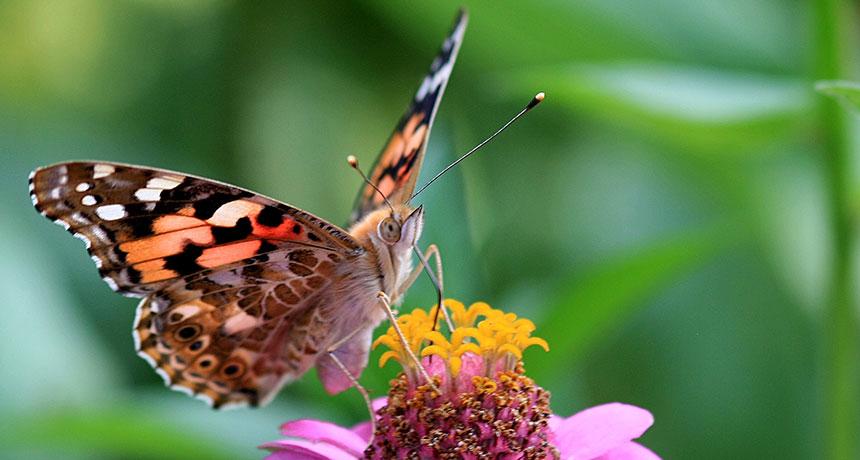
And in Lichfield this morning, walking by the remains of the medieval friary, I spotted something flying frenetically from ivy bush to old stone wall and darting around at speed in jagged circles. It was a Painted Lady! One of very few I've seen this year, and a very late one. There's nothing like a late butterfly to lift the heart (unless it's an early one as spring gets under way)...
And then, in the sweetshop where I was buying a few Halloween treats for the grandchildren, the very nice woman behind the counter looked at me in a slightly startled manner and said, 'You look just like Sir Ian McKellen.' This was a new one on me. 'People must tell you that all the time, don't they?' she asked. Well, no, I replied truthfully, though I've been told I'm the living spit of many another thespian (most pleasingly Jimmy Stewart). 'Your height, your build,' she continued, 'the way you carry yourself.' Gulp. Do I carry myself like Ian McKellen? I had better work on that...
A Do and a Window

So, after but one day of residence in Lichfield, it was off again, this time to Pangbourne on the Berkshire Thames, for a family do – not quite a wedding but a joyous celebration of a rather wonderful case of late love. We stayed overnight in what was very self-consciously a 'boutique hotel', where, to judge (perhaps unfairly) by the bedroom we were in, interior design had run riot, and the relentlessly pursued 'theme' (a wild mashup of Indian, Far Eastern and East Indian) prevailed over such old-school notions as comfort and amenity. Hotels these days mostly seem to fall into one of two camps: International Bland or Boutique Bonkers, with fewer and fewer in between these poles. By and large, I prefer the first; at least it's restful, which is rather the point of a hotel, isn't it?
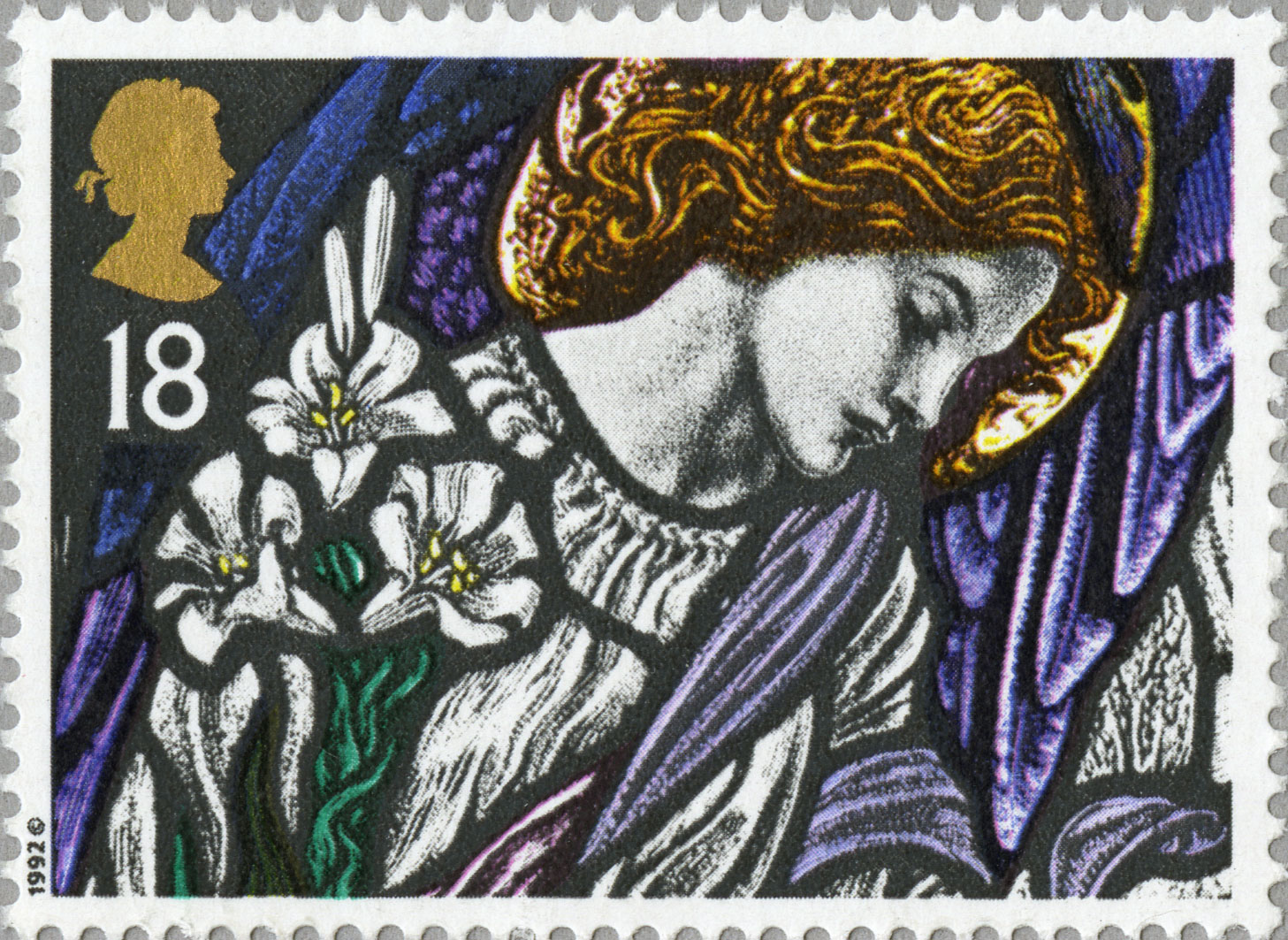
But enough of hotels. It was a gloriously sunny autumn afternoon when we arrived, and I was soon out for a look around the village – and, of course, the church, dedicated to St James the Less (as against St James the Least of All, one of the rivalrous churches in Augustus Carp, Esq, by Himself). This is Victorian, all but the tower, with a pleasant, if rather fussy, interior and some interesting tablets commemorating military men, including a young officer who died in Bengal and is remembered 'with deep love and affection' by an unrelated Major-General. But the glory of the church is the handsome East window, a blaze of light and colour, by the late Arts and Crafts stained-glass designer Karl Parsons. This too is a memorial window, to a member of the local Armstrong family and to all the men of the parish who died in the Great War. There's a detail from the central panels above, and another detail that made a rather lovely Christmas stamp in 1992, below.
And now it's Lichfield again, for rather longer this time...
Sunday, 23 October 2022
The Last Day in the Old Home

The painting above, The Last Day in the Old Home by Robert Braithwaite Martineau, was hugely popular with the Victorian public, who liked a picture that not only told a story but punched home a barrage of strong moral lessons.
Chez Nige, I'm glad to say things don't look much like the scene depicted by Martineau, but today is indeed the last day in the old home before it's all packed up and carted away, mostly into storage. Mrs N and I will follow in due course and by Wednesday will have waved farewell to the suburban demiparadise and settled in the delightful 'city of philosophers', Lichfield, from where I shall resume my dispatches. Hasta la vista.
Friday, 21 October 2022
Coleridge Unveiled

Today, on the 250th anniversary of his birth, a statue of Samuel Taylor Coleridge was unveiled outside the (magnificent) church in his natal town of Ottery St Mary, Devon. The statue is by Nicholas Dimbleby, son of broadcasting legend Richard and brother of David and Jonathan (he is, by all accounts, the 'quiet one' of the three). This picture of the statue in the studio, before casting, shows it to better advantage, I think...

It shows the young poet and outdoor man, full of energy and promise and idealism (and sometimes touched by genius), rather than the bloated old windbag he became. (Seriously, has Biographia Literaria ever given anyone an iota of reading pleasure?). It's good to know there are figurative sculptors at work who can create convincing full-length public portrait sculpture of this quality. Why, one wonders, do those who clearly lack the ability get so many big commissions? The Diana statue?! The Lovers at St Pancras...?!
Never mind. Here is another by Dimbleby, his statue of Whistler on Chelsea embankment.

Wednesday, 19 October 2022
Joan Carlile

'There are mystically in our faces certain characters which carry in them the motto of our souls, wherein he that cannot read A, B, C may read our natures.' The best-known image of Sir Thomas Browne (born on this day in 1605) is taken from this double portrait of Lady Dorothy and Sir Thomas, painted by one Joan Carlile, who has the distinction of being one of the first British women to paint professionally. She was married to Lodowick Carlile (or Carlell), a playwright and courtier, who under Charles I was Gentleman of the Bows and Groom to the King and Queen's Privy Chamber, and maintained the post of Keeper of the Great Forest at Richmond Park through the Commonwealth period, and with it the handsome residence of Petersham Lodge. The Carliles had three children, and are buried in Petersham churchyard. Of Joan Carlile's paintings, rather few survive, mostly portraits. As the Browne double portrait shows, her style borders on the naive, but is lively and charming. She was capable of working on a much larger scale, and the grandest of her surviving paintings, combining landscape with portraiture, shows The Carlile Family with Sir Justinian Isham in Richmond Park. Sir Justinian was a scholar and Royalist politician, and the painting hangs at his family seat, Lamport Hall in Northamptonshire. Joan Carlile is thought to be the figure at the far left.

Subscribe to:
Posts (Atom)
