Wednesday, 24 September 2014

Birthday Girl

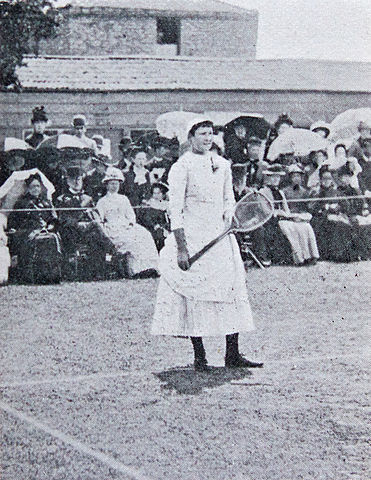
Today we should remember England's greatest-ever all-round sportswoman, Charlotte 'Lottie' Dod, born on this day in 1871. A product of that late Victorian golden age when families who had made a pile in industry or commerce could devote acres of their time purely to leisure pursuits, Lottie, who never had to work in her life, never married and lived for many years with her equally sporty brother, was a sporting natural. She achieved a high standard in golf (British amateur champion), field hockey (English national team), archery (Olympic silver), skating, toboggan (Cresta Run) and mountaineering. But her main sport was lawn tennis (formerly known as Sphairistike), in which she won the Wimbledon Ladies' Singles five times, the first time at the age of 15 (she remains the youngest-ever women's singles winner). On that occasion she defeated the defending champion Blanche Bingley 6-2, 6-0, the second set reportedly lasting just ten minutes - and yet, like many female players of her time, she served underhand and rarely employed such fiendish devices as spin. How do you serve an ace underhand and unspun? It's hard to imagine...
 Lottie worked for the Red Cross in the Great War, but to her chagrin was not allowed to travel to the front because of sciatica (her Wimbledon days were long over). She lived a long and happy life, attending Wimbledon every year, and died in a nursing home in Hampshire at the age of 88 - while in bed listening to the tennis on the radio.

Tuesday, 23 September 2014

Autumn

The first day of Autumn - marked by a rather nice Google doodle - though it's still more of an Indian Summer over much of the country, and long may it last. It looks as if it's a bit of a Mast Year too - that's two in a row. Certainly the Horse Chestnuts are fruiting in far greater abundance than I've seen in several years - fine, big, fully-formed conkers, raining down from the trees these past few days (I've nearly been hit several times, and would count it an honour if I were).
 This is very gratifying, as just a few short years ago it looked as if the Horse Chestnut might be on its way out, killed off by a lethal combination of Horse Chestnut Leaf Miner and a fungal pathogen. I remember seeing entire avenues apparently dead or dying. But it seems this fine tree is  fighting back and might even be regaining the upper hand. Having adapted to the threat by shortening its season, it now seems to be getting back to a more normal cycle. It was at just this time of year, more than half a century ago, that I would be out gathering conkers after school in the park. There is still nothing quite so fresh, so glossy, so richly brown, so entirely and essentially nutty as a newly fallen conker nestling in its green shell.
 (That's a Samuel Palmer above, by the way.)

Sunday, 21 September 2014

Picturing England

Another nice Ravilious, eh? Well no actually, though you might easily take it for one Eric Ravilious's lovely High Street series. It's actually by Barbara Jones, as artist I had not been aware of until I happened to catch a programme on Radio 4 Extra about the wartime Recording Britain project. This was the brainchild of Kenneth Clark who, at the height of the Second World War, sent an elite force of watercolour artists out across the land, armed only with paints and brushes, to record whatever caught their eye so that, whatever happened, a picture of England (and it was mostly England) as it was at that point in time should survive for posterity (this must have been undertaken in the hope of an Allied victory - the Nazis could hardly be relied on to keep such a record, created by artists of whom they would by and large have disapproved).
  The principal focus of the radio programme was Thomas Hennell, described by presenter Patrick Wright as 'the nearest thing England had to a Van Gogh'. This is a curious assertion; all the work of Hennell's I have seen online seems firmly in the English watercolour tradition, and rather towards the watery end of it. He was passionately interested in the vanishing scenes of rural crafts and husbandry that he painted - and was a very intense man, whose mental health was frail - but that's about as far as the Van Gogh analogy goes. For all his frailty, though, he went on to be become a serving war artist, being initially sent to Iceland to replace Eric Ravilious, tragically lost in 1942. Hennell took part in D-Day, following the 1st Canadian Army, then a Royal Navy unit in Belgium,  before heading to the Far East towards the end of the war, and on to Java, where it seems he was attacked by a crowd, spurred on by Indonesian nationalists, as he painted. That was the last that was heard of him - a terrible end.
 Barbara Jones, whose style was very different from Hennell's - closer to coloured drawing that wash painting - was fascinated by more urban trades, by details, unexpected scenes and overlooked corners of small towns. The optician's shop above (now an anonymous branch of Vision Express) is in Croydon, where Barbara grew up. In the radio programme, there is much discussion of the painting below - Savage's Yard, King's Lynn - a haunting image of fairground figures in storage, with something about it that looks forward to Paula Rego and back to Goya. It has a strong sense of transience about it, as if these are fragments of a fast vanishing world (the oil drum representing the world to come?). I'm pleased to discover that there's quite a lot of appreciative writing about Barbara Jone on the blogscape. One of a hugely talented Royal College of Art generation along with Piper, Bawden, Ravilious and Ardizzone, she surely deserves to be as well known as them.
Friday, 19 September 2014

Phew

'See Nature, rejoicing, has shown us the way
With innocent revels to welcome the Day...'
Sorry, I was listening to Purcell on the way in. But here we are - the Union still stands, a little dazed and swaying slightly, but intact. Phew. Now we can turn our attention from the knuckle-end of England to the wider world - in particular to North Korea, whence this rather alarming story issues. It seems our old friend Kim Jong-Un is piling on the pounds, and sporting a limp. No one is quite sure whether this is in emulation of his grandfather Kim Il-Sung, 20 years dead but still Eternal President - or if this growing corpulence is down to Kim Jong-Un's addiction to Emmental cheese (the Emmental President as against the Eternal President?).
 This is a bit of a jolt for me, as I also love this particular cheese - indeed, if all other cheeses were to be thrown overboard in the general wreck, it is the one I would keep (along with the one alcoholic drink - whisky - and the one symphony, Schubert's 9th). Kim, it is reported, is trying to get his elite cheese monkeys to create a decent Emmental in North Korea, but they cannot possibly succeed: even French and Bavarian emmentals are sorry substitutes for the Swiss original. Kim will just have to keep jetting the stuff in.
 By the way, in case you were wondering what a piece of Emmental looks like, keep scrolling down on that story and you'll find a picture, alongside one of Kim Il-Sung's face. From now on, I fear, every time I slice an emmental, I'll be looking for the face of the Dear Leader.

Thursday, 18 September 2014

'A continual state of Inelegance'

It's seriously warm in London today - unseasonably warm. 'What dreadful Hot weather we have!' wrote Jane Austen on this day in 1796, down in Kent. 'It keeps one in a continual state of Inelegance.' Well, quite.

Day of Destiny

Well yes, here it is at last, after a campaign that seems to have been going on an awfu' lang time (as they say Up There). There's a fine, clear-headed summing-up of the whole sorry business by expat Scot Daniel Kalder over on The Dabbler. But at one point he says that the 'Better Together' campaigners 'failed completely to articulate a positive sense of Britishness'. Well, I'm not surprised. Speaking for myself, I have never felt a positive sense of Britishness, and have no clear idea of what it would feel like if I did. I feel a very strong and positive sense of Englishness - never more so that when I spent a year living in Scotland, which seemed to me then and still seems to me now to be essentially a foreign country. And this was 40 years ago - in oh so civilised Edinburgh.
 I've never had any very strong feelings about that country being united with England in an entity called the United Kingdom - it seemed to work, which is the main thing, and I was happy to overlook the fact that it was increasingly working in favour of the decidedly junior partner. But now it's all up in the air, and who knows where the pieces will fall? We should never have started on this road (thank you, Tony Blair) and, now that it's come to the crunch, we should have handled it with a great deal less panic-stricken ineptitude than has been displayed recently. If ever there was a thing that should be left firmly alone, it's the British (English) Constitution. No good will ever come of tampering with it, especially for ideological reasons.
  Meanwhile, here's a simple test. When you're abroad and someone in the ordinary course of conversation asks you your nationality, do you reply 'British'? I don't recall ever having done so, and I doubt I'd be well understood if I did.

Wednesday, 17 September 2014

Drawing

We all know the art world is one mad world - but does it not take the biscuit when a major drawing prize, the Jerwood Drawing Prize - yes, that's drawing, a prize for drawing - is won by a 40-second audio recording in which the Artist reads from an archaeological description of a Roman pot? What next - a sculpture prize won by an audio description of a marrow? We all know prizes like the Turner can be awarded for Anything - but a drawing prize - really...
It's such a shame too, as the runner-up, Sigrid Muller's Seed Pods (above, in part), is lovely work and would have been a worthy winner. If, by the way, you bother to listen to the winning audio, the reference to 'a little Muscovite' has nothing to with Vladimir Putin. Muscovite is a mineral, a form of Mica, with, according to Wikipedia, 'a highly perfect basal cleavage'. Intriguing.