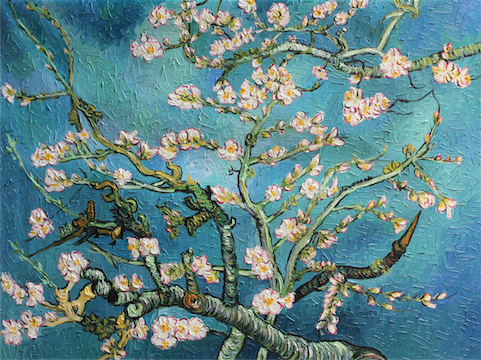
Friday, 31 March 2017

The Trouble with Nature

Those almond blossoms are all very well, but there's something intrinsically wrong with nature, isn't there? The 18th-century French painter Francois Boucher certainly thought so, and he knew just what it was. 'Nature,' he declared boldly, 'is too green, and badly lit' ('trop verte et mal éclairée').
 I came across this quotation today, and it reminded me rather of Ronald Firbank's equally lofty and absurd 'The world is so badly managed, one hardly knows to whom to complain.' One suspects, though, that Boucher probably meant it. He's not a painter I'm drawn to - his frothy Rococo confections  don't appeal - but I'm prepared to forgive the man who could paint the outrageously erotic Mademoiselle O'Murphy (below).


Thursday, 30 March 2017

Birthday Blossom


Here, to mark the birthday of Vincent Van Gogh (born on this day in 1853), is something seasonal, beautifully painted and almost jolly. It's one of the studies of almond blossom that he painted in 1888 to celebrate the birth of his nephew, whom his brother Theo named after Vincent.
 The paintings are suffused with the happiness of their occasion and the joy and promise of new life, but are too honest to be merely pretty, or merely jolly. The pink-edged impasto blossom is vividly present, but no more so than the gnarled and knotted branches, their visual counterpoint, sharply outlined and firmly drawn in the manner of the Japanese artists whose work had such a powerful effect on Van Gogh. The blossom will soon be gone, but those assertive branches will live on, jagged, difficult, undeniable. Vincent's moment of happiness too was soon gone, and his troubled life did not have much longer to run - but is that to be read in these bright images of almond trees in flower? Better perhaps just to enjoy them as things of beauty. That they undoubtedly are.

Wednesday, 29 March 2017

Heady Times

These are heady times for us retroprogressives. At a civilised hour this morning, Theresa May will hand a letter - a letter, remember those? - to our masters in Brussels, informing them that they have delighted us enough and we're intending to head for the exit door, if they could kindly point out where it is, please. It's not quite on a par with Henry VIII extracting us from the clutches of the Papacy, but there have been plenty of historically minded pundits queueing up to draw such reassuring analogies. That's the kind of long perspective we retroprogressives like.
 Meanwhile, across the Atlantic, El Trumpo has decided to restore King Coal to his throne, thereby flabbergasting the carbonistas. In practice, this might not make much difference to anything (including, of course, 'climate change'), but it's a pleasingly retroprogressive gesture - let's hope there are more to come.
 As for the forthcoming negotiations with the Eurocracy, heaven knows where they will lead, if anywhere. A booby-trapped morass might be what lies in wait for us, and our best hope might be that the EU collapses quite soon in an orderly manner, rendering the whole process irrelevant. I fear the Union as at present constituted is like the Hotel California - 'You can check out any time you like, but you never can leave'. However, checking out is the right retroprogressive thing to do. Back to the future, forward to the past!

Monday, 27 March 2017

Radio at Walking Pace


One of the best things I've heard on Radio 4 in a while was on yesterday's Broadcasting House - the sound of a rescue greyhound called Billy chattering his teeth in anticipation of his favourite food, pilchards. Since then I've discovered that greyhounds often chatter their teeth when a treat is in the offing - there's plentiful footage on YouTube if you're interested - but this was a great piece of radio. Of 'slow radio', in fact, which is given a little showcase on Broadcasting House every Sunday. The time allotted is far too short to give a real sense of slowness, but at least it's always restful and unstructured, a little oasis of peace in the hubbub. And it's always a joy to listen to.
 Now comes news that Radio 3 is going to give us a proper bit of Slow Radio - the soundtrack of a four-hour, twelve-mile walk in the Black Mountains, beginning in Cwmdu and ending in Hay-on-Wye. The walker will be writer and broadcaster Horatio Clare (not to be confused with Horatio Caine of CSI: Miami), so there will no doubt be an intermittent commentary, but the point of the exercise will be to bring us the sounds of buzzards, ravens and other more musical birds - including, with luck, skylarks - of sheep and ponies, the rustle of grass, the sighing breeze, the soft tramp of Horatio's walking boots. It promises to be rather wonderful - perhaps the best thing since the much lamented Radio Birdsong - and I hope it's the harbinger of more Slow Radio to come.
 As I took a stroll on Epsom Downs this glorious sunny spring morning, I wondered what the soundtrack of my walk might have sounded like. There was birdsong, but not as much as I was hoping for, and dominated by robins and great tits - if any warblers had arrived, they were still tuning up - and distant sounds of cars and of golfers on the course that disfigures so much of these downs. I fear much of the soundtrack would have consisted of my involuntary sounds, tuneless humming, random phrases spoken out loud and occasional exclamations, mostly of pleasure. And there was plenty to take pleasure in - primroses, violets, coltsfoot and celandine, brimstones, commas, peacocks and tortoiseshells, cherry blossom, hawthorn in leaf, blackthorn coming into flower. It wouldn't have made great radio, but oh yes, it was a good walk.

Saturday, 25 March 2017

Nature Notes


Seeing the first butterfly of the year is always a spirit-lifting thrill - and I experienced it quite early this year - but there's also something very special about catching that flash of sky blue that is the first glimpse of a Holly Blue. In a sense, this is also the first butterfly of the year, being the first to have emerged from a pupa, the others - Brimstones, Tortoiseshells, Red Admirals, Commas, Peacocks, Painted Ladies (if you're lucky) - all being awakened hibernators. I saw my first Holly Blues of the year this sunny morning (and my first, rather late, Peacock), so my butterfly year has begun again. So much more to look forward to now...

Yesterday another natural spectacle caught my eye too as I walked down my road. Looking up, I saw a kestrel and a crow in close proximity - the familiar sight of corvid harrying raptor, I thought - but as I carried on watching, it became clear that this was something different, more like an aerial ballet than the usual snappy chase-off. Kestrel and crow were staying unusually close together, seemingly quite relaxed about it, making no more than gestures at aggression. Each was mirroring the other's movements, moving together like a pair of aerial syncrhronised swimmers and giving a strong impression of playful enjoyment. The crow seemed to be imitating the kestrel's wingtip flutters, the kestrel dropping its purposeful style to adopt a crow-like abandon. All the time, I was expecting this aerial display to break down into the usual unseemly scuffle, but it never happened, and gradually kestrel and crow flew off into the distance with every appearance of perfect harmony. Has peace broken out between these normally fierce competitors, I wonder, or was this just an outburst of vernal friskiness?


Friday, 24 March 2017

Saint Mug's Day

Born on this day in 1903 was Malcolm Muggeridge. If he's remembered at all now, it is as the rather ridiculous, overexposed figure he became in his latter years, when he was a fixture on the nation's television screens - and, with his contorted features and strangulated vowels, a gift to impressionists. He made a fool of himself over his infatuation with Mother Teresa (see Christopher Hitchens on all that) and there was undoubtedly much of the humbug about him (his sexual habits didn't bear much examination), but there is also much to praise about Muggeridge. Despite his early socialism, he was one of the first to see Soviet Communism for what it was, travelling unofficially in the Ukraine in the Thirties, seeing the famine for himself, and attempting to report on it. Sadly his efforts were trumped by the New York Times' Walter Duranty's whitewash job, for which he won the Pulitzer Prize (Mug subsequently described Duranty as 'the greatest liar I have met in journalism').
 Muggeridge also had a very 'good war', serving with the Intelligence Corps and MI6, working with the Free French forces and winning a Croix de Guerre. In the Fifties, he made a surprisingly good job of being editor of Punch, despite having, by his own account, no sense of humour. It was with the Swinging Sixties, and after his conversion to Christianity, that 'Saint Mug', the ubiquitous moral scourge, took over and, driven (one suspects) as much by vanity as by moral fervour, Muggeridge grew into an often ludicrous caricature of himself.
 And yet, and yet. Looking back to that time when Muggeridge and the even more ridiculous - as it seemed - Mary Whitehouse railed against the excesses of the 'permissive society', it's possible to feel quite nostalgic for a period when matters of morality were discussed at such a high pitch and with such seriousness in the mass media. And it is even possible, in view of subsequent events, to see Muggeridge and Mrs Whitehouse as canaries in the cultural coal mine, sensing the moral nihilism that was soon to become common currency, sweeping away so much in its path. Both these 'moral crusaders' often made fools of themselves by firing off at the wrong targets, but, viewed from here, there is also something rather admirable about their efforts to stem the unstemmable tide.

Thursday, 23 March 2017

More than Dutch

Last night I came across (again) this poem by Kay Ryan -

Dutch
Much of life
is Dutch
one-digit
operations
in which
legions of
big robust
people crouch
behind
badly cracked
dike systems
attached
by the thumbs
their wide
balloon-pantsed rumps
up-ended to the
northern sun
while, back
in town, little
black-suspendered
tulip magnates
stride around.
 Everything about this little poem - even the title - is as Dutch as can be. It could be the description of a scene painted on a Dutch tile or a Delft bowl, and the tone is fittingly comic and naive. Yet it seems to me that the image presented here could have a much wider application.
 Is there not something oddly recognisable in this picture of a world where most lead lives of quiet, good-humoured desperation, stoically holding disaster at bay, while 'back in town' a complacent elite, who know nothing of the ordinary struggles of life, enjoy a wealth founded on unrealities - tulip fever, the derivatives boom, there's little to choose between them (and both are doomed to crash when an altogether different kind of dike bursts, and reality floods in). The divided society so quaintly depicted in Dutch is not that far, it seems to me, from the one that gave us Brexit and the Trump victory, when the big, wide-rumped stavers-off of disaster turned on the little self-regarding magnates of unreality and showed their strength.