Monday, 30 May 2011

The Pain of the Past

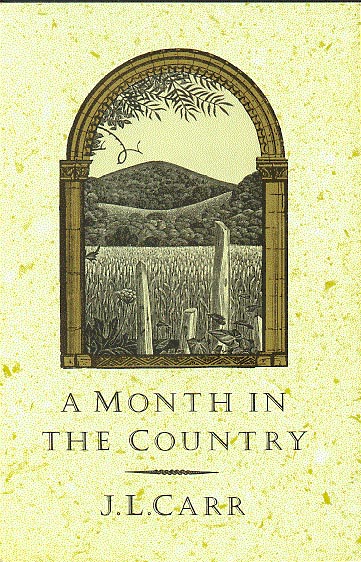
I'm not sure how long ago I first read J.L. Carr's A Month in the Country - maybe 20 years - but when I spotted a copy of the Quince Tree Press paperback on the shelves of my Favourite Bookshop, I snapped it up, wondering what it would be like to read again this short sad tale, set in rural Yorkshire in 1920. J.L. Carr was - as well as novelist, painter, teacher, mapmaker, dictionary-maker, Yorkshireman and 'English eccentric' - a great small-press publisher, and his Quince Tree Press books are wonderful little volumes (some of the them very little indeed). Not notably 'beautiful' productions (in the fine art sense), they are full of delights. A Month in the Country has a perfect front cover design, incorporating part of a larger wood engraving by Monica Poole, and scattered around the endpapers are motifs by Thomas Bewick and Joan Hassall, while the text itself is illustrated by drawings by Christopher Fiddes (a little dense and heavy for my taste). The colophon includes this bold declaration of press freedom:
'This is a Printing Office,
Cross-roads of Civilisation,
Refuge of all the Arts against the Ravages of Time.
From this place Words may fly abroad
Not to perish as Waves of Sound but fix'd in Time,
Not corrupted by the hurrying Hand but verified in Proof.
Friend, you are on Safe Ground:
This is a Printing Office.'
Underneath this, Carr's life is summed up thus: 'James Lloyd Carr, born 1912, attended the village school at Carlton Miniott in the North Riding and Castleford Secondary School. He died in Northamptonshire in 1994.' His educational career was in fact almost the only undistinguished thing about J.L. Carr's life - but no doubt he chose that curiously reticent epitaph himself...
As for A Month In The Country - rereading it, I found I'd remembered the core of the book very clearly: the love story, the uncovering of the medieval wall painting in the church, the long hot summer in the Yorkshire countryside, all of which were evoked every bit as vividly as I'd remembered. What I'd forgotten was the bone-dry humour in the telling of the tale - and, especially, the narrator's involvement with the Wesleyan Methodist chapel life of the Ellerbeck family, whose head is (as Carr's own father was) the village stationmaster. This world of strenuous hymn-singing in chapel and front parlour, huge teas and hellfire sermons is clearly the world in which Carr grew up. In re-creating it so richly, he brings back to life what is so often missed in period fiction - the central place of religious faith, or at least observance, in virtually everybody's world - a fact of life that lasted well into the 20th century, and seems so strange to us now, one of the things that make the past irretrievably the past.
Yet, above all A Month In The Country remains a tale - a classic tale, I think - of love and loss, and the pain of the past:
'We can ask and ask but we can't have again what once seemed ours for ever - the way things looked, that church alone in the fields, a bed on a belfry floor, a remembered voice, the touch of a hand, a loved face. They've gone and you can only wait for the pain to pass.'

Friday, 27 May 2011

Spotted

Holland Park, with its woodland area that is as near to rus in urbe as anything in London, is surely the most rewarding of all the city's large parks, constantly coming up with unexpected delights. Today, on my way to visit the pigs - they're thriving and send their best regards - I was greatly cheered by the sight of two male Blackcaps flitting about on the fence that encloses the pigs' former territory (now a riot of poppies, foxgloves and campion). These pretty, plump warblers are always a pleasing sight, and they're increasingly common now that many of them are overwintering here instead of flying south. The females have a beautiful chestnut cap, but the male's is a black cap indeed - very black and very much a cap, pulled down almost over the eyes. While so many of our warblers come in indistinguishable shades of pale brown, the Blackcap makes a welcome change for the amateur bird-spotter - an instantly identifiable warbler!

Thursday, 26 May 2011

Peter Cushing

Here at Nigeness, we can't let the day pass without celebrating what would have been the 98th birthday of that fine actor and, by all accounts, lovely man, Peter Cushing. From boyhood I always had a soft spot for him, and rather wanted to be like him (that didn't work out). I especially loved his Sherlock Holmes, a part he was made for, as he was for Baron Frankenstein and Dr Van Helsing, not to mention Doctor Who (before the characterisation went wacky). He was a memorable Winston Smith in an early TV version of 1984 - and he even had the honour of appearing with Laurel and Hardy, in A Chump At Oxford (Cushing played a student), and, much later, with Morecambe and Wise on several of their TV shows. A great face, a great voice, one of a great generation of British film actors.
Sadly, his last years were overshadowed by grief after he lost his wife, the actress Helen Beck. After his death, his friend Christopher Lee, in an interview, paid him this moving tribute: 'At some point of your lives, every one of you will notice that you have in your life one person, one friend whom you love and care for very much. That person is so close to you that you are able to share some things only with him. For example, you can call that friend, and from the very first maniacal laugh or some other joke you will know who is at the other end of that line. We used to do that with him so often. And then, when that person is gone, there will be nothing like that in your life ever again.'

Wednesday, 25 May 2011

Six Pigs, No Book

This lunchtime, in my haste to slip the surly bonds of NigeCorp HQ and get a little sunshine and fresh air, I set off without anything to read - calamity! My fixed habit is - in the masculine spirit of multitasking and filling the unforgiving minute - to read while I eat my alfresco sandwich. What to do? The solution was obvious - go to see the Holland Park pigs. They are now six in number - four whites and two saddlebacks, all sows and all fine specimens of contented pighood. They tend to form into a quietly grunting party of five, two of whom are inclined to squabble with each other, and a straggler who wanders off, then comes running to join the others. I took a seat and watched them while I munched my sandwich, and came to the realisation that there are few more pleasurable, relaxing pastimes than watching a party of pigs rootling around. I could have sat all afternoon enjoying them. Into the bargain, I was able, undistracted by a book, to watch a pair of bluetits coming and going every half-minute to a nestbox full of hungry chicks, and a robin following the pigs in hope, just as robins would have followed the wild pigs in the woods before we humans came along to turn the earth for them. Sun and shade dappled the trees, people came and went, pausing to admire the pigs, a Speckled Wood flew past and settled nearby on a sunny leaf... I think I must try a bookless lunch break again - it's easy to forget that there are times when it is more restorative and more rewarding simply to sit and look around.

Tuesday, 24 May 2011

White Americano: The Mystery Deepens

You know how it is - you ask for an Americano, and back comes the question, 'Do you want milk in that?' Rather than wearily remind the coffee jockey that an Americano is by definition black, being an Espresso to which hot water is added (in fact my own preference is the other way round, which preserves the crema and is technically known as a Long Black, but I know better than to ask for that), you politely reply, 'No, thank you.' Today I discovered from a barista that there is a further complication to all this - the White Americano. Ah, you might think - that'll be the Americano with milk that they're always offering me. But no, it is not - a White Americano, the barista explained, is an Americano that is not filled to the top, hence leaving white space visible above the coffee. But somehow I know in my bones that if I asked for a White Americano, I'd get an Americano ruined by the addition of milk. You can't win.

Bob

It's Bob Dylan's 70th birthday - a date I was sure would be marked by a fancy graphic on the Google home page, but it isn't. The BBC is, of course, all over this like a rash - especially the radio networks - but so far the low point has been hit, predictably enough, by our old friend Will Gompertz who, on last night's News, treated us to his very own homage to Subterranean Homesick Blues, throwing down a succession of cue cards as he delivered his usual stream of banalities - Enuf you sla me, as Nigel Molesworth would say. What's more, the BBC was going big on the 'new' shock revelation that Dylan had been on the heroin for a while (next week, What bears do in the woods)... Needless to say, the Dabbler rises to the occasion nobly with a thoughtful festschrift. Anyway - Happy birthday, Bob! And thanks for everything. Really.

Monday, 23 May 2011